The Gondarine Gospel, a richly illustrated Ge'ez manuscript looted from Emperor Tewodros II after the 1868 British raid on Magdala, was listed at the Abu Dhabi International Book Fair for $250,000, prompting urgent demands from the Ethiopian Heritage Authority for its withdrawal and return. Inlibris, the Vienna-based dealer, argues there are no legal grounds for forced restitution and says the listing was a prop, while Ethiopian scholars emphasize the manuscript's cultural and scholarly importance. The dispute has revived wider debates over repatriation of colonial-era plunder and advocates for negotiated outcomes such as return, long-term loan, donation or shared custodianship.
Stolen 'Gondarine Gospel' Resurfaces at Abu Dhabi Book Fair, Prompting Restitution Battle
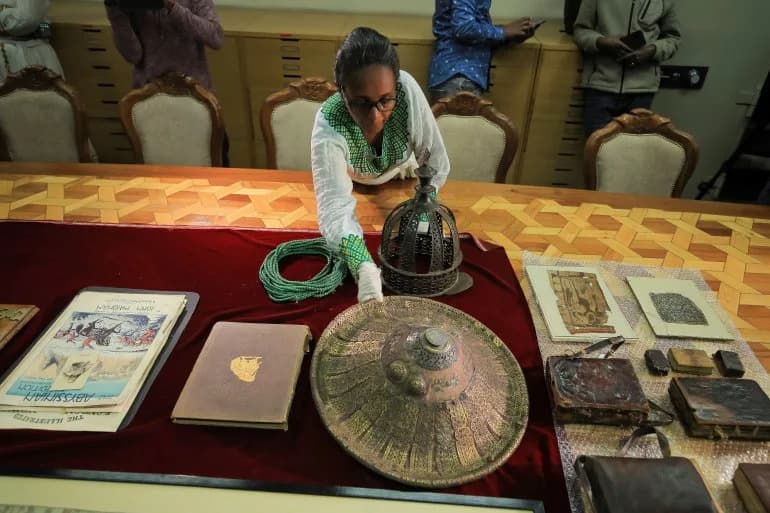
An employee arranges artefacts that were looted during the colonial-era by British forces at the Ethiopian National Museum in Addis Ababa after they were restituted from the UK, November 20, 2021 [Tiksa Negeri/Reuters]
A rare Ethiopian manuscript known as the Gondarine Gospel — taken by British forces from Emperor Tewodros II during the 1868 raid on Magdala — has reappeared in a private sales catalogue tied to the Abu Dhabi International Book Fair, listed at $250,000. Its re-emergence has prompted urgent demands from Ethiopian authorities for the manuscript's withdrawal and return on moral and ethical grounds.
Ethical Demand and Commercial Pushback
Abebaw Ayalew, head of the Ethiopian Heritage Authority (EHA), wrote to Vienna-based rare book dealer Inlibris asking that the item be removed from sale and repatriated. "There are clear moral grounds for art dealers to avoid selling items which are established as having been looted," Ayalew wrote, warning of reputational risk for dealers who handle confirmedly looted objects.
"It is considered morally unethical and raises serious reputational risks for famous art dealers such as Inlibris to be involved in the sale of items that are questionably looted." — Abebaw Ayalew, Ethiopian Heritage Authority
Inlibris responded that it sees "no legal grounds for restitution," arguing that international legal frameworks governing wartime cultural property did not exist in the same form in the mid-19th century and that the manuscript's current private owner is not legally obliged to surrender it. Hugo Wertscherk, head of Inlibris, told Al Jazeera the listing was presented as a prop for the fair and said returning the manuscript without legal basis would be unlawful.
What the Manuscript Is—and Why It Matters
The Gondarine Gospel is bound in glossy leather with intricate gold tooling and contains 235 vivid illustrations that depict episodes from the Gospels of Luke and John in bold reds, greens and yellows. Written in Ge'ez, an ancient South Semitic language, scholars believe the manuscript was likely produced in Gondar between 1730 and 1734. Ethiopian art historians stress its importance not only as a religious artifact but as a key source for understanding Ethiopian manuscript culture, Ge'ez literature and the artistic traditions of Gondar.
"It is not simply an old religious book, nor should its significance be reduced to its association with Emperor Tewodros," said Abreha Kiros, professor of art history at Aksum University. "Its absence from Ethiopia represents a loss to scholarship and to communities of origin."
Historical Provenance
Emperor Tewodros II ruled Ethiopia from 1855 until his death in 1868. After diplomatic relations with Britain collapsed, a British force of about 13,000 troops—sent from India under the command of Robert Napier—attacked Magdala on April 9, 1868. Facing defeat, Tewodros took his own life. The victorious soldiers looted the royal stronghold, seizing manuscripts, ritual objects and even locks of the emperor's hair. The Gondarine Gospel was removed from Tewodros's library during that raid and subsequently passed through colonial officers and museum collections before entering private hands roughly a decade ago.
Paths Forward
The dispute has rekindled broader debates about restitution of objects taken during colonial-era conflicts. Several Western countries, including Britain, Germany, France and Belgium, have in recent years begun to return items or negotiate long-term loans. In May, Britain returned a lock of hair believed to be Emperor Tewodros's and a cloth said to be stained with his blood to Ethiopia.
Experts and activists urge negotiation rather than confrontation. Proposed solutions range from outright return and donation to long-term loans, shared custodianship or institutional purchase by museums that agree to repatriation terms. "The absence of a clear legal mechanism does not mean there is no basis for dialogue or restitution," Kiros said, calling for arrangements that respect the voices of the country and communities of origin.
Inlibris has said it is open to discussions and would consider an institutional purchase at a "preferential price," while maintaining that negotiations should not assume an obligation to restitute. Ethiopian officials say the manuscript should first be withdrawn from public sale while constructive negotiations proceed—a course that has led to settlements in recent cancellations of auctions in the UK, the US and Italy.
Why It Matters: The case highlights the continuing ethical and cultural questions surrounding objects removed during 19th-century conflicts and the growing international pressure on dealers, collectors and museums to resolve claims through transparent dialogue and, where appropriate, restitution.
Help us improve.