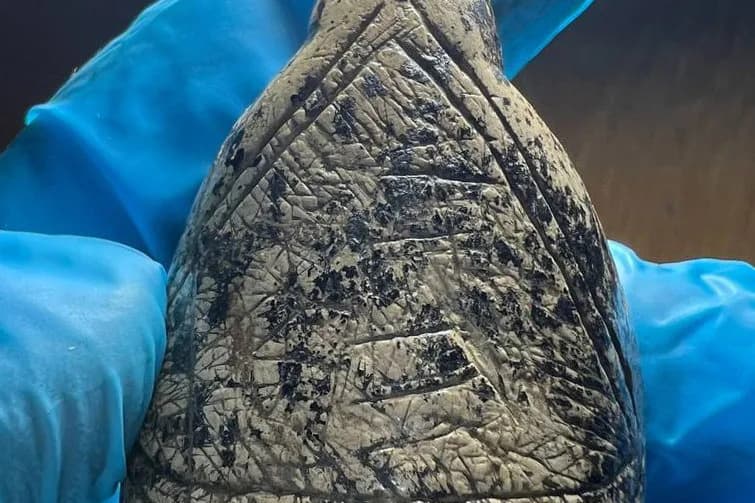
The 11th-century copper-alloy medallion discovered near Staraya pairs a warrior saint—possibly Theodore Stratelates—on its obverse with a Medusa-like, snake-crowned head on the reverse. Identified as a Zmeeviki or coil-image talisman, it likely blended Christian protective symbolism with older, pre-Christian amuletic traditions. If securely dated to the 11th century, this could be the earliest such find at Staraya and highlights cultural ties with Byzantium and local craft production.
11th-Century Russian Talisman Depicts Warrior Saint Opposing Medusa — Possible Earliest Zmeeviki from Staraya
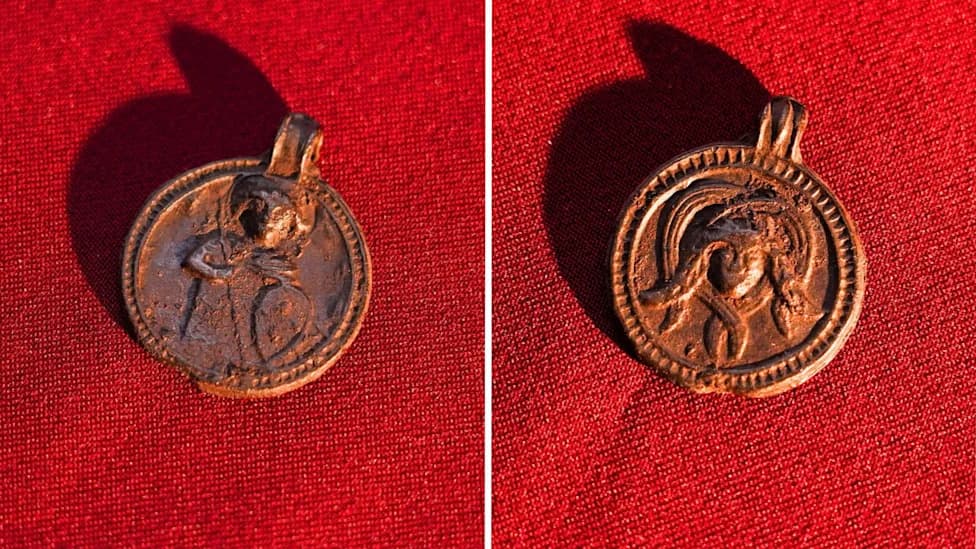
The front image likely depicts the warrior saint Theodore Stratelates.
Archaeologists have uncovered a rare 11th-century copper-alloy medallion near the town of Staraya, about 400 miles southeast of St. Petersburg, that dramatically illustrates a meeting of medieval Christian belief and older mythic imagery. The double-sided pendant shows a mounted warrior saint on its obverse and a snake-crowned, Medusa-like head on the reverse.
Identified as a Zmeeviki (or coil-image) talisman, the piece belongs to a tradition that pairs a canonical Christian figure on one face with a serpentine or “pagan” motif on the other. Typical subjects for these pendants include Christ, the Archangel Michael and the Virgin Mary, though saints such as the one on this example also appear.
Researchers at Novgorod State University propose the saint may be Theodore Stratelates, a Roman-era martyr (born c. 281 CE) commonly portrayed carrying a spear and shield and celebrated in Eastern Orthodox tradition for slaying a great serpent. While the reverse seems to portray the gorgon Medusa specifically, archaeologists argue it likely functioned as a visual shorthand for broader malevolent forces rather than a literal invocation of Greek myth.
"Most likely, this is not a specific mythological creature, but a collective image of dark forces," said Novgorod State University archaeologist Sergei Toropov, in a statement translated from Russian.
Only four similar serpent-themed artifacts have previously been recorded at Staraya, and those date to the 12th–14th centuries. If this medallion is securely dated to the 11th century, it could be the oldest known example from the site and a striking indicator of cultural exchange with Byzantium and lingering pre-Christian practices in early medieval Russia.
Specialists note that such Zmeeviki likely served dual roles: the Christian image offered spiritual protection while the serpentine reverse may reflect pre-Christian amuletic traditions—invocations against disease or harm. The pendant was recovered inside the remains of an urban estate, suggesting its owner was probably a relatively prosperous middle-class resident; wealthier people tended to wear gold or silver, while poorer inhabitants could not afford metalwork of this sort. Evidence of an artisan workshop near the findspot raises the possibility the talisman was manufactured locally.
Beyond its material and stylistic features, the new discovery underscores how religious life in early Russia was often syncretic rather than uniform, blending orthodox Christian imagery with older symbolic traditions. As Toropov observed, the hallmark of these coil images is their deliberate combination of motifs that strict dogma might consider incompatible.
Help us improve.