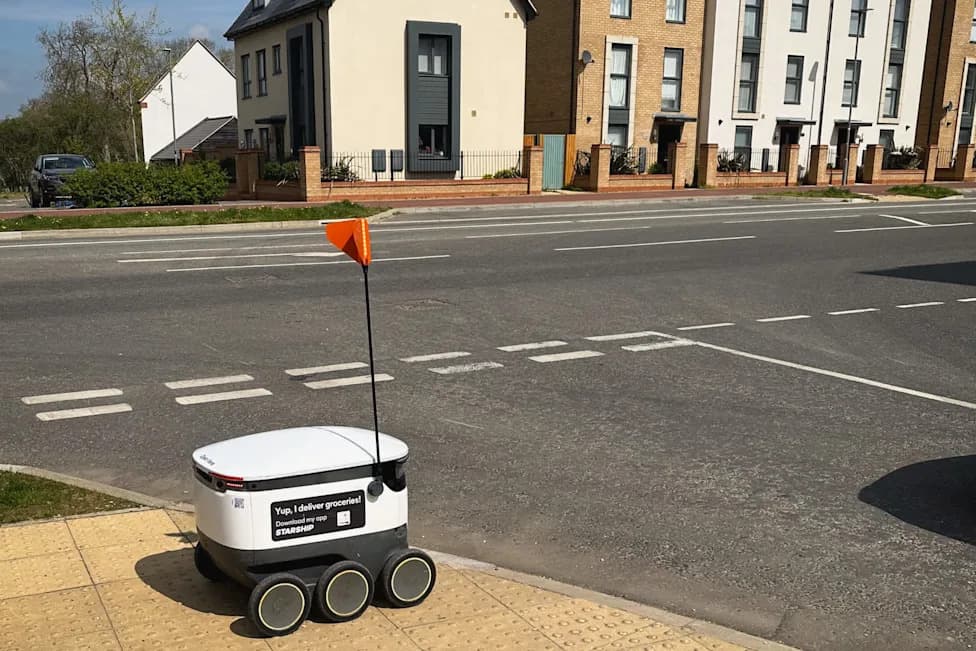
Chicago’s sidewalk delivery pilot drew scrutiny after a viral video showed a dozen Coco Robotics units clustering and blocking a North Clark Street sidewalk. Coco called it a “sidewalk deployment error” and says it has fixed the routing behavior, but residents report recurring congestion and safety issues. Disability advocates and petitioners warn these clusters create real barriers; ward-level opposition has already produced exclusion zones. The pilot runs through May 2027, when City Council will decide its fate.
Dozen Delivery Robots Jam Chicago Sidewalk After Routing Glitch — Residents Raise Safety Concerns
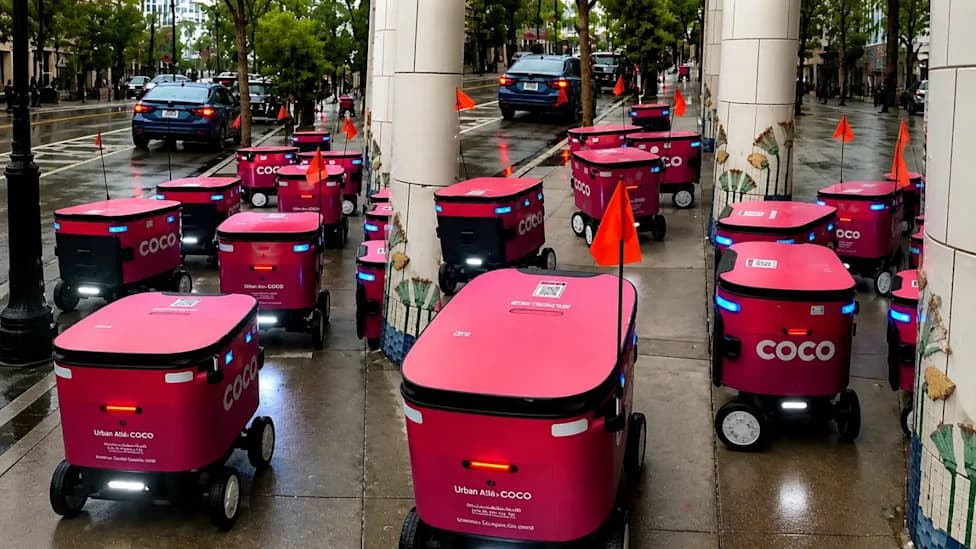
Image: beccarunschicago via Instagram
Becca Ostien was on her usual morning run along North Clark Street when she ran into a wall of red — not cars or construction, but a cluster of a dozen Coco Robotics delivery robots, their lights flashing as they circled one another and blocked the sidewalk. She filmed the scene, captioned it “Run route was crowded this morning,” and the clip quickly racked up hundreds of thousands of views. What looked funny online raised real concerns for people who can’t simply step around a robot traffic jam.
What Happened
Coco Robotics called the incident a “sidewalk deployment error,” saying multiple units were rerouted to the same location at the start of their daily shift. The company says the cluster cleared within minutes and that it has "solved the routing behavior that led to this." Still, Ostien told Block Club Chicago she sees robots congregating near Clark and Reebie Storage roughly once a week.
Program Scale
The pilot has logged nearly 28,000 deliveries and about 29,000 sidewalk miles since late 2024. Coco operates roughly 50 robots across about 34 square miles and partners with roughly 125 restaurants via DoorDash and Uber Eats. On paper the program meets delivery targets; in practice, localized clusters can make sidewalks effectively impassable.
Community Reaction And Reported Incidents
Although the company and city data report no documented serious injuries, multiple incident reports and resident accounts describe robots striking people’s legs, blocking curb cuts, and stopping mid-sidewalk. A petition led by Lincoln Park resident Josh Robertson has gathered more than 1,000 signatures. One alderman’s ward survey of roughly 500 respondents found 83% strongly opposed to expansion beyond a defined boundary, prompting a de facto neighborhood exclusion zone.
Accessibility And Safety Concerns
What a runner can step around in seconds can be an impenetrable barrier for someone using a wheelchair, a parent with a stroller, or anyone with limited mobility. Disability advocates have repeatedly flagged these clusters as more than nuisances — they are blocked routes. Reporting compiled by outlets such as Futurism also cites instances of robots colliding with bus stops and injuries that required hospital visits, raising concerns about cumulative risk rather than isolated glitches.
“A cluster of robots at a curb cut isn’t a minor nuisance — it’s a blocked route,” disability advocates told reporters.
Broader Context
Confusion among autonomous systems isn’t unique to sidewalk delivery bots. Other high-profile incidents — such as a recent driverless robotaxi safety event — have intensified the public debate over where and how autonomous machines should operate in visible, public-facing roles. Advocates point to carefully targeted robotics uses, like snake robots in search-and-rescue, as examples of mindful deployment in complex environments.
What’s Next
The pilot runs through May 2027. After that, the City Council will vote to renew, modify, or end the program. Ward-level bans and strong neighborhood feedback show that local political pressure can override citywide plans — meaning Coco must address both technical routing issues and community trust, one block and one alderman at a time.
Bottom line: Chicago’s experiment seeks to reduce car trips and delivery emissions, but the viral clip underscores unresolved safety and accessibility trade-offs that will shape the program’s future.
Help us improve.