New modeling suggests salt crusts on tropical sea ice could have amplified Snowball Earth cooling. Lab measurements show hydrohalite-rich crusts can reach an albedo near 0.93, higher than fresh snow or bare sea ice. Adding a salt-albedo feedback to a latitude-resolving energy-balance model produced two stable Snowball states: a warmer salt-free state and a substantially colder salt-covered state that is harder to melt. The authors view salt as a potential amplifier, not a proven trigger, and note the model omits ice dynamics, atmospheric CO₂, clouds, winds and dust.
Sea Salt Could Have Deepened Snowball Earth — Hydrohalite Crusts May Have Boosted Albedo to ~0.93
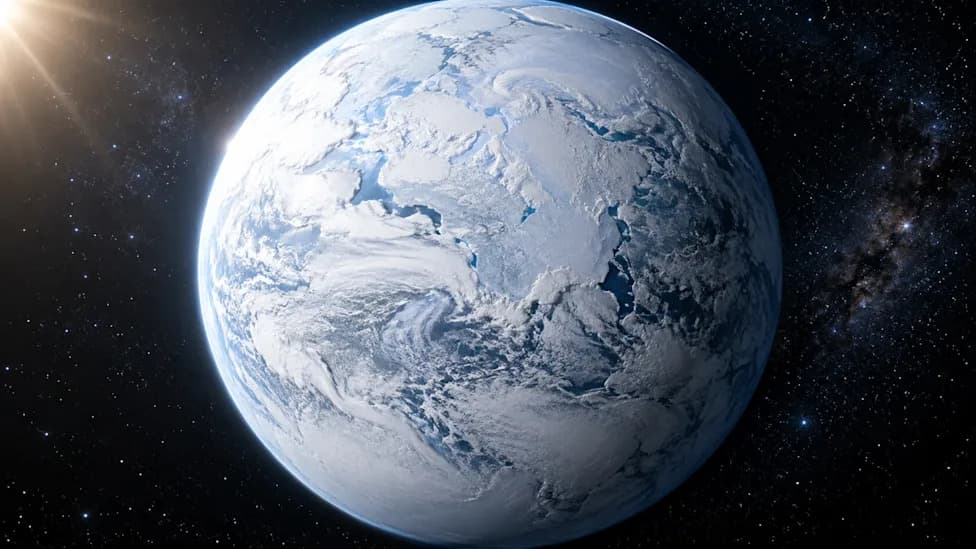
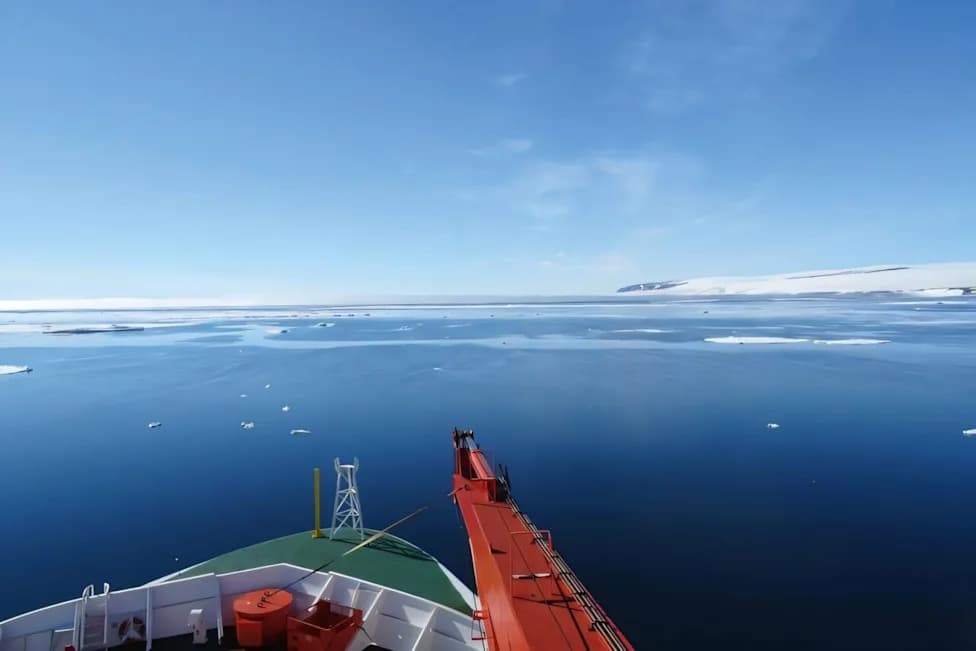
A climate model suggests bright salt crystals on frozen oceans may have amplified cooling during Earth's Snowball episodes. (CREDIT: Shutterstock)
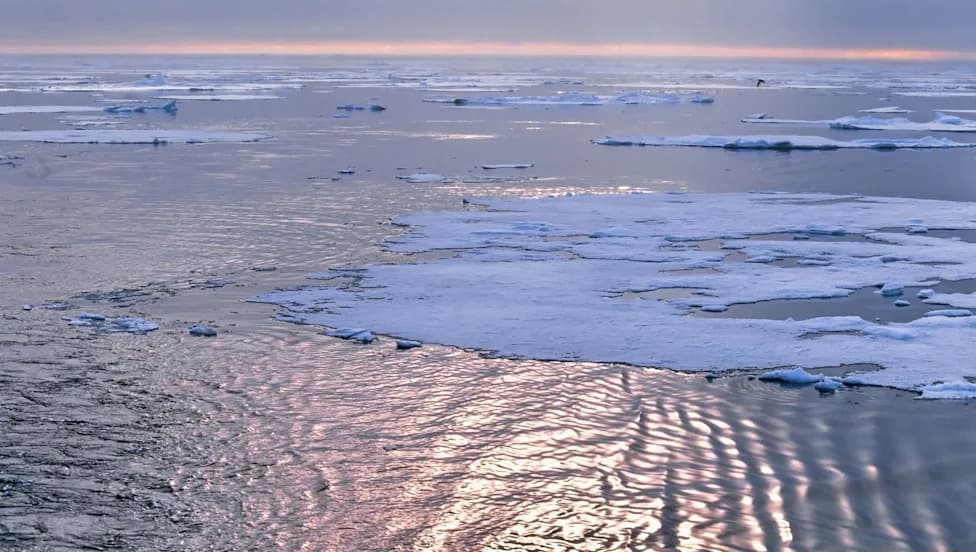
Ordinary sea salt left behind on tropical sea ice may have made Earth's frozen surface substantially more reflective during the Neoproterozoic Era, amplifying cooling as the planet marched toward a Snowball Earth. Laboratory work shows hydrohalite-rich salt crusts can reach an all-wave solar albedo near 0.93, significantly higher than fresh snow (~0.83) or bare melting sea ice (~0.67), so widespread salt deposits on sunlit equatorial ice could have had a large climatic effect.
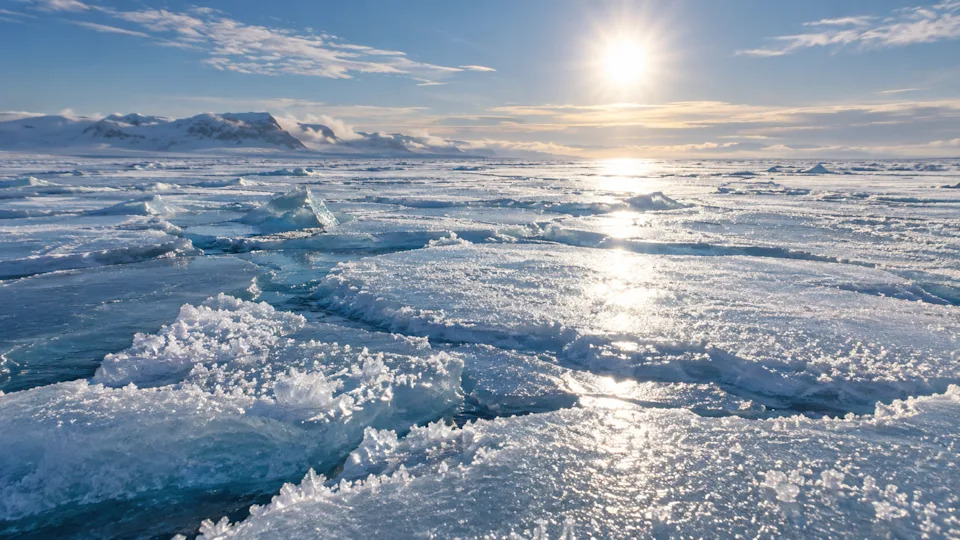
As oceans froze during the Neoproterozoic Era, crystals left behind on exposed tropical sea ice could have made Earth's already-bright frozen surface even more reflective. (CREDIT: Shutterstock)
What the Study Did
Researchers Aksel Samuelsberg, Per Kristen Jakobsen and Martin Rypdal at UiT The Arctic University of Norway incorporated a salt-albedo feedback into a simplified one-dimensional energy-balance climate model and published their results in Climate of the Past. The model divides the planet by latitude and assigns different reflectivities to open ocean, bare sea ice, snow-covered ice and salt-coated ice (the salt surface was given an albedo of 0.93 based on laboratory measurements).
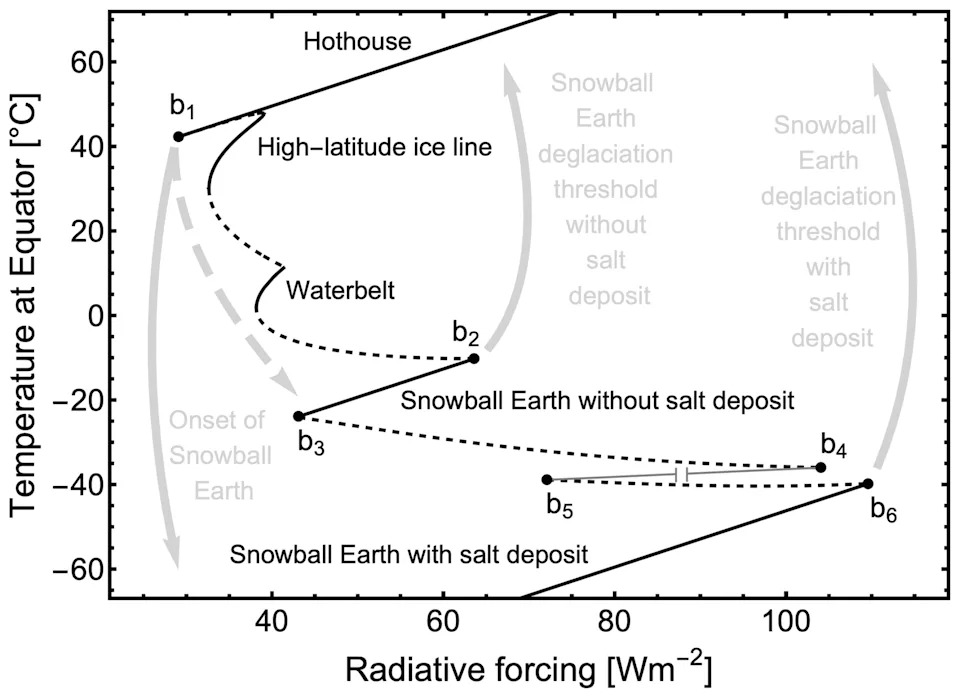
Bifurcation diagram for the EBM with a salt-albedo feedback. Radiative forcing on the x axis is defined as ΔA = A₀ − A, where A₀ is the reference value given in Table 1. Black solid lines indicate stable equilibrium states and dashed lines indicate unstable states. Stable climate states are labeled. (CREDIT: Aksel Samuelsberg et al, Climate of the Past)
Key Results
The model produced two distinct, stable globally frozen states. Both display near-global ice cover, but one retains bare tropical sea ice while the other develops bright salt deposits over that exposed ice. The salt-covered Snowball is markedly colder and requires substantially greater radiative forcing to begin melting—meaning the salt-enhanced state is harder to escape in the model.
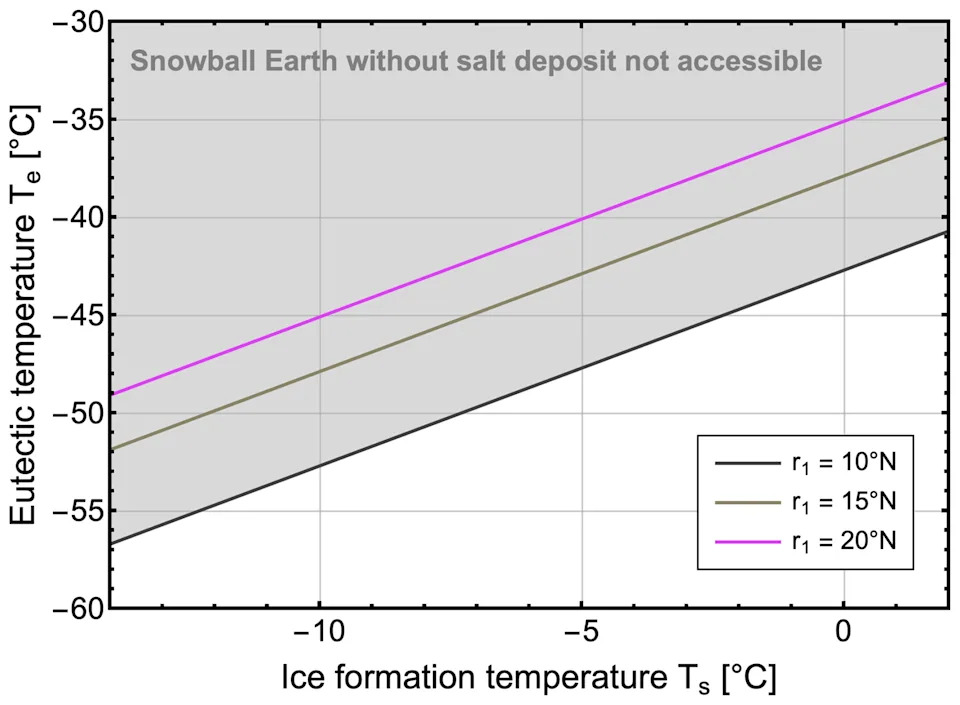
Diagram showing the accessibility of the Snowball Earth without a salt deposit for different values of the critical temperatures Ts and Te. (CREDIT: Aksel Samuelsberg et al, Climate of the Past)
How The Feedback Works
When seawater freezes, salts are excluded from ice and concentrate in brine pockets. Continued cooling and surface sublimation can concentrate salts at the top of the ice until mineral salts crystallize. Different salts precipitate at different temperatures: mirabilite can appear near −8 °C, hydrohalite near −23 °C, and the full eutectic mixture near −36 °C. Laboratory experiments and optical modeling indicate that hydrohalite-rich crusts brighten the surface as sublimation concentrates them, providing the physical basis for a positive salt-albedo feedback.
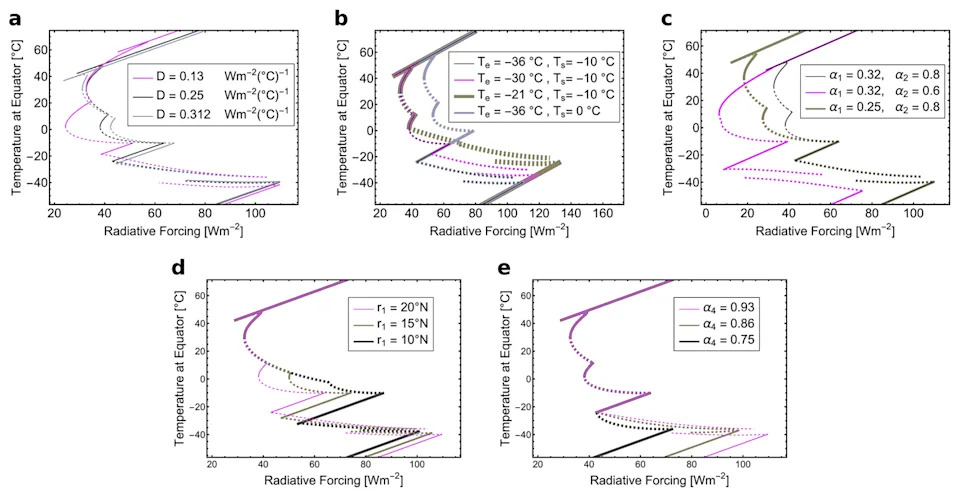
Bifurcation diagram for the EBM in with the albedo function and: (a) Different diffusion rates D. The numerical value D=0.312 gives the temperate solutions to the EBM a modern-day temperature field. (CREDIT: Aksel Samuelsberg et al, Climate of the Past)
Limitations And Uncertainties
Important caveats limit how far to take these results. The study used a simple energy-balance model that does not explicitly simulate atmospheric CO₂, sea-ice dynamics, clouds, winds, dust or full atmospheric circulation. In a real Snowball Earth, ice would flow toward the tropics and bring fresher, snow-derived ice that could dilute or disrupt surface salt crusts. Clouds could mask bright surfaces; winds might redistribute crystals onto snow; and dust could darken salt crusts, reducing their reflectivity.
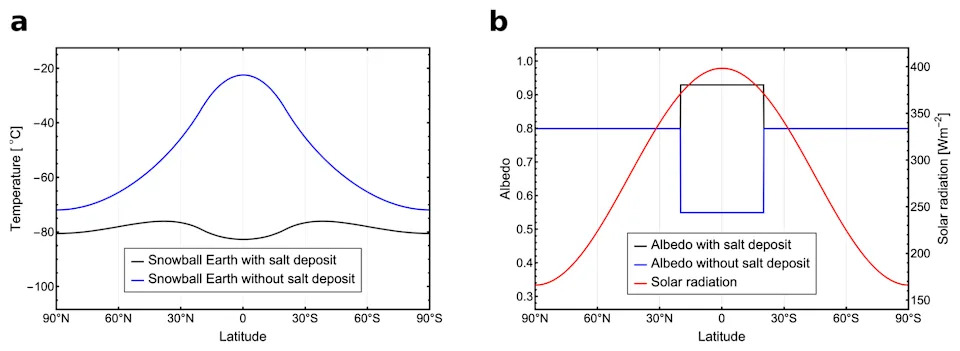
(a) Temperature profiles for Snowball Earth with a salt deposit (black) and Snowball Earth without a salt deposit (blue) at radiative forcing level ΔA=45. (b) The ice/snow albedo functions (a(x,T)∀T < Tₛ) for Snowball Earth with a salt deposit (black) and Snowball Earth without a salt deposit (blue), together with the latitudinal distribution of Neoproterozoic solar radiation Qs(x) (red). (CREDIT: Aksel Samuelsberg et al, Climate of the Past)
Rather than proposing salt as the trigger for Snowball Earth, the authors present it as a potential amplifier: once ice and cold were widespread enough, salt precipitation could have deepened the freeze and made deglaciation more difficult.
Implications
The proposed salt-albedo feedback offers a plausible mechanism that could have reinforced an already advancing global glaciation and increased the greenhouse forcing required for deglaciation. However, confirming whether extensive salt crusts actually formed and persisted on ancient tropical sea ice will require more sophisticated models that include ice flow, atmospheric CO₂, clouds and other processes.
Data and further reading: The model results and discussion appear in Climate of the Past, and the study builds on laboratory and optical-modeling work measuring the spectral albedos of hydrohalite and other sea-ice salt crusts.
Help us improve.