Estonia is ranked the best country to live in for 2026, narrowly ahead of Singapore and Malaysia, according to Rumavi’s index of 184 nations. The ranking uses 24 indicators across four pillars: financial and tax conditions, livability and health, safety and stability, and settling and opportunity. Europe supplies half of the top 20, while many lowest-ranked countries—largely in Africa—face governance and security challenges. The United States sits at 107th, constrained by high living costs despite strengths in education and entrepreneurship.
Ranked: The Best and Worst Countries To Live In 2026 — Estonia Tops Rumavi’s Global Index
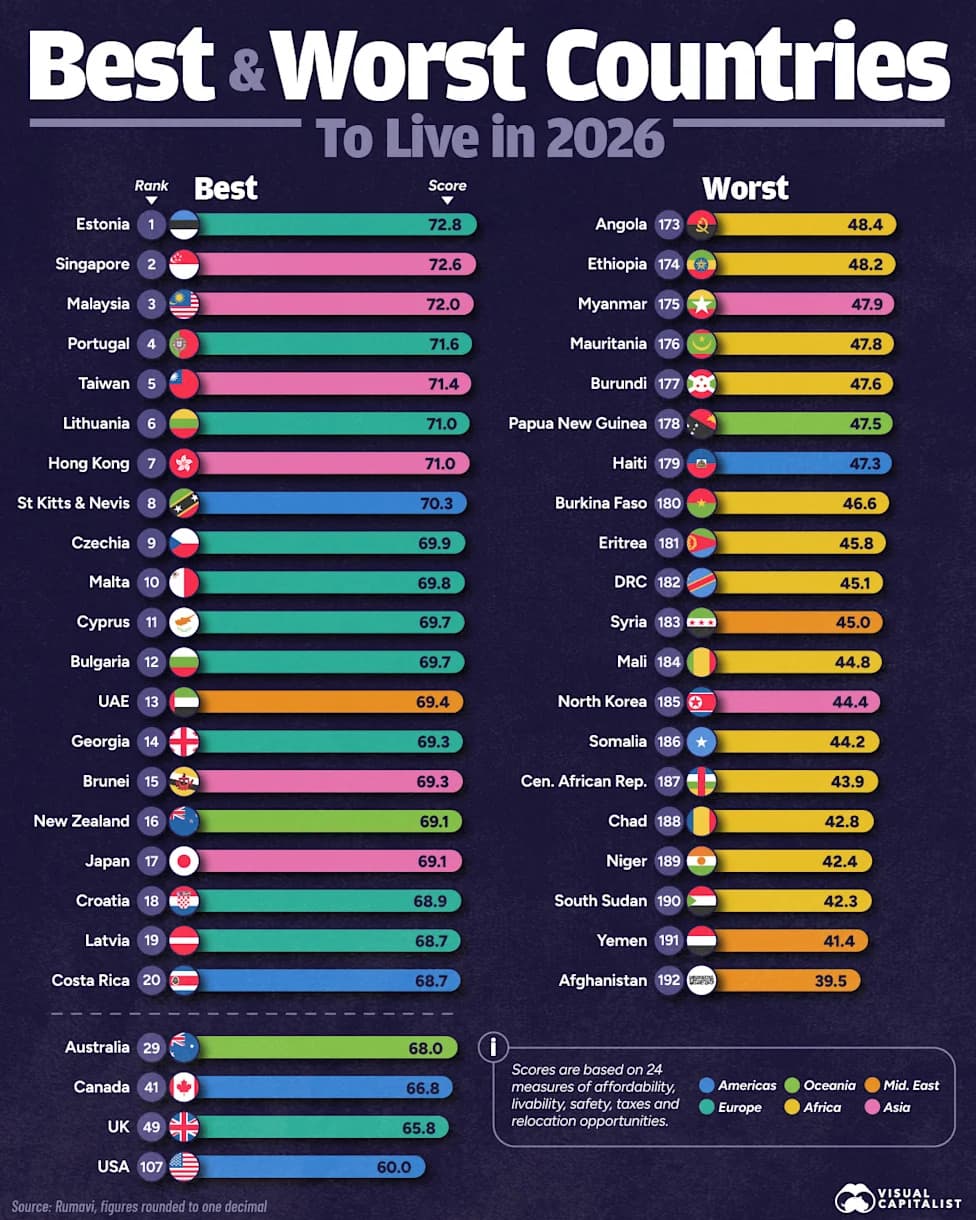
Double-ranking showing the best and worst countries to live in 2026.
Estonia has been named the best country to live in for 2026, narrowly edging out Singapore and Malaysia in Rumavi’s global index. The ranking evaluates 184 countries using a composite score derived from 24 indicators across four pillars: financial and tax conditions, livability and health, safety and stability, and settling and opportunity.
Key Findings
Estonia leads the list with a score of 72.8, followed by Singapore (72.6) and Malaysia (72.0). Europe supplies half of the top 20 countries, while many of the lowest-ranked nations—predominantly in Africa—face challenges such as political instability, weak institutions, and poor safety and property-rights protections. The United States places 107th with a score of 60.0, held back by high living costs despite strengths in education and entrepreneurship.
Why Estonia Ranks First
Estonia’s top placement is notable for a nation of roughly 1.3 million people. Strong rule of law, low youth unemployment, a dynamic startup ecosystem, and high scores on safety and settling metrics all contribute to its leading score. The Baltic neighbours Lithuania (71.0) and Latvia (68.7) also appear in the global top 20.
Top 20 Countries To Live In 2026
- Estonia — Europe — 72.8
- Singapore — Asia — 72.6
- Malaysia — Asia — 72.0
- Portugal — Europe — 71.6
- Taiwan — Asia — 71.4
- Lithuania — Europe — 71.0
- Hong Kong — Asia — 71.0
- St Kitts & Nevis — Americas — 70.3
- Czechia — Europe — 69.9
- Malta — Europe — 69.8
- Cyprus — Europe — 69.7
- Bulgaria — Europe — 69.7
- UAE — Middle East — 69.4
- Georgia — Europe — 69.3
- Brunei — Asia — 69.3
- New Zealand — Oceania — 69.1
- Japan — Asia — 69.1
- Croatia — Europe — 68.9
- Latvia — Europe — 68.7
- Costa Rica — Americas — 68.7
Lowest-Ranked Countries (Selected)
The bottom of the index is dominated by countries facing severe governance, security, and institutional challenges. Below are selected entries from the lowest ranks.
- 173. Angola — Africa — 48.4
- 174. Ethiopia — Africa — 48.2
- 175. Myanmar — Asia — 47.9
- 176. Mauritania — Africa — 47.8
- 177. Burundi — Africa — 47.6
- 178. Papua New Guinea — Oceania — 47.5
- 179. Haiti — Americas — 47.3
- 180. Burkina Faso — Africa — 46.6
- 181. Eritrea — Africa — 45.8
- 182. DR Congo — Africa — 45.1
- 183. Syria — Middle East — 45.0
- 184. Mali — Africa — 44.8
- 185. North Korea — Asia — 44.4
- 186. Somalia — Africa — 44.2
- 187. Central African Republic — Africa — 43.9
- 188. Chad — Africa — 42.8
- 189. Niger — Africa — 42.4
- 190. South Sudan — Africa — 42.3
- 191. Yemen — Middle East — 41.4
- 192. Afghanistan — Asia — 39.5
Context And Methodology
The ranking is compiled by Rumavi and uses a composite score that aggregates 24 measures across four pillars: financial and tax conditions, livability and health, safety and stability, and settling and opportunity. Results can favour smaller countries that perform consistently well across specific pillars, while some high-income countries rank lower due to weaknesses in affordability, social equity, or safety metrics.
United States snapshot: The U.S. scores 60.0 and ranks 107th out of 184. It performs well on education, business opportunity and entrepreneurship, but higher living costs and mixed outcomes in health, livability and safety reduce its overall score. Despite this mid-table ranking, the United States received more than 1.3 million new immigrants in 2025.
Data source: Rumavi’s 2026 index covering 184 countries.
Help us improve.