On August 11 a Tesla Megapack fell from a flatbed on I‑40 near Forrest City, Arkansas, struck the road and ignited almost immediately, spreading flames to adjacent grass. Crews contained the scene, moved the heated module about five miles to a remote state facility, and allowed it to burn out while Tesla specialists joined the investigation. The event underscores that LFP battery chemistry, while generally more stable, can still ignite under severe impact, and that battery fires are often managed by containment rather than aggressive water dousing. Officials praised the local fire department and noted the incident will inform future emergency training.
Tesla Megapack Falls From Flatbed on I‑40, Ignites Large Fire Near Forrest City, AR
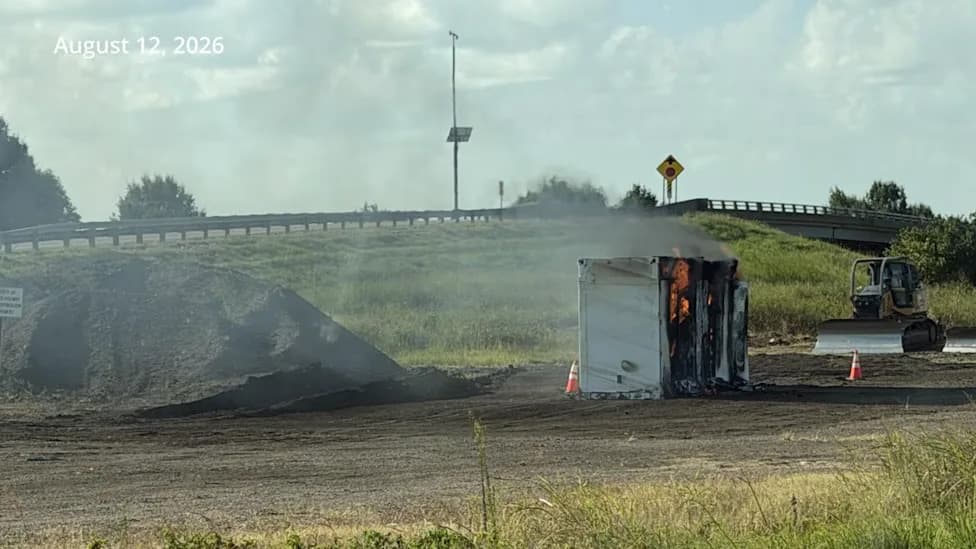
Image Credit: StacheD Training / YouTube.
On August 11 at about 1:30 p.m., a Tesla Megapack fell from a flatbed truck on Interstate 40 near Forrest City, Arkansas, after the load shifted while the driver had stopped for fuel. The battery pack struck the pavement and ignited almost immediately, with flames spreading to nearby grass.
Local authorities described the blaze as unprecedented for the Forrest City Fire Department. Grid-scale energy storage systems like Megapacks are engineered to remain stationary on concrete pads, not to be jostled or dropped from a moving vehicle. Responders spent many hours on scene managing a complex and unfamiliar hazard.
Response and Containment
According to footage and commentary shared by StacheD Training, crews brought the main fire under control, then placed the still‑hot battery module on a trailer and transported it roughly five miles to a state highway facility away from homes and traffic. There it was allowed to burn out in a controlled location while Tesla specialists from Memphis and Texas joined the formal investigation.
Why Battery Fires Differ
Battery fires require tactics that differ from typical vehicle or structure fires. The immediate priority is containment rather than aggressive extinguishing: shield nearby structures, establish a secure perimeter, position personnel upwind, and let the battery complete its burn in a controlled area when necessary. Pouring large volumes of water on a compromised pack can create conductive paths that trigger additional short circuits and spread the fire; in many cases patient containment and focused cooling of surrounding areas are safer.
Some reports note that Tesla modules include design features intended to steer a developing fault toward a sustained burn rather than an explosive rupture. The idea is that a controlled burn is more predictable and easier for responders to manage; investigators are reviewing whether that behavior played a role in this incident.
Officials praised the Forrest City Fire Department for managing an unusual and hazardous event under difficult circumstances. While a full highway closure might have reduced smoke exposure for drivers, staffing and operational constraints can make such closures impractical. As mobile and stationary battery systems become more common, incidents like this are increasingly likely to shape training and protocols for emergency services.
Driver Safety Reminder
If you encounter smoke or an emergency scene while driving, slow down, move over, follow directions from emergency personnel, and avoid stopping near the incident to take photos.
Help us improve.