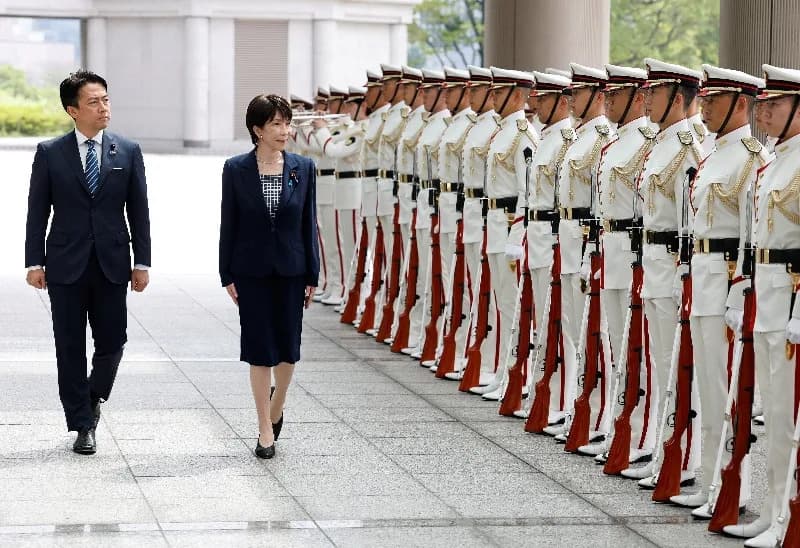
Senior Japanese leaders, including Prime Minister Sanae Takaichi, are reopening a national debate over the three non‑nuclear principles amid rising regional tensions and doubts about US deterrence. Defence Minister Shinjiro Koizumi and some coalition partners have urged open discussion, while an off‑the‑record remark that Japan should consider owning nuclear weapons drew wide criticism. Survivors of Hiroshima and Nagasaki—now fewer and older—warn the debate threatens Japan's postwar pacifist identity as the government updates defence policy.
Japan's Nuclear Crossroads: Leaders Reopen Debate Over Three Non‑Nuclear Principles
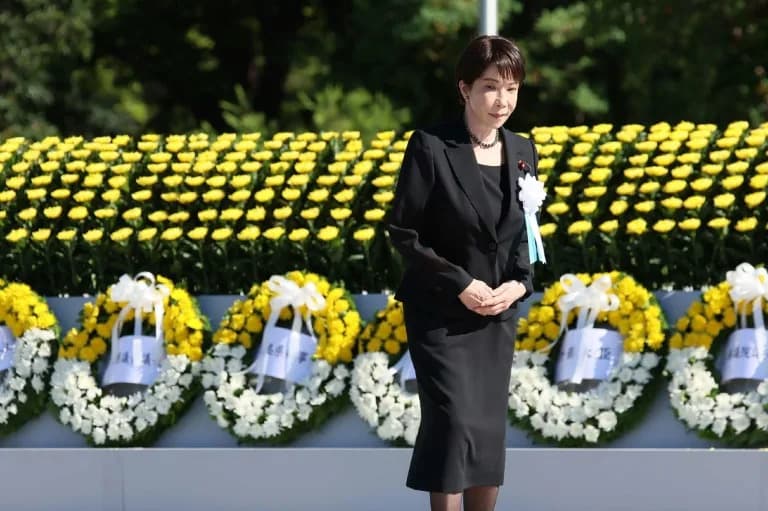
Japanese Prime Minister Sanae Takaichi looks on during a memorial at the Peace Memorial Ceremony, on the 81st anniversary of the dropping of the atomic bomb, at the Peace Memorial Park in Hiroshima on August 6, 2026 (JIJI PRESS)
As Japan observes the anniversaries of the 1945 atomic bombings, senior government figures are pushing for a renewed national debate on nuclear weapons that challenges the country's long-standing postwar pacifist orientation.
A Fragile Consensus Under Pressure
Japan's constitution renounces offensive military force, and successive administrations have upheld the three non‑nuclear principles since 1967: not to possess nuclear weapons, not to produce them and not to permit their introduction into Japanese territory. That consensus is now under strain as neighbouring powers, particularly China, expand their military capabilities and as doubts grow about the reliability of Japan's key security guarantor, the United States.
Political Signals and Public Reaction
Prime Minister Sanae Takaichi has declined to say whether she will continue to support the three non‑nuclear principles. Defence Minister Shinjiro Koizumi called last month for a "discussion without a taboo" on the subject, and in December an unnamed senior administration official reportedly suggested in an off‑the‑record session that Japan should consider possessing nuclear weapons. That remark was widely reported by major outlets including NHK and the Asahi Shimbun, prompting public criticism.
"If I look at it cynically, I can't help but think that maybe she really wants to change" Japan's anti‑nuclear commitment, said 82‑year‑old Satoshi Tanaka, a survivor of the Hiroshima bombing and longtime campaigner.
Policy Shifts And Regional Reaction
The Takaichi administration is preparing a major revision of Japan's national defence strategy amid concerns about China's growing military ambitions. The prime minister has lifted Japan's self‑imposed ban on weapons exports, increased defence spending and is advocating constitutional revision. Beijing has denounced these moves as evidence of a return to "new militarism," and critics at home worry that a more hawkish posture will raise regional tensions.
Survivors' Voices And A Dwindling Generation
Survivors of the Hiroshima and Nagasaki attacks—who have played a central role in shaping Japan's postwar pacifist identity—are alarmed by the debate. As of March, Japan officially recognized just over 91,000 survivors, down from more than 164,000 a decade ago; their average age is 86.7. The country observed the Hiroshima anniversary this week and will mark Nagasaki on Sunday. The US atomic strikes in August 1945 killed more than 210,000 people, many of whom later died of radiation‑related illnesses; they remain the only wartime use of atomic weapons.
Stakes And Uncertainty
Supporters of revisiting the three non‑nuclear principles argue that the clause forbidding the entry of nuclear arms should be reconsidered to allow greater flexibility under the US‑Japan security alliance and to strengthen extended deterrence. Opponents argue any loosening of Japan's anti‑nuclear stance would undermine its moral leadership on disarmament and increase the risk of being drawn into nuclear confrontation.
The debate — touching history, national identity and regional security — is likely to intensify as the government moves ahead with defence reviews and constitutional discussions. For survivors and many citizens, the discussion raises profound questions about the future of Japan's pacifist legacy.
Help us improve.