Genta Koja, backed by Prime Minister Sanae Takaichi's government, won Okinawa's gubernatorial race with 59% of the vote, unseating two-term incumbent Denny Tamaki and ending 12 years of often adversarial local leadership. Koja's victory could weaken opposition to relocating some U.S. Marines from Futenma to Henoko and make it easier to open civilian airports and ports to military use. The result arrives as Tokyo prepares a major national security strategy to accelerate Japan's biggest defence build-up since World War Two amid rising tensions with China over Taiwan. Key items to watch include formal moves on Henoko and changes to facility designations.
Okinawa Election Win Gives Tokyo Leverage to Expand Military Presence
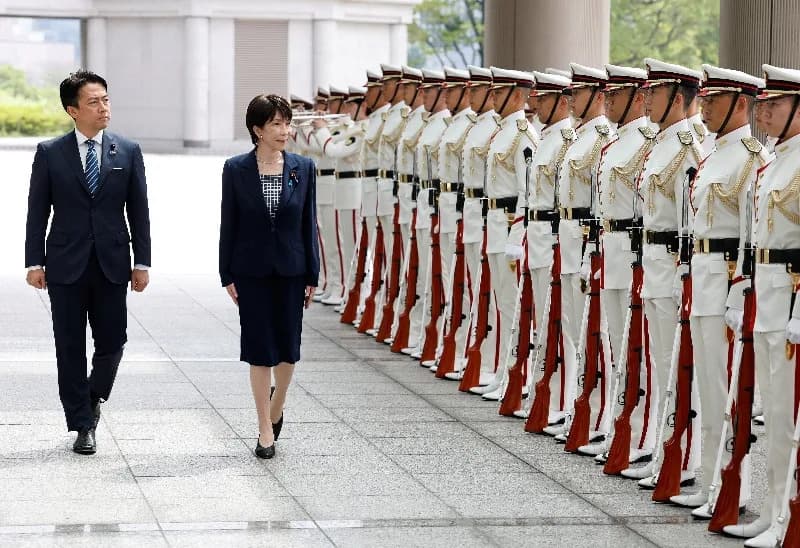
Japanese Prime Minister Sanae Takaichi and Defence Minister Shinjiro Koizumi inspect the honor guard at the Self-Defense Forces Senior Commanders' Conference in Tokyo, Japan, September 2, 2026. REUTERS/Kim Kyung-Hoon/Pool
TOKYO, Sept 14 — Genta Koja, a 42-year-old candidate backed by Prime Minister Sanae Takaichi's administration, won Okinawa's gubernatorial election on Sunday, defeating two-term incumbent Denny Tamaki with 59% of the vote in a result announced early Monday.
Koja's victory follows a campaign in which voters were primarily concerned about rising living costs and ends 12 years of leadership by governors often at odds with the central government. The outcome could alter the balance between Okinawa's local authorities and Tokyo on security and base issues that have long been contentious.
Implications for U.S. Marine Relocation and Military Access
The defeat of Tamaki, a prominent opponent of Tokyo's military build-up on the islands, may weaken local resistance to moving some U.S. Marines from the crowded Futenma air base to a more remote facility at Henoko on Okinawa's main island. Opponents had called for moving the troops entirely out of the prefecture rather than transferring them within it.
Japan's central government said on Monday it would press ahead with the Henoko relocation plan. Observers also say Koja's victory could make it easier for Tokyo to expand military access to civilian airports and ports across Okinawa.
“Koja could reasonably be expected to approve their designation, opening wholly civilian facilities to military use,”
— Masaaki Gabe, Professor Emeritus, University of the Ryukyus
Strategic Context
The election result comes as Prime Minister Takaichi prepares to unveil a new national security strategy expected this year that would accelerate Japan's largest military build-up since World War Two. The administration argues that higher defence spending and expanded basing options are needed to deter China from using force to advance territorial claims in East Asia.
Okinawa is part of the so-called First Island Chain, a strategic arc of territory from Japan through the Philippines that shapes regional military planning. Yonaguni, Japan's westernmost inhabited island, lies roughly 110 km (68 miles) east of Taiwan—territory Beijing claims as its own—and the area has seen heightened Chinese activity.
Tokyo has already deployed missile and electronic-warfare units to several southwestern islands and is expanding ammunition storage across the region as tensions with Beijing rise. The election result may therefore have immediate consequences for operational basing, logistics and civilian-military facility use in Okinawa.
What To Watch: Whether Tokyo moves quickly to formalize the Henoko transfer, any new designations opening civilian ports and airports to military use, and the content of the upcoming national security strategy.
(Reporting by Tim Kelly and Yukiko Toyoda; Editing by Stephen Coates and Raju Gopalakrishnan)
Help us improve.