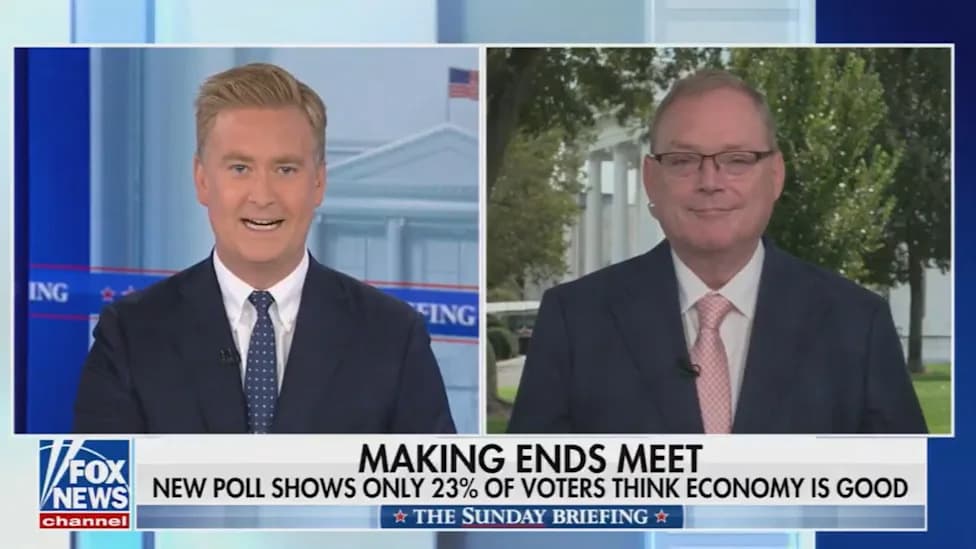
Kevin Hassett, director of the National Economic Council, drew criticism after offering an upbeat interpretation of a weak July jobs report. The BLS reported a loss of about 23,000 payroll jobs in July and revised May–June payrolls down by roughly 103,000. Hassett said excluding the World Cup and government workers would show about +100,000 jobs — a claim widely mocked online as stretched accounting. Observers noted this followed previous instances where Hassett offered controversial reinterpretations of data.
Kevin Hassett Draws Criticism After Upbeat Spin On Weak July Jobs Report

Trump Adviser Kevin Hassett Ridiculed For Dubiously Positive Take On Weak Jobs Report
The White House's director of the National Economic Council, Kevin Hassett, defended the administration's handling of the economy after July's surprisingly weak jobs report, prompting widespread criticism that his interpretation stretched the data.
What the Report Showed
Official Bureau of Labor Statistics data showed the U.S. economy lost about 23,000 payroll jobs in July. The BLS also revised May and June payrolls downward by roughly 103,000 combined, according to The Associated Press. The unemployment rate was reported at 4.1% — which The AP noted may be the lowest reading since June 2025 — even as the labor force shrank by about 264,000 people who dropped out of the job market in July.
Hassett's Response
On Fox News, Hassett suggested that special factors distorted the headline number. He argued that "if you throw out the World Cup and the government workers, we actually had a number that was plus 100,000, which is about what we expected given that the unemployment rate went down." He also pointed to stronger sectors such as construction and manufacturing and said policymakers should "look through the special factors when we're trying to judge this."
Hassett: "If you throw out the World Cup and the government workers, we actually had a number that was plus 100,000..."
Reaction And Context
Many economic forecasters had expected roughly 100,000 job gains in July, so the downward surprise drew startled reactions from commentators on both CNBC and Fox News. On social media, critics lampooned Hassett's framing as contorted accounting — some mockingly called it "MAGA math." Others suggested the explanation stretched credibility by effectively excluding real-world factors to arrive at a more favorable headline.
Observers also flagged that this was not Hassett's first controversial reinterpretation of economic data. In June he suggested excluding New York and California from inflation calculations to make the measure look better; in May he framed rising credit-card balances as a sign of consumer confidence; and in December 2025 he blamed higher layoff figures in part on how pollsters word survey questions.
Why It Matters
The episode highlights the tension between headline economic statistics and political messaging. A falling unemployment rate can mask underlying weakness if it results from people leaving the labor force rather than newly employed workers. Analysts say policymakers and communicators must be careful not to conflate selective adjustments with the overall health of the labor market.
Reporting referenced: The Associated Press and public comments by Kevin Hassett.
Help us improve.