Researchers claim three perforated sloth osteoderms from Santa Elina, Brazil, display tool marks and smoothing consistent with being worn as pendants and date to about 25,000–27,000 years ago. Critics accept the deposit's antiquity but caution that insect or microbial bioerosion and other taphonomic processes can mimic human modification; only three of 7,069 osteoderms were identified as altered. The debate ties into broader controversies over early sites such as Monte Verde II and is informed by ancient-DNA studies that currently place key population splits at about 20,900 and 15,700 years ago.
Perforated Sloth Bones from Brazil Could Push Human Presence in South America Back to 25,000–27,000 Years
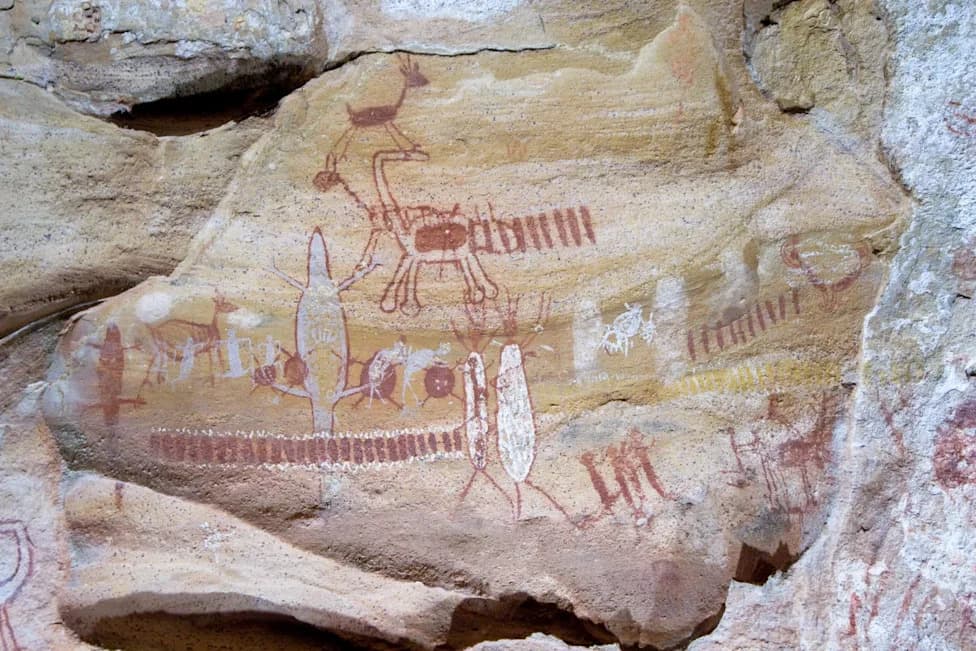
Sloth Bones Could Rewrite South American HistoryAGB Photo Library - Getty Images
Researchers reexamining material from the Santa Elina rock shelter in Mato Grosso, central Brazil, report that three perforated osteoderms (bony plates) from the giant ground sloth Glossotherium phoenesis show marks consistent with deliberate human modification and use as pendants. If those interpretations hold, the assemblage — dated to roughly 25,000–27,000 years ago — would substantially predate the widely cited Monte Verde II site in Chile and reshape debates about early human dispersal into South America.
What the Study Found
In a 2023 paper published in Proceedings of The Royal Society B, the Santa Elina team describes microscopic and optical-scanning evidence from three osteoderms. Inside the perforations they document linear striations consistent with stone-tool drilling or abrading, scraping marks, and polished surfaces consistent with suspension on a cord and prolonged wear. The investigators compared these traces with experimentally produced marks and natural damage types, concluding that neither rodent gnawing nor passage through a digestive tract can account for the full suite of modifications.
Methods and Interpretation
The authors applied high-resolution microscopy, optical scanning, and comparative taphonomic analysis to separate human-made tool marks from natural bioerosion and mechanical damage. They argue the perforations were produced before fossilization and later smoothed by use, consistent with personal ornaments worn as pendants.
Criticisms and Alternative Explanations
Critics accept the antiquity of the deposit itself but question whether the holes are unequivocally anthropogenic. Only three of 7,069 osteoderms recovered from the site were identified as modified — about one in 2,350 — which raises questions about representativeness. Work on extinct armadillo osteoderms has shown that insect or microbial bioerosion can produce lesions visually similar to small perforations, and other taphonomic processes can mimic tool marks. The Santa Elina team's interpretations therefore depend on careful discrimination between cultural modification and natural processes, and many researchers urge additional testing and replication.
Broader Context: Monte Verde and the Wider Debate
Santa Elina's dates would place it roughly 12,000 years older than Monte Verde II, long regarded as the best-supported late Pleistocene site in South America (radiocarbon dated to ~14,500 years). That consensus was shaken in March 2026 when Surovell and colleagues published a reassessment arguing that Monte Verde II is a mid-Holocene landform (about 4,200–8,200 years) and that older radiocarbon dates reflect redeposited Ice Age wood. That paper prompted strong rebuttals from many archaeologists and geoarchaeologists who defend the original late-Pleistocene interpretation. The exchange highlights how interpretations of stratigraphy, context, and redeposition can dramatically affect age estimates.
Independent Evidence From Ancient Genomes
Genomic studies provide an independent line of evidence for population timing and movement. Current ancient-DNA analyses estimate that ancient Beringians split from other Native American ancestors around 20,900 years ago and that the northern and southern Native American branches diverged around 15,700 years ago. An April 2026 study of 128 Indigenous genomes described multiple South American dispersals, a faint Australasian-related signal in some Amazonian groups, and a migration from central and southern Mexico into South America and the Caribbean beginning roughly 1,300 years ago. Those genetic timelines do not easily accommodate a firmly established South American founding population at ~27,000 years ago, although complex multiwave models and unsampled populations complicate direct comparisons.
Conclusion and Next Steps
The Santa Elina team frames their results as a careful invitation to further inquiry rather than a definitive rewrite of the peopling of the Americas. Resolving whether the perforations are cultural will require additional experiments, expanded sampling from the site and region, independent replication of microscopic analyses, and integration with sedimentary, radiocarbon, and genomic data. If validated, the finds would force a substantial reevaluation of migration timing and routes into South America; if not, they will serve as a useful case study in the challenges of distinguishing human manufacture from natural taphonomic processes.
Authors note: Questions regarding timing and routes for human dispersal into the Americas remain open. Multiple routes and time frames remain plausible, and Late Pleistocene sites should be scrutinized closely.
Help us improve.