Overview: This analysis reviews Supreme Court voting patterns from the 2022–23 through 2025–26 terms, when the current nine justices served together. Chief Justice John Roberts repeatedly anchors narrow cross-ideological majorities, often joined by Justice Brett Kavanaugh. Neil Gorsuch frequently serves as a dissent-side bridge to liberals, while Justices Jackson and Barrett supply selective crossover votes in particular issue areas. Coalitional "drift" is most evident for Barrett (from a small base), while Thomas has moved away from cross-ideological alignments.
Beyond the 'Swing' Justice: How Roberts, Gorsuch and Others Reshape Supreme Court Coalitions
Justice Amy Coney Barrett has rejected the label "swing justice," saying it sounds "sort of flighty," and preferring to be called "independent, or just following the law." Historically, a "swing" justice described a durable centrist who repeatedly supplied decisive votes. This article examines whether the current Court, across the 2022-23 through 2025-26 terms when all nine current justices served together, contains comparable centrists or instead reveals different patterns of cross-ideological influence.
Majority Makers
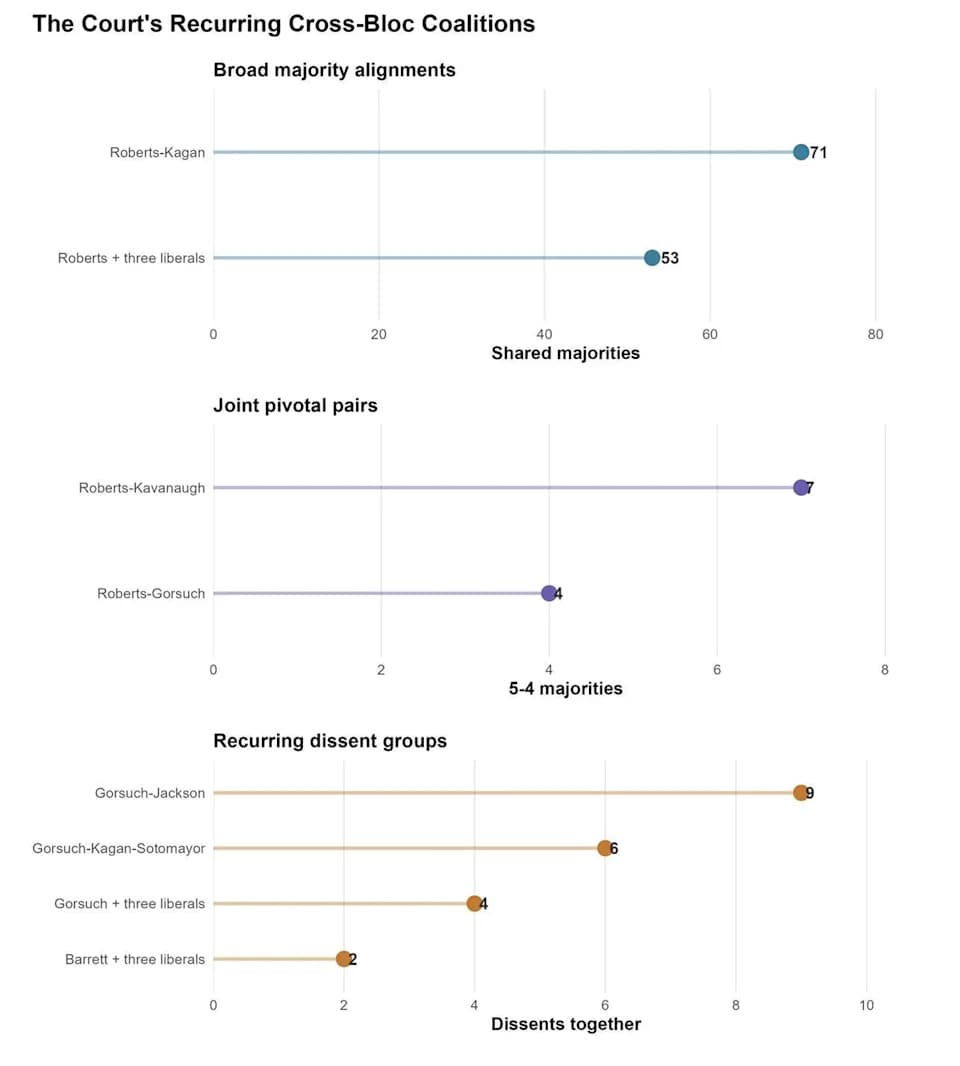
Chief Justice John Roberts emerges as the central majority-builder of the current Court. Since Justice Ketanji Brown Jackson joined the bench, Roberts took part in 12 cross-bloc 5–4 majorities in which the three liberal justices joined him plus two conservatives. Seven of those coalitions paired Roberts with Justice Brett Kavanaugh, four with Justice Neil Gorsuch, and one with Justice Amy Coney Barrett.
Notable examples include Allen v. Milligan (a Voting Rights Act case) and Cruz v. Arizona (a capital-sentencing dispute), where Roberts led majorities that included Sotomayor, Kagan, Jackson and Kavanaugh. The most recent term reinforced the pattern: decisions such as Bowe v. United States, Pitchford v. Cain, and Trump v. Cook show repeated Roberts–Kavanaugh coalitions. In Watson v. Republican National Committee, Barrett authored a cross-bloc opinion joining Roberts and the three liberals in a voting-rights challenge.
Justice Jackson’s pivotal majorities follow a different trajectory: in cases like Bittner v. United States and Harrington v. Purdue Pharma she was the lone liberal in otherwise conservative coalitions. But across most divided cases Jackson remains closely aligned with Justices Sotomayor and Kagan.
The Dissent Bridge
Justice Neil Gorsuch stands out for cross-ideological activity on the dissent side. During the review period he joined dissents led by the opposite ideological bloc in eight of 46 dissents (about 17.4%). Examples include Arizona v. Navajo Nation, Campos-Chaves v. Garland, and USPS v. Konan, where he joined liberal dissents addressing tribal obligations, immigration rescission claims, and the scope of the Federal Tort Claims Act.
Gorsuch and Justice Jackson also formed a recurring two-justice dissent in cases such as Bufkin v. Collins, Delligatti v. United States, and Monsanto Company v. Durrell, spanning veterans’ benefits, definitions of violent crimes, and federal preemption—an unusual cross-issue pattern that makes their pairing notable despite its modest share of total votes.
Barrett has a smaller set of liberal-aligned dissents—examples include Fischer v. United States, Ohio v. Environmental Protection Agency, and City and County of San Francisco v. EPA—often tied to administrative and environmental issues. By contrast, Jackson dissented 63 times over the four terms and joined conservative colleagues in only two of those dissents, keeping most of her dissenting votes within the liberal bloc.
Recurring Pairs, Trios, and Foursomes
Different pairings capture distinct kinds of influence. Roberts and Elena Kagan form the broadest cross-ideological partnership, siding together in 75 of 131 non-unanimous cases in the common-period sample, including 71 shared majorities and 15 of 27 5–4 decisions. Roberts and Kavanaugh are the leading pivotal duo, supplying the two conservative crossover votes in seven of 14 liberal-led 5–4 majorities. Gorsuch and Jackson lead cross-bloc dissents, with nine shared dissents in the period.
Two recurring foursomes crystallize broader dynamics: Roberts plus the three liberals joined in majority in 53 non-unanimous cases (including 12 of 27 5–4 decisions), while Gorsuch plus the three liberals form the clearest mixed dissent group. Barrett with the three liberals forms a smaller, more issue-specific dissent network.
Coalition Drift
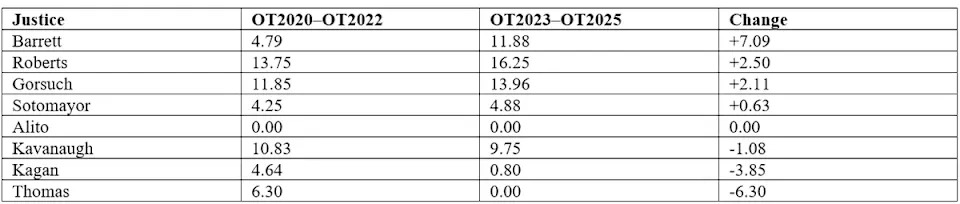
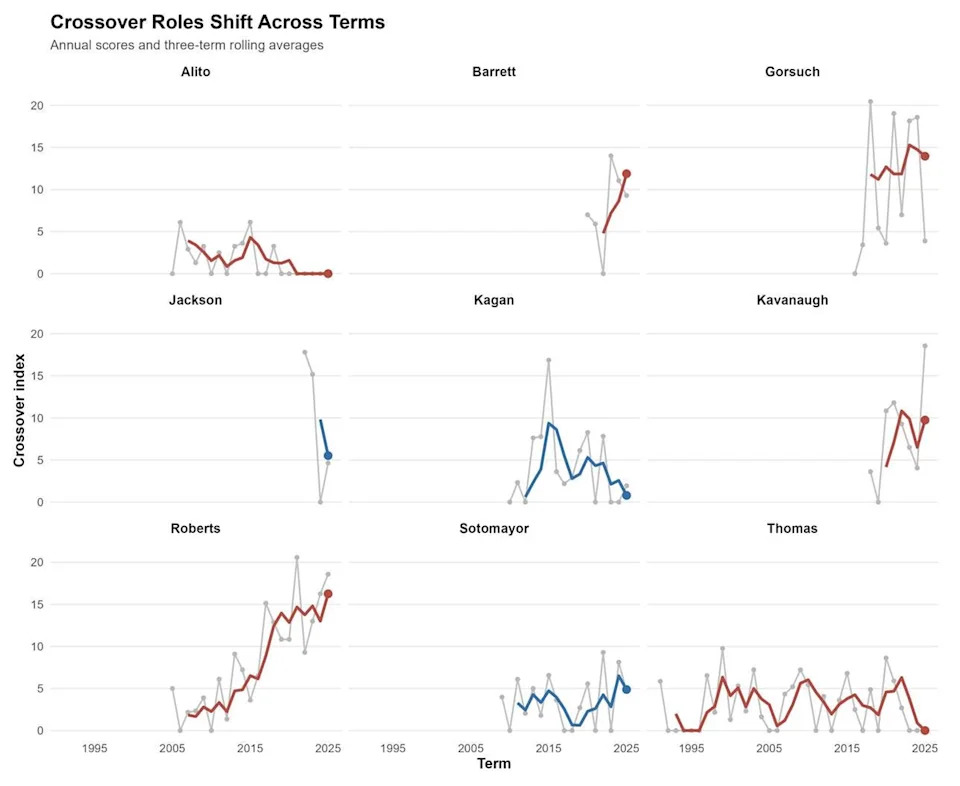
"Coalition drift" measures whether justices have become more likely over time to vote with ideological opposites. Barrett shows the largest percentage drift in recent terms, though that change is amplified by a small absolute number of cross-bloc dissents. Roberts shows the next-largest increase in cross-bloc participation largely because of his frequent role in narrow majorities. Gorsuch’s elevated score reflects persistent dissent alliances plus participation in some Roberts-led majorities. By contrast, Justice Clarence Thomas recorded no pivotal votes or cross-ideological dissents from 2023–24 through 2025–26, and Justice Samuel Alito showed little measurable change. Jackson’s shorter tenure limits firm trend conclusions.
Interpretation and Limits
These voting patterns show that bloc members are not interchangeable: the chief justice, Gorsuch, Kavanaugh and Barrett each exert different forms of cross-ideological influence, while Thomas and Alito rarely cross. Important caveats: these measures capture votes, not motivations; fractured opinions mean a justice can agree with an outcome without adopting the controlling rationale; and small sample sizes make some percentage-based claims fragile (Barrett’s dissent percentage rests on just three cases; Jackson’s pivotal-majority count on four).
Bottom line: Roberts has anchored narrow majorities by often beginning with the liberal bloc and recruiting one conservative vote; Gorsuch is the primary bridge on the dissent side; Kavanaugh, Jackson and Barrett connect blocs in particular issue areas. Future dockets will determine which of these patterns persist.
Help us improve.