The MAIUS‑B team demonstrated a rubidium–potassium dual‑species Bose‑Einstein condensate in microgravity with a particle flux about 10× higher than prior mobile systems. Experiments in the Einstein Elevator validated an expanded laser system and Zerodur optical benches that preserve alignment under shock and thermal variation. These advances underpin the BECCAL atom laboratory planned for the ISS and aim to enable more precise tests of Einstein’s equivalence principle by comparing free‑fall accelerations of the two atomic species.
Record Dual‑Species Rubidium–Potassium BEC Achieved in Microgravity, Clearing Path to ISS Atom Lab
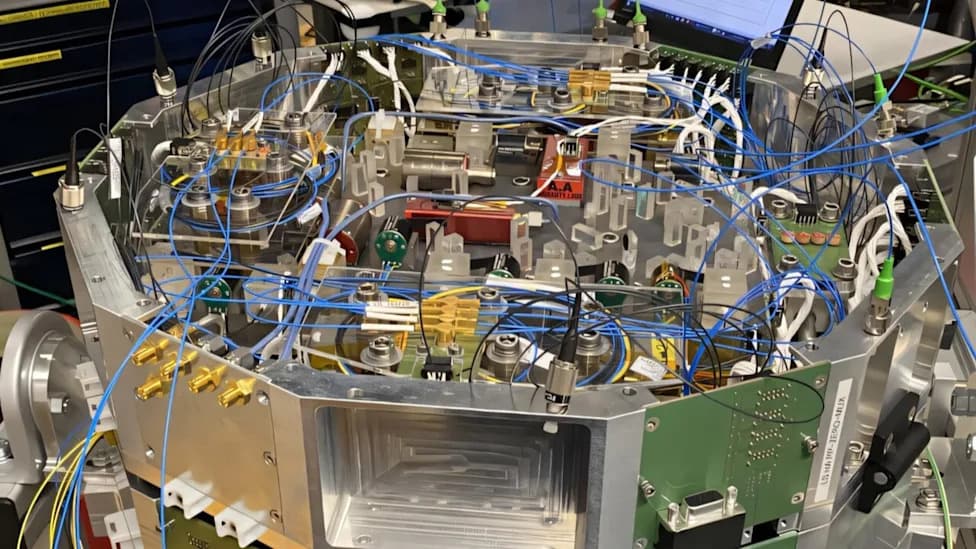
Scientists produce record rubidium-potassium BEC in microgravity, paving way for ISS lab
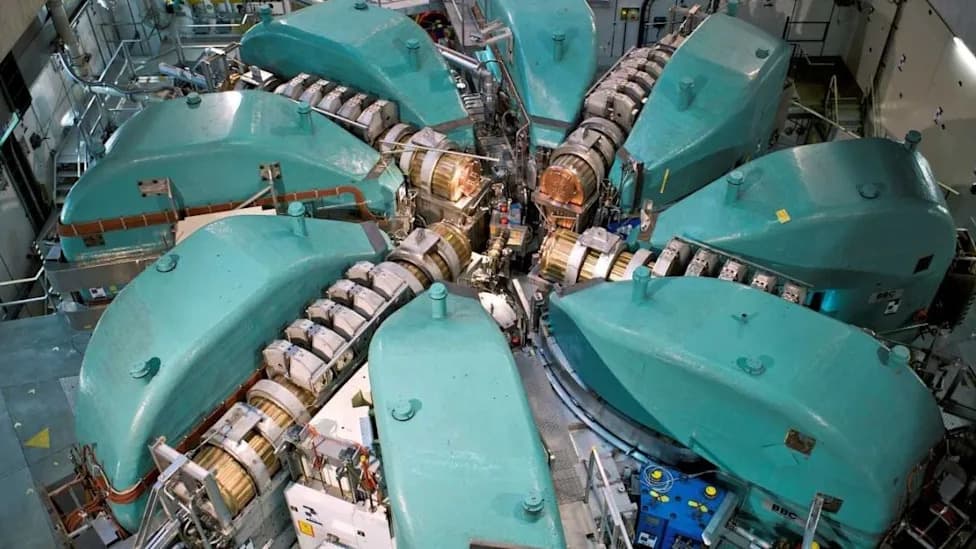
An international team has produced a rubidium–potassium dual‑species Bose‑Einstein condensate (BEC) in microgravity with a particle flux roughly an order of magnitude higher than any previous mobile system. The experiments were carried out with the MAIUS‑B apparatus inside the Einstein Elevator at Leibniz University Hannover, a facility that generates brief free‑fall intervals without the cost or complexity of a rocket launch or orbital mission.
What the Team Achieved
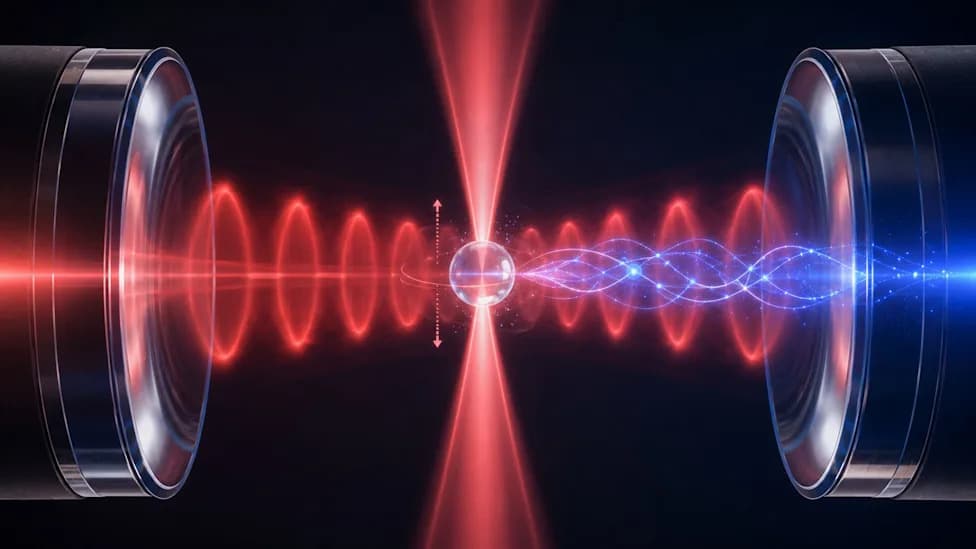
The researchers simultaneously cooled and controlled chemically distinct rubidium and potassium atoms into BECs — a quantum phase of matter that appears near absolute zero and reveals macroscopic quantum behavior. Producing a single‑species BEC in space was first demonstrated by MAIUS‑1 in 2017; MAIUS‑B extends that capability by handling two different elements in one instrument under microgravity, a substantially more demanding technical challenge.
Key Technical Advances
Expanded Laser System: Each atomic species requires its own laser set tuned to specific transitions. The MAIUS‑B laser assembly, led by Professor Patrick Windpassinger and Dr. André Wenzlawski at Johannes Gutenberg University Mainz (JGU) in collaboration with Humboldt‑Universität zu Berlin and the Ferdinand‑Braun‑Institut, uses roughly twice as many laser components as a single‑species system plus additional optics and electronics. Despite this complexity, the team maintained nearly the same payload volume and mass as the predecessor system — a critical constraint for flight hardware.
Zerodur Optical Benches: The most technically demanding hardware are the optical benches: the interface layer between lasers and the vacuum chamber where atoms are trapped and cooled. Co‑developed by JGU and the University of Hamburg, these benches are machined from Zerodur, a glass‑ceramic with an exceptionally low coefficient of thermal expansion. That thermal and mechanical stability preserves optical alignment through the shocks and temperature swings encountered during testing and launch environments.
Validation and Performance
Extended operation inside the Einstein Elevator validated the design under repeated, realistic free‑fall cycles. The result is a dual‑species BEC particle flux approximately 10× higher than any previously reported mobile apparatus of this type — a major step toward practical, high‑precision atom interferometry in space.
Scientific Significance and Path to ISS
The technologies and lessons from MAIUS‑B form the engineering foundation for BECCAL, a planned German‑American atomic physics laboratory for the International Space Station. In orbital microgravity, experiments can run for long durations, enabling measurements that are impossible within the Einstein Elevator's short free‑fall windows.
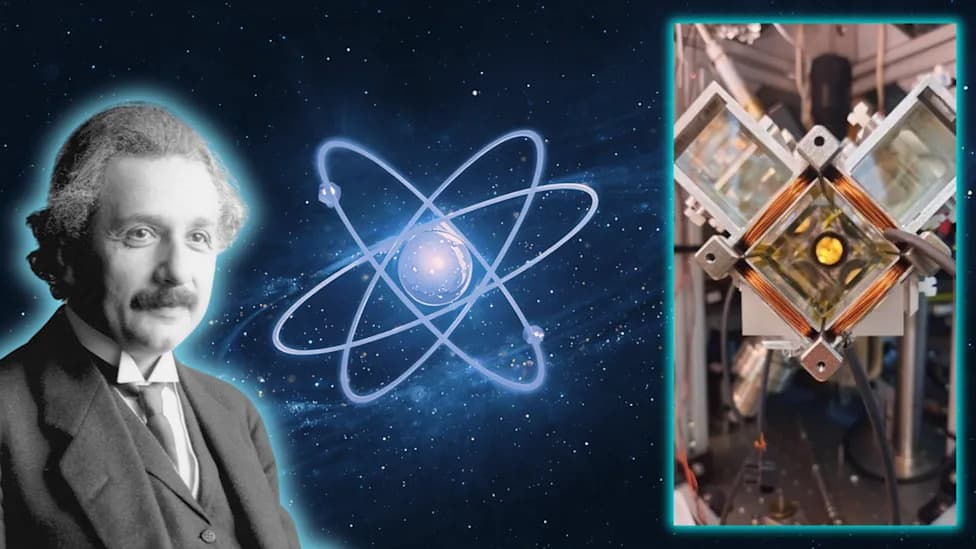
The primary scientific goal is a direct test of Einstein’s equivalence principle at quantum scales: comparing the free‑fall acceleration of rubidium and potassium atoms, which differ in mass and internal structure. A dual‑species BEC in orbit would push equivalence‑principle tests to new precision and probe the interface between quantum mechanics and general relativity beyond the reach of ground‑based experiments.
Publication: The research was published in Nature Communications.
Why it matters: Higher particle flux, robust flight‑ready engineering, and dual‑species control are essential milestones on the road to spaceborne quantum sensors that could transform precision measurements, fundamental physics tests, and applied navigation technologies.
Help us improve.