CT scans of three dodo skulls reveal the bird’s cognition-related brain regions were proportionate to its size, challenging the long-held view that the dodo was stupid. Researchers say trusting behaviour toward humans — not low intelligence — made dodos easy prey after Dutch sailors arrived in 1598. The study also suggests the dodo may have been active at dusk or at night and possibly relied more on smell than sight, though some findings are tentative because comparative data are limited.
The Dodo Was Smarter Than Its Reputation — Trust In Humans, Not Low Intelligence, Led To Extinction
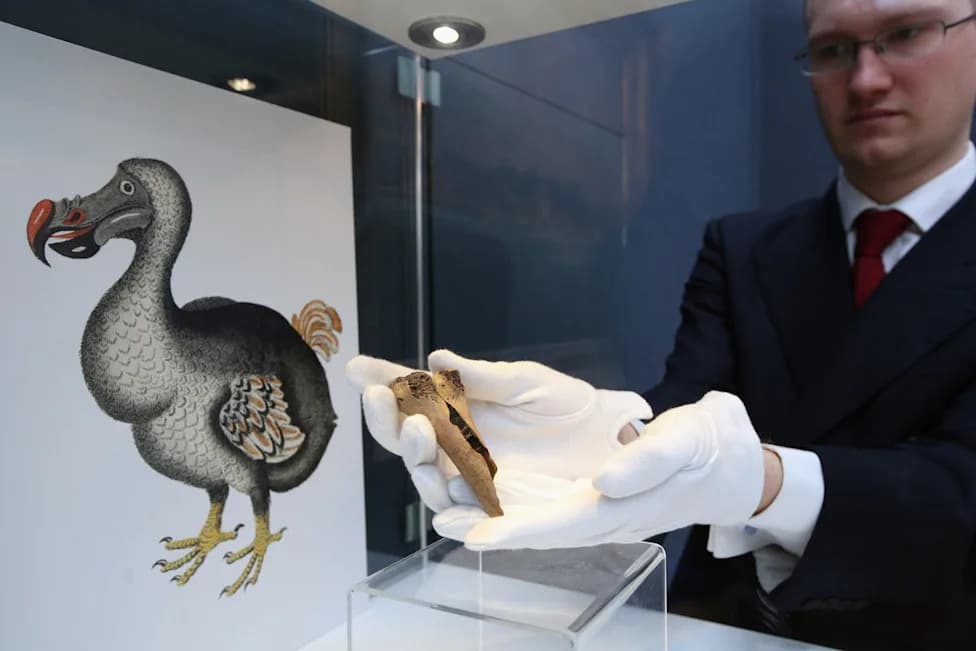
An employee at Christie's auction house holds a rare fragment from a dodo's femur bone (Getty)
New research shows the long-extinct dodo was not the dimwitted symbol of folly it has long been made out to be. CT scans of dodo skulls in museum collections reveal that the brain regions tied to cognition were proportionate to the bird’s large body — comparable to those of its pigeon relatives — suggesting intelligence was not the cause of its rapid disappearance.
How researchers reached this conclusion
Scientists used computed tomography (CT) to create high-resolution 3D models of the internal shape of three dodo skulls. Because a bird’s brain leaves an imprint on the inside of the cranium, these “endocasts” let researchers estimate brain-region sizes long after soft tissue has disappeared. The scans were compared with a range of living and extinct pigeon species, including the Rodrigues solitaire, the dodo’s closest relative and the largest pigeon known to science.
Findings and interpretation
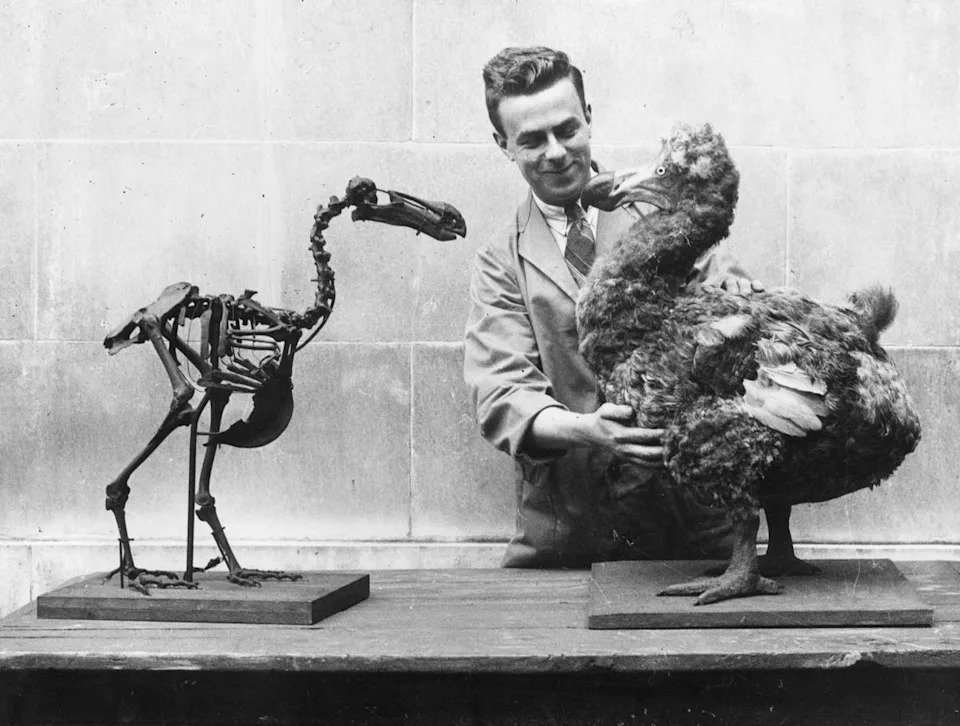
A dodo skeleton opposite a reconstructed model of the extinct bird in the National Museum of Wales, Cardiff (Getty)
The team found the dodo’s forebrain — the area linked to higher cognition and problem solving — was about the size expected for a bird of its bulk. “There is no evidence that the dodo was any less intelligent than its relatives, and we know that pigeons are pretty smart,” said Andrew Iwaniuk, the study’s senior author.
Researchers argue the dodo’s reputation for foolishness stems from behaviour, not brainpower. Early sailors described dodos approaching people without fear and clustering around distressed group members, behaviours typical of island species that evolved with few predators and thus little reason to fear large animals — including humans. That trusting behaviour made dodos easy to hunt and contributed to their extinction after Dutch sailors reached Mauritius in 1598.
Other anatomical clues
The scans also revealed slightly larger-than-expected eyes paired with unusually small optic lobes (the brain region that processes vision). This combination appears in birds adapted to low-light activity, such as some nocturnal or crepuscular species. Co-author Vera Weisbecker notes similar patterns in the Australian night parrot and the New Zealand kakapo, suggesting the dodo may have foraged at dusk or during the night — a behavior unknown among more than 300 pigeon species.
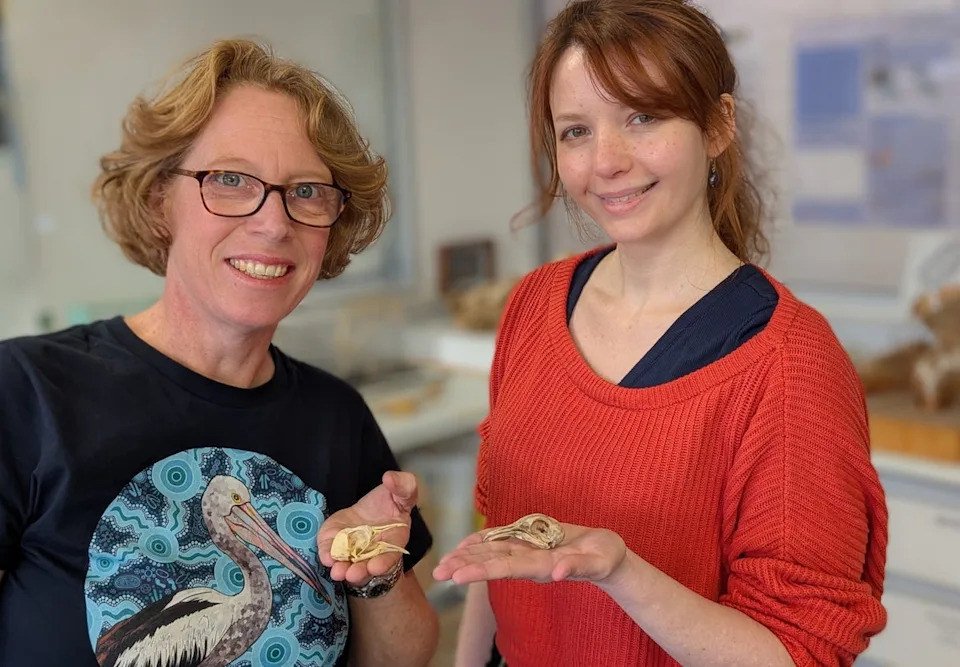
Vera Weisbecker and Aubrey Keirnan with pigeon skulls (A Keirnan/Flinders University)
The olfactory (smell) region of the dodo’s brain also appeared relatively large compared with some pigeons and the solitaire, hinting that scent may have been important for finding food. However, the authors caution that comparative data are limited, and this conclusion remains tentative.
Limits and legacy
The study used specimens from the Smithsonian Institution (Washington), National Museums Scotland and the Natural History Museum of Denmark. No complete dodo skeleton from a single individual survives; most knowledge comes from scattered bones recovered in Mauritius and from sailors’ sketches and accounts. The researchers have released their scan data publicly to encourage further study and testing of their conclusions.
“Calling these birds stupid because they trusted humans risks implying they deserved their fate,” said lead author Sara Citron. Island life shaped behaviour, not cognitive inferiority.
What this means
Rather than being inherently unintelligent, the dodo appears to have been a large, possibly crepuscular pigeon with normal cognitive capacity for its size. Its tragic extinction was driven by human arrival and introduced predators, combined with behaviours shaped by a predator-free island environment.
Help us improve.