Researchers have proposed a theoretical, programmable device that directs thermal radiation differently in opposite directions and retains that setting without continuous power. The design breaks Kirchhoff reciprocity using a magnetically biased indium arsenide layer combined with a nonvolatile GST phase-change grating that locks the response. It works near normal incidence (~3°), improving practical integration, but remains unfabricated and faces engineering challenges around GST thickness and cycling. Potential applications include infrared sensing and advanced radiative heat management.
Physicists Propose Programmable Material That Directs Heat and Remembers Its Setting
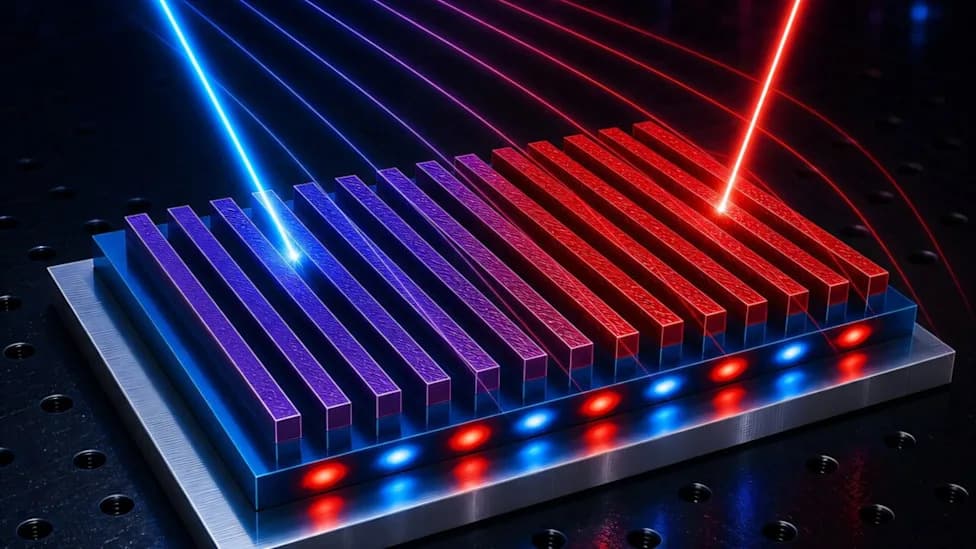
Blue and red laser shooting into series of rectangles.
Researchers have proposed a theoretical material system that can be "programmed" to control how it emits and absorbs thermal radiation—and retain that setting without continuous power. If realized, the approach could enable more efficient thermal management and even information storage based on heat rather than electricity.
How the Design Works
The design, published June 25 in Laser & Photonics Reviews, circumvents a nearly 160-year-old principle in physics linking absorption and emission of thermal radiation. Under ordinary conditions a body that absorbs thermal radiation well from a given direction also emits well in that direction—an idea first formalized by Gustav Kirchhoff—making it difficult to independently control incoming and outgoing radiative heat.
The proposed layered device pairs two complementary materials and uses a magnetic field to break symmetry in a layer of indium arsenide, a semiconductor that interacts strongly with infrared radiation. This magneto-optical bias makes radiation traveling in one direction behave differently than radiation traveling the opposite way (nonreciprocity).
On top of the indium arsenide sits a grating made of the phase-change material germanium-antimony-tellurium (GST). GST can switch between amorphous and crystalline phases and remain in a chosen phase without power. Once the GST is switched, it locks in the directional contrast created by the magnetically biased layer, so the device "remembers" its programmed heat-response even after power is removed.
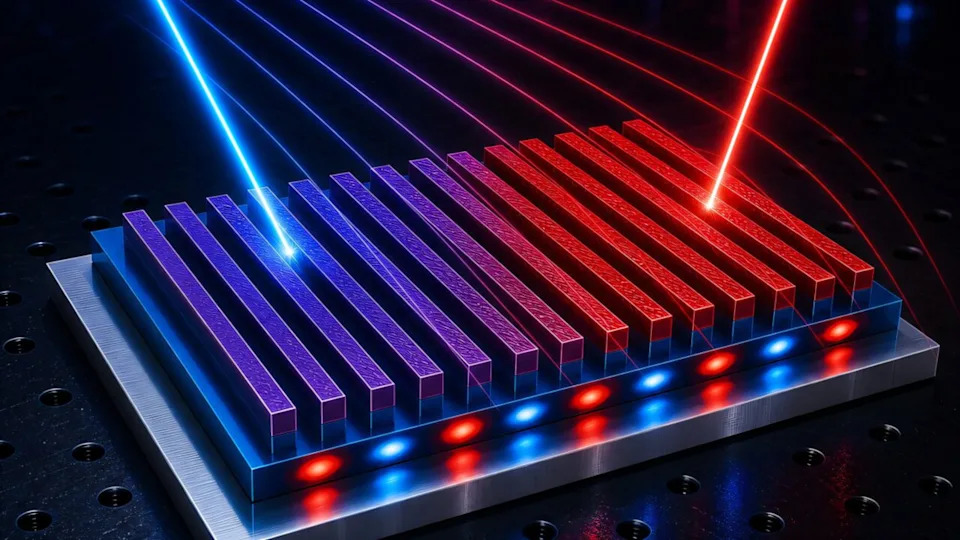
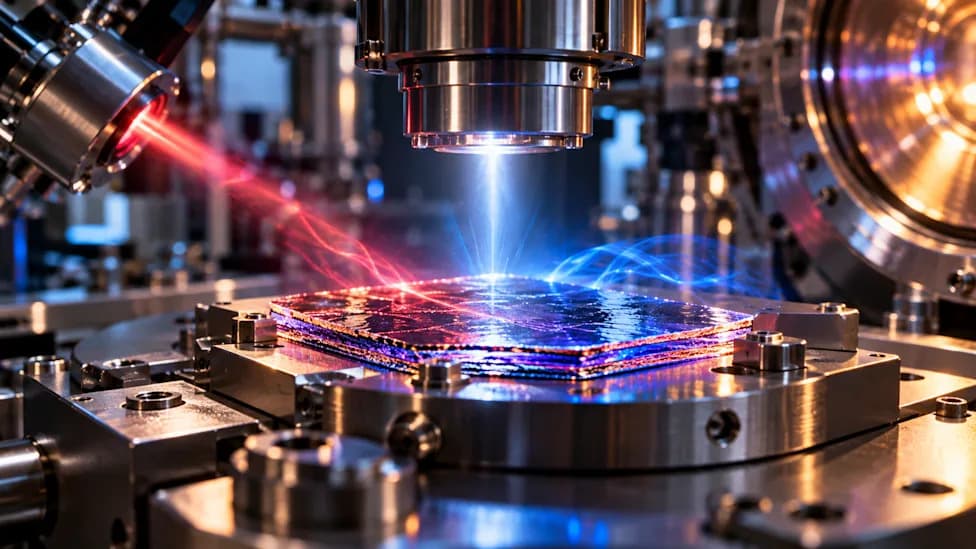
The proposed device uses magnetic fields and a phase-change material to independently control how it absorbs and emits heat. | Credit: Osaka Metropolitan University
Why This Matters
Previous attempts to achieve directional thermal emission often required very oblique incidence angles, limiting real-world integration. The new design shows directional behavior even when radiation arrives only about 3° from normal incidence, a much more practical tolerance for optical and thermal systems.
"I was impressed by the elegant combination of magneto-optical nonreciprocity with a nonvolatile phase-change material," said Juejun Hu, a professor of materials science and engineering at MIT who was not involved in the study.
The authors compare the device's behavior to computer memory because it preserves its programmed state after power is removed. As Hu clarified, the device stores a material phase (GST's atomic arrangement) rather than thermal energy itself: GST simply holds its amorphous or crystalline structure without power, and that persistent state preserves the directional emission and absorption properties.
Practical Status and Challenges
So far the concept is theoretical and has not been fabricated or tested experimentally. The researchers used materials and effects that are well known, so experts consider the idea realistic. However, the GST layer required for the reported effect is relatively thick, and repeatedly cycling thick GST between phases can be technically challenging. The authors and outside experts suggest that alternative phase-change materials or thinner switching layers might address that limitation.
Potential Applications
Early practical uses could appear in infrared sensing, where compact, direction-selective absorption is directly useful. Longer-term applications include advanced radiative heat management in energy systems and devices that encode information in thermal properties instead of electric charge—if fabrication and material challenges are solved.
Bottom line: The study outlines a clear pathway to program directional thermal radiation by combining magneto-optical nonreciprocity in indium arsenide with a nonvolatile phase-change grating, but experimental validation and engineering refinements remain necessary.
Help us improve.