College students from a wide range of majors are increasingly enrolling in AI courses as universities add minors, majors, certificates and graduation requirements aimed at non–computer science students. Institutions including VCU, Northwestern, Purdue, Harvard and Ohio State are accelerating approvals and expanding offerings to meet student demand and employer expectations. While AI tools lower barriers and power new interdisciplinary programs in music, healthcare and the arts, educators warn that overreliance on AI could undermine foundational skills.
Colleges Rush to Teach AI Across Majors as Demand and Jobs Shift

Faith Maeba, a student at Virginia Commonwealth University, poses for a portrait with her tablet at her home Monday, July 20, 2026, in Stafford, Va. (AP Photo/Moriah Ratner)(AP Photo/Moriah Ratner)
With no coding background, Faith Maeba, a 21-year-old psychology senior at Virginia Commonwealth University, was hesitant when her mother suggested taking classes on artificial intelligence. But as she researched graduate programs that study workplace behavior — a field being reshaped by machine learning — she changed her mind and is now pursuing an AI minor.
“It’s giving me an edge and helping me stand out,” Maeba said.
AI Across the Curriculum
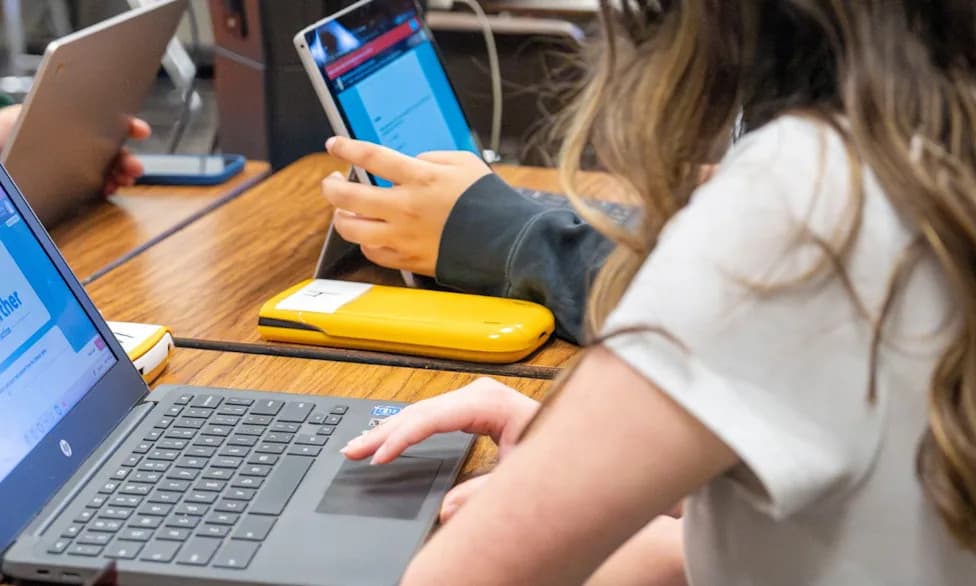
Even as hiring for entry-level software developers has cooled and enrollment in traditional computer and information science majors has dipped, demand for AI instruction from students in other fields is surging. Professors report larger-than-ever enrollments from non–computer science majors seeking a working literacy in AI.
“We have to democratize it,” said Peter Stone, chair of computer science at the University of Texas at Austin, who created an introductory AI essentials course for non–computer science students. “In the same way that everybody needs some degree of math, reading and writing, I think everybody needs a degree of AI literacy.”

Faith Maeba, a student at Virginia Commonwealth University, shares an assignment she completed assignment for her Practical AI Synthesis course at her home, Monday, July 20, 2026, in Stafford, Va. (AP Photo/Moriah Ratner)(AP Photo/Moriah Ratner)
New Programs and Requirements
Institutions are responding with a mix of minors, majors, certificates and new graduation rules. Virginia Commonwealth University is rolling out AI minors for non–computer science students. Purdue University has introduced an AI graduation requirement. Harvard is teaching first-year students how large language models work while examining legal and ethical topics such as copyright and disinformation. Ohio State requires AI fluency and hands-on workshops. At the same time, more AI-focused undergraduate and graduate degrees are appearing nationwide.
Northwestern University, which saw a boom in computer science popularity before the arrival of ChatGPT, is converting some of that energy into cross-disciplinary offerings. The department is adding an AI major, expanding an existing AI minor and easing prerequisites so nonmajors can take machine learning and AI courses more easily.
Interdisciplinary Reach
Music, art and theater programs are increasingly incorporating AI. Northwestern’s Bienen School of Music now offers a certificate in music and artificial intelligence. At Eastern Mennonite University, a planned course will bring musicians, artists and theater students together with math, computer science and engineering majors to build skills at the intersection of art and technology.
“In my mind, AI is no more disruptive than the record player, the radio, the metronome, the synthesizer or the computer,” said Benjamin Guerrero, assistant music professor at Eastern Mennonite.
Faster Course Approval, Community College Agility
Universities that once took a year or more to approve new courses are now moving in months or weeks. Community colleges, where approval processes are often lighter, are able to launch short noncredit classes and occupation-specific training quickly. One suburban Kansas City college offered a noncredit “vibe-coding” course to teach nontechies how to build working software, while Johnson County Community College is designing AI classes for fields such as human resources and healthcare.

Faith Maeba, a student at Virginia Commonwealth University, poses for a portrait with her tablet at home Monday, July 20, 2026, in Stafford, Va. (AP Photo/Moriah Ratner)(AP Photo/Moriah Ratner)
“What AI does is shrink that distance between a complete novice and an expert,” said Grant Carlson, program coordinator for workforce development and continuing education at Johnson County Community College.
Benefits and Warnings
AI tools make coding and data work more accessible for STEM students and newcomers alike, lowering the traditional learning curve. But educators also voice caution: relying too heavily on AI to generate code or do analytic work can leave students without a deep understanding of fundamental concepts.
“When you ask the AI to do it for you, on the surface it might just seem it is writing the code,” said Murtaza Ali, a doctoral candidate at the University of Washington. “But under the hood, it’s also doing the understanding of the task for you.”
Faculty are also tailoring instruction to diverse student goals — from practical workplace applications to philosophical and scientific questions about intelligence and creativity. For VCU music composition student Althea Pappas, AI study raises existential questions: “What happens when we create actual life, or how do we even make that distinction?”
Meanwhile, aspiring neurologist Makenzie Stovall said she studies AI because of its parallels to the brain: “If I’m going to try to make people’s brains the best they can be, why not study AI?”
Reporting note: This article was produced by The Associated Press. AP is solely responsible for its content. For AP's standards and a list of supporters, see AP.org.
Help us improve.