A new model in Current Biology (2026) proposes that vertebrate paired retinas evolved from a single median eye present in a worm-like ancestor about 600 million years ago. Researchers from Lund University and the University of Sussex argue that a central light-sensitive organ persisted during a sedentary phase and was later repurposed and expanded to form left and right retinas as descendants became more mobile. Comparative developmental and cellular evidence — including a 2024 lamprey study — supports the idea that many retinal cell types were present early in vertebrate evolution, though no direct fossil evidence yet confirms the scenario.
Our Two Eyes From One 'Cyclops'? New Model Traces Vertebrate Retinas to a Single 600-Million-Year-Old Median Eye
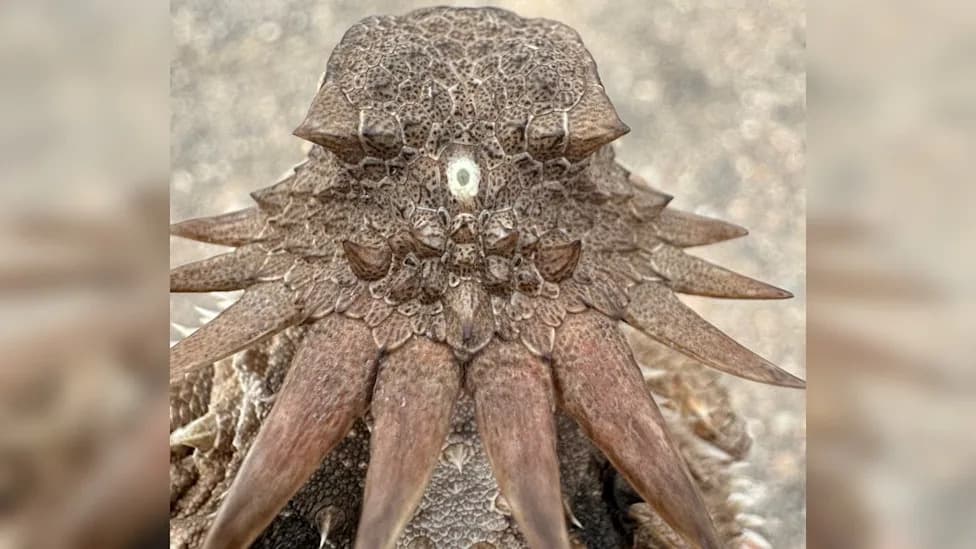
A median (parietal) eye on the head of a regal horned lizard. (© Bruno Frías Morales/iNaturalist/CC BY 4.0)
The human eye — one of nature's most intricate sensory systems — may trace its origin to a small, worm-like marine ancestor that bore a single light-sensitive organ in the center of its head. A new evolutionary model published in Current Biology (2026) proposes that paired vertebrate retinas evolved by repurposing components of this ancient median eye.
What the Model Proposes
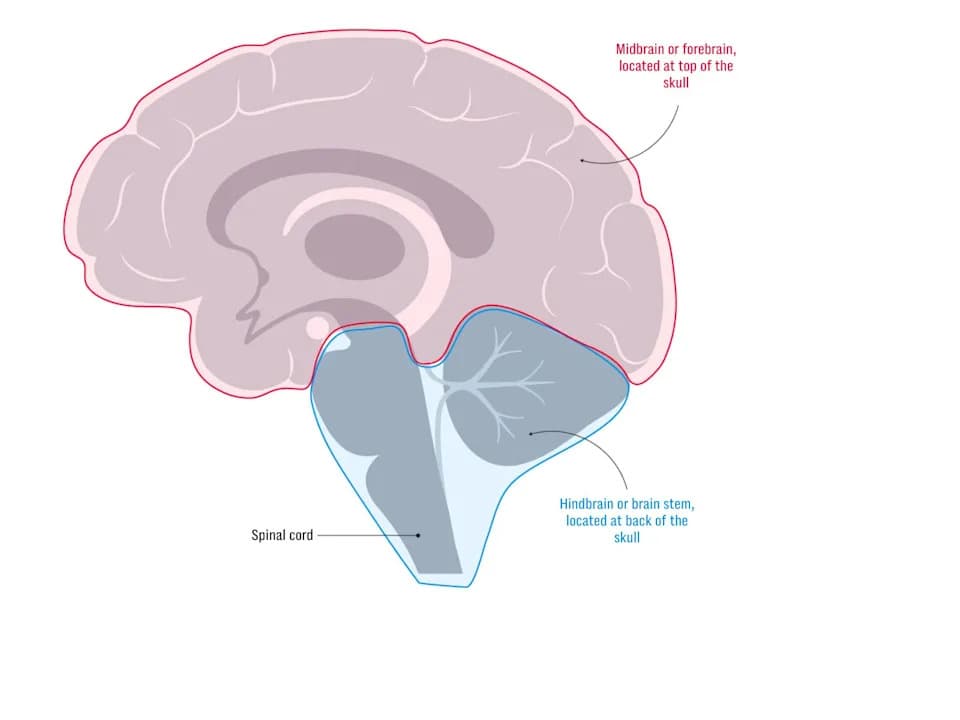
Researchers Dan-Eric Nilsson (Lund University), George Kafetzis, Michael J. Bok and Thomas Baden (University of Sussex) synthesized comparative data on photoreceptor types, visual organs and neural circuits across animal groups to reconstruct a plausible pathway for eye evolution. They suggest that a burrowing, filter-feeding ancestor — roughly 600 million years ago — lost much of its lateral light-sensing apparatus during a sedentary phase but retained a central cluster of light-sensitive cells that formed a simple median eye.
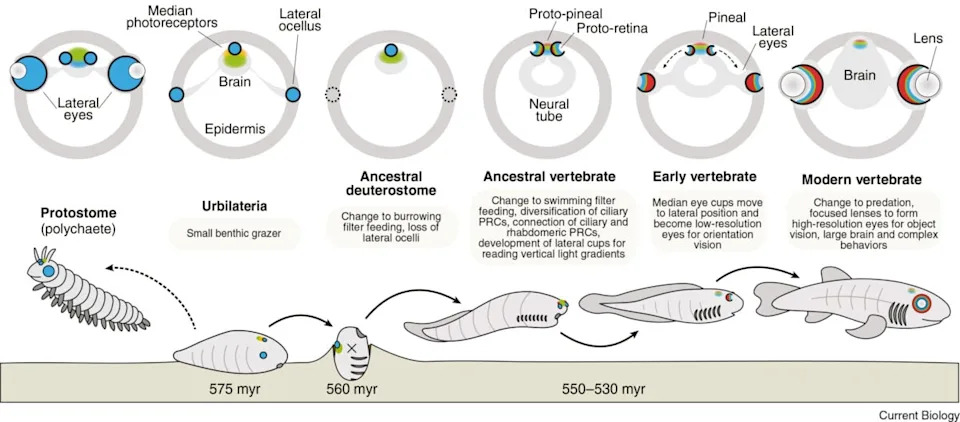
Repeated lifestyle changes drove the unique evolution of vertebrate eyes. Repeated lifestyle changes drove the unique evolution of vertebrate eyes. (Kafetzis et al.,Curr. Biol., 2026)
When descendants of this lineage later adopted a swimming, more mobile lifestyle, selection favored improved vision. Rather than reinventing an eye from scratch, evolution may have redeployed and laterally expanded cells and neural circuits from the median organ to form the separate left and right retinas, as well as the pineal and parapineal systems found in early vertebrates.
Developmental and Cellular Evidence
Developmental differences support a distinct vertebrate route: the vertebrate retina forms as an outgrowth of the brain, whereas many invertebrate eyes (for example, insect and cephalopod eyes) develop from surface head tissues. The model helps explain why vertebrate retinas combine cells from two ancient photoreceptor lineages: ciliary photoreceptors (rods and cones) that transduce light into electrical signals, and circuit-forming cells (ganglion, amacrine and horizontal cells) related to rhabdomeric photoreceptors that help process and relay visual information.

Subscribe to ScienceAlert's free fact-checked newsletter
Crucially, comparative cellular studies — including a 2024 Nature Communications study that found conserved retinal cell types in sea lampreys, mice, chickens and zebrafish — support the idea that many building blocks of vertebrate visual circuits were present early in vertebrate evolution.
Evidence Limits and Implications
No fossil of a one-eyed 600-million-year-old animal has been found. The proposal is an evolutionary reconstruction based on modern comparative anatomy, developmental biology and neural-circuit data, not direct fossil evidence.
If the model is correct, two features of our visual biology — the paired retinas that enable stereoscopic vision and the pineal-related system that helps regulate circadian rhythms — could both be inheritances from a single primitive median eye in a very early vertebrate ancestor.
Why This Matters
This reconstruction offers a coherent explanation for how complex retinal circuits could assemble by reorganizing existing cell types and pathways rather than inventing entirely new structures. It also highlights how changes in lifestyle (sedentary filter-feeding versus active swimming) can reshape sensory systems across deep evolutionary time.
Citation: Nilsson, D.-E., Kafetzis, G., Bok, M. J., & Baden, T. (2026). Current Biology. Supporting comparative work: Nature Communications (2024).
Help us improve.