Inflation and uneven AI-driven growth are eroding GOP midterm prospects. Polls show weak approval for President Trump on the economy and inflation, and Kalshi prices Democrats’ chance to win the House at roughly 82%. Rising gas costs recently outpaced wage gains, while massive AI investment has concentrated benefits in a small group of firms—leaving many households behind and making swing districts vulnerable to Democratic gains.
Inflation Sours GOP Midterm Hopes As AI Boom Deepens Economic Divide

President Donald Trump with U.S. Attorney General Pam Bondi (left) and Senator Ashley Moody, R-Florida (right), to honor the 2025 NCAA Men's College Basketball Champions, the University of Florida Gators, at the White House in Washington, D.C. Moody is running in 2026 to retain the Senate seat to which she was appointed. (Samuel Corum/AP 2025 file)
As summer dwindles and midterm campaigns heat up, Republicans face a difficult political landscape: a persistently sour economy for many voters and a technology-driven boom that benefits a relatively small slice of the electorate.
Economy and Voter Sentiment
Voters increasingly view the economy unfavorably, and President Trump bears much of the blame. RealClearPolitics polling shows Mr. Trump with a 38% favorable rating on the economy and 59% unfavorable; on handling inflation his ratings are roughly 30% favorable and 67% unfavorable. Market prediction platform Kalshi currently prices Democrats’ chances of winning the House at about 82%.
Prices, Wages and Everyday Pain
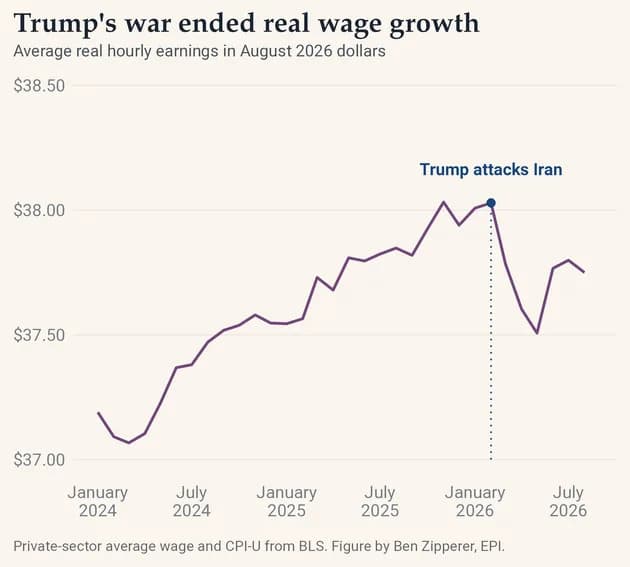
The arithmetic is straightforward: higher gasoline prices have pushed consumer prices up. From February to June, rising fuel costs added an estimated 1.6 percentage points to consumer prices while wages rose by about 1 percentage point. That gap may look small on paper, but after five years of accelerated inflation it registers strongly with households struggling to pay for essentials like gas and groceries.
Jobs, AI and a K-Shaped Outcome
Layoffs have slowed, yet job-security fears remain. Last year’s mix of AI adoption and a post-COVID correction following overhiring created a sluggish and uneven labor market. Some CEOs—including Jack Dorsey at Block—argued AI investments were necessary to stay competitive; critics counter that executives sometimes used AI as a cover for earlier hiring errors.
Overall, jobs separations (voluntary quits plus firings) are lower than during the early periods of the Trump and Biden presidencies, while roughly one-quarter of job seekers report being unemployed for more than six months. Economists describe this as a K-shaped dynamic: some workers—often those tied to the tech and AI boom—see rising incomes, while many others see stagnant or falling real wages and greater precarity.
Investment Winners — And Those Being Left Behind
Investment has bifurcated. Tech giants—Alphabet, Meta, Microsoft, Amazon and Oracle—are estimated to be spending about $800 billion on new AI infrastructure, up from roughly $380 billion last year (about 2.4% of GDP on a net basis). That spending is creating a boom for data-center builders, firms that sell construction equipment, and U.S. manufacturers of semiconductors, power and cooling systems, and fiber-optic cabling.
Examples include Vertiv’s new factory in Pelzer, South Carolina, and Generac’s expansion in Wisconsin. Companies such as Corning (fiber and glass) and Kohler (industrial power-generation business) are also benefiting. Yet investment outside the AI ecosystem remains muted amid uncertainty tied to the war with Iran and legal questions around tariff policy, limiting broader economic momentum.
Markets Reflect The Split
The divergence showed up in corporate profits: from 2022–2024 the so-called Mag7—Alphabet, Amazon, Apple, Meta, Microsoft, Nvidia and Tesla—averaged about 19% annual profit gains while the other 453 S&P 500 firms managed roughly 3% average gains. That gap has begun to narrow: in 2025 Mag7 margins rose about 22% while the other firms increased margins roughly 10%, and FactSet projects continued margin growth for both groups this year.
Political Implications
For voters who own significant stock or work in AI-related industries, the economy may feel strong. For the large share of households without direct market exposure, the picture is more worrying. Thirty-eight percent of U.S. households do not own stock, and many others hold assets primarily in tax-sheltered retirement plans that limit near-term access to gains. That disconnect means the stock-market-driven prosperity will do little to boost incumbents’ standing among many swing voters.
Redistricting has been expected to advantage Republicans—analysts estimate net gains in several maps—but aggressively gerrymandered districts can also create more competitive seats elsewhere. With inflation, tariff-related uncertainty, and international shocks weighing on voter sentiment, Democrats could flip a number of districts that have grown less reliably Republican. If that happens, President Trump could confront a Congress controlled by Democrats after November 4.
Byline: Peter Morici is an economist and professor emeritus at the University of Maryland and a national columnist.
© 2026 Newsmax Finance. All rights reserved.
Help us improve.