Satellite radar observations and deformation models from 2018–2024 indicate that Masaya volcano in Nicaragua hosts two active shallow magma chambers. Distinct ground patterns—subsidence north of the Santiago crater followed by uplift, together with steady crater deflation—are best explained by magma migration between two reservoirs. Masaya sits ~20 km from Managua (nearly 2 million people) and frequently emits SO2 above WHO limits, underscoring the need for continued monitoring and hazard mitigation.
Masaya Volcano Hides Two Active Magma Chambers — A Growing Risk For Nearly 2 Million People
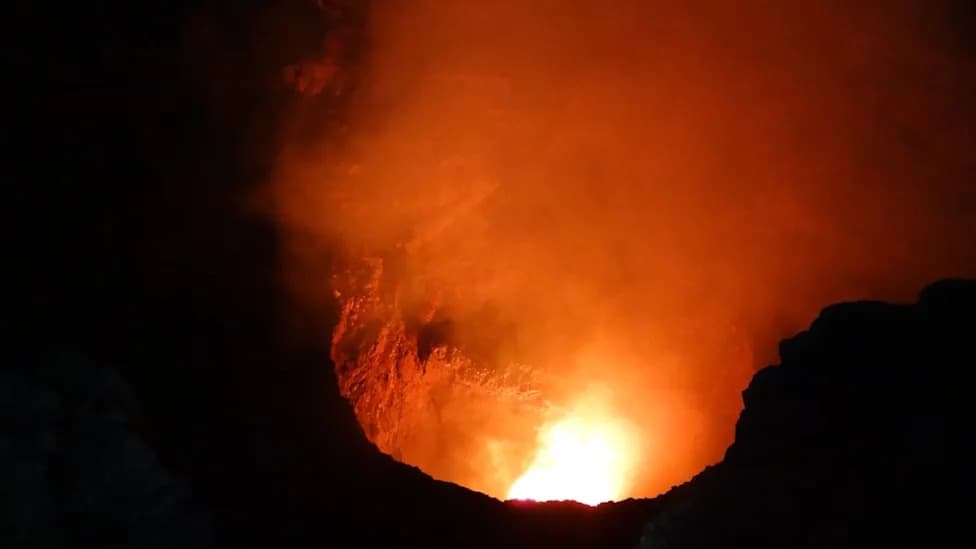
Masaya Volcano. (Leon Petrosyan/Wikimedia Commons/CC BY-SA 4.0)
Scientists report that Masaya, one of Nicaragua's most active volcanoes, contains two active shallow magma chambers. A new study in Geophysical Research Letters combines satellite radar imagery and deformation modeling from 2018–2024 to reveal subtle but sustained ground movements that point to a dual-reservoir system beneath the Santiago crater and surrounding caldera.
What The Study Found
Using long-term satellite radar (InSAR) observations, researchers mapped ground motion around Masaya over six years. The area north of the Santiago crater experienced slight subsidence from 2018 until mid-2022, then uplifted from mid-2022 through 2024. In contrast, the ground immediately surrounding the crater showed steady deflation across the entire study period. This spatially distinct pattern of uplift and deflation is best explained by magma transfer between two separate shallow reservoirs.
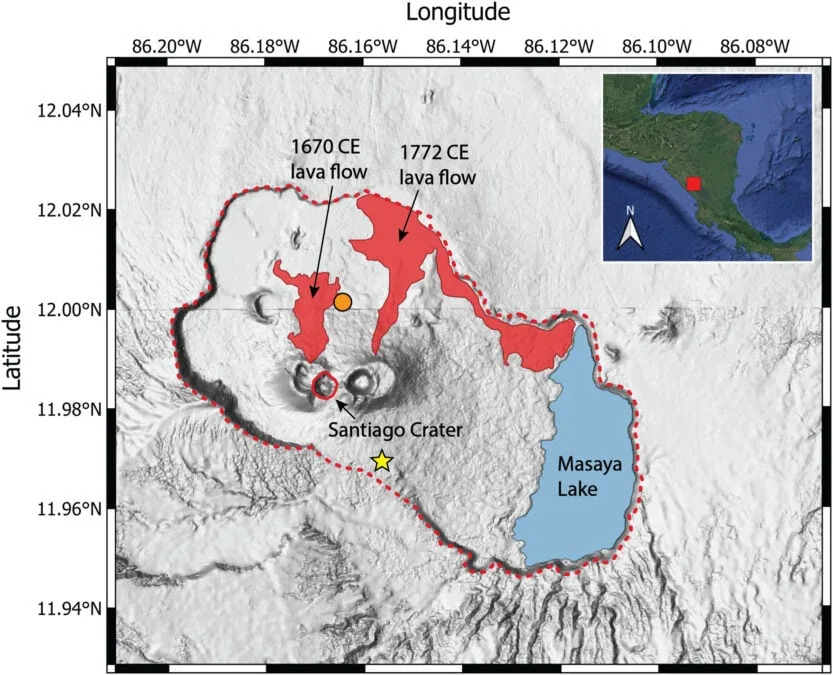
Hill-shade map of Masaya volcano, with the caldera outlined by the dotted red line, the active Santiago crater, which has hosted a lava lake since December 2015, outlined in solid red, and Masaya Lake and previous lava flows labeled. (Johnson et al.,Geophys. Res. Lett., 2026)
The authors describe the inferred plumbing as "interestingly similar" to the layout beneath Kīlauea: multiple interconnected shallow magma chambers that can exchange magma and volatiles, producing a range of surface behaviors from persistent lava lakes to intermittent explosive activity.
Historical Context And Current Activity
Masaya is a basaltic shield volcano that has hosted a lava lake in the Santiago crater since December 2015 and has been nearly continuously active since the mid-1500s. While shield volcanoes typically produce fluid, effusive eruptions, Masaya has produced at least four caldera-forming Plinian eruptions in its geologic history and much larger events about 30,000 and ~6,500 years ago—the latter reportedly among the largest eruptions worldwide in the past 10,000 years. Its last major lava flow occurred in 1772 and remained largely confined to the caldera.
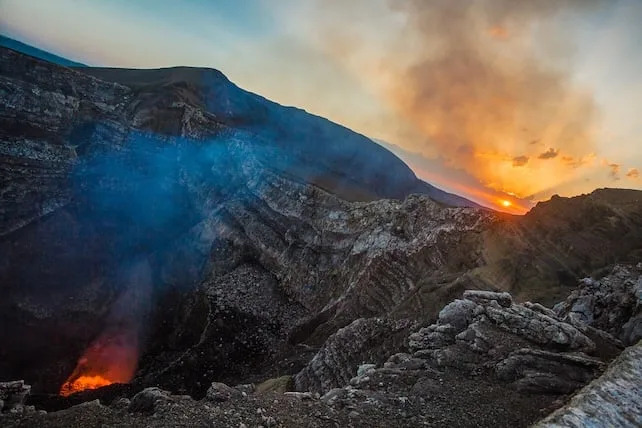
Masaya Volcano National Park. (Jorge Mejía Peralta/Flickr/CC BY 2.0)
Hazards And Human Impact
Masaya lies roughly 20 km southeast of Managua, placing nearly 2 million people within the zone of potential impact. Beyond the immediate hazards of lava and explosive eruptions, chronic degassing from Masaya regularly pushes atmospheric sulfur dioxide (SO2) concentrations above World Health Organization air-quality guidelines, posing long-term public-health concerns for nearby communities.
"Masaya volcano sits within 20 km of 2 million people and is a popular tourist destination due to its lava lake, making it critically important to understand transitions in its behavior and shallow magma processes," the authors write.
Why The Two-Chamber Model Matters
Recognizing multiple shallow magma reservoirs helps explain Masaya's alternating effusive and explosive behavior and improves eruption forecasting. Multi-chamber systems can change the timing, style, and intensity of eruptions when magma migrates between reservoirs or when volatile-rich magma intrudes upward. The study's authors call for continued long-term geodetic monitoring and modeling to better capture these dynamics and to support more effective hazard mitigation.

Subscribe to ScienceAlert's free fact-checked newsletter
Study Source: Geophysical Research Letters (data and models from 2018–2024).
Implication: The dual-chamber architecture beneath Masaya highlights the need for sustained monitoring and public-health planning for communities and visitors near the volcano.
Help us improve.