New analysis shows textile production leaks tens of thousands of tonnes of microfibres each year. Earth Action estimates over 92,000 tonnes are lost in production annually, with about 63% (roughly 58,000 tonnes) entering the environment. Washing, dyeing and finishing are the main sources; Bangladesh, Pakistan and China are major contributors. The report argues that combined production changes, wastewater treatment and proper sludge management could reduce leakage by up to 95%.
Textile Production Leaks Tens of Thousands of Tonnes of Microfibres—Combined Fixes Could Cut Emissions by Up to 95%
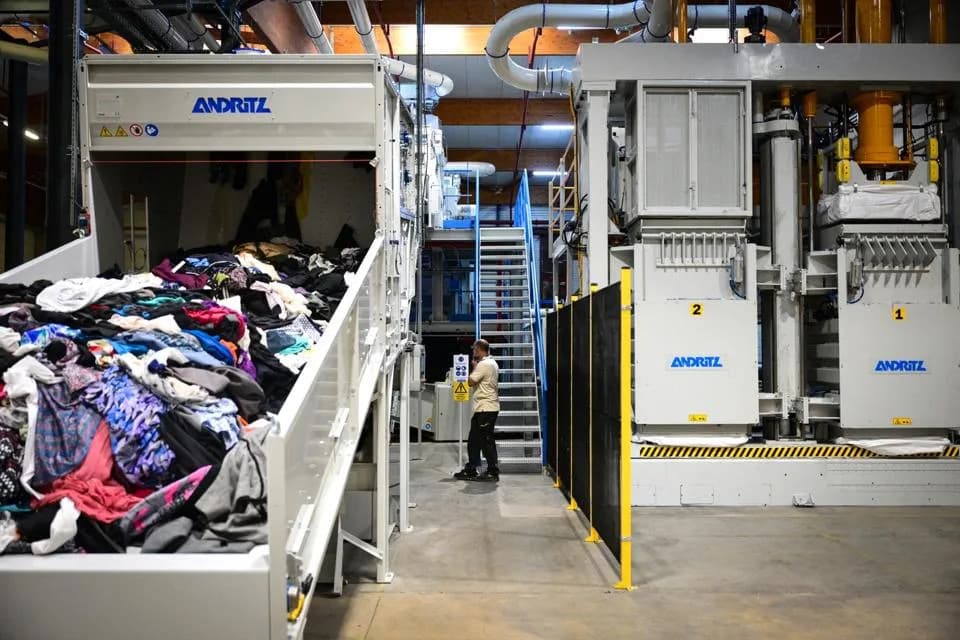
An employee stands next to machinery at the French textile recycling company Nouvelles Fibres Textiles - Les Tissages de Charlieu, which produces secondary raw materials for textile companies, in Amplepuis, central France, on June 2, 2025. (Photo by OLIVIER CHASSIGNOLE / AFP) (Photo by OLIVIER CHASSIGNOLE/AFP via Getty Images)AFP via Getty Images
Photo: An employee stands beside machinery at French textile recycler Nouvelles Fibres Textiles - Les Tissages de Charlieu in Amplepuis, central France (Photo by OLIVIER CHASSIGNOLE/AFP via Getty Images).
A new analysis from research consultancy Earth Action finds that textile production releases tens of thousands of tonnes of microfibres into the environment every year. The study estimates more than 92,000 tonnes of microfibres are lost across production processes annually, with roughly 63% (about 58,000 tonnes) escaping into natural systems.
Key Findings
Earth Action traces most losses to wet processing stages—finishing, dyeing and washing—with washing alone accounting for the largest share of intrinsic production losses. The report breaks down the production-stage losses as follows: washing 49%, dyeing 24% and finishing 7%.
Regional Hotspots
Production-phase losses are concentrated in major textile-manufacturing countries. About 25% of global production losses occur in Bangladesh, 17% in Pakistan and 12% in China. When the analysis shifts to actual environmental leakage—accounting for differences in wastewater treatment and sludge practices—the distribution changes: Bangladesh is estimated to contribute 24% of global microfibre emissions, China 15% and Pakistan 11%.
Wastewater Treatment, Sludge Management—and Limits of Capture
The report highlights that wastewater treatment can dramatically reduce microfibres in water where it is deployed—by around 82%. However, Earth Action cautions that capture is not elimination: if captured fibres are disposed of in unmanaged sludge, pollution is simply shifted from water to land. For this reason the authors argue that wastewater treatment and sludge management must be treated as integrated parts of the same system.
Alone, advanced wastewater treatment is estimated to reduce total leakage by only 6%, while switching all facilities to well-managed sludge disposal could reduce leakage by 43%. Deployed together, these measures reinforce each other and unlock far greater reductions than either would alone.
Potential For Large Reductions
Earth Action co-founder Sarah Perreard says collective action across production, treatment and disposal could cut microfibre leakage by as much as 95%. She highlights a domino effect: if a brand asks a mill to implement changes, other brands using the same mill benefit—so targeted action can scale.
“By working in production sequence and at all levels—what brands can do, what textile mills can do and what governments can do—we see real potential for significant reductions,” Perreard told the author.
Industry View
Matt Dwyer, Vice President of Global Product Footprint at Patagonia, described microfibre shedding as a pervasive pollution issue across industries and product lifecycles, and urged partnership and collective action to accelerate solutions.
Bottom line: The textile sector releases substantial microfibre pollution, but targeted production improvements, widespread wastewater treatment and responsible sludge management—deployed together—offer a credible pathway to slash emissions and protect both water and land.
Help us improve.