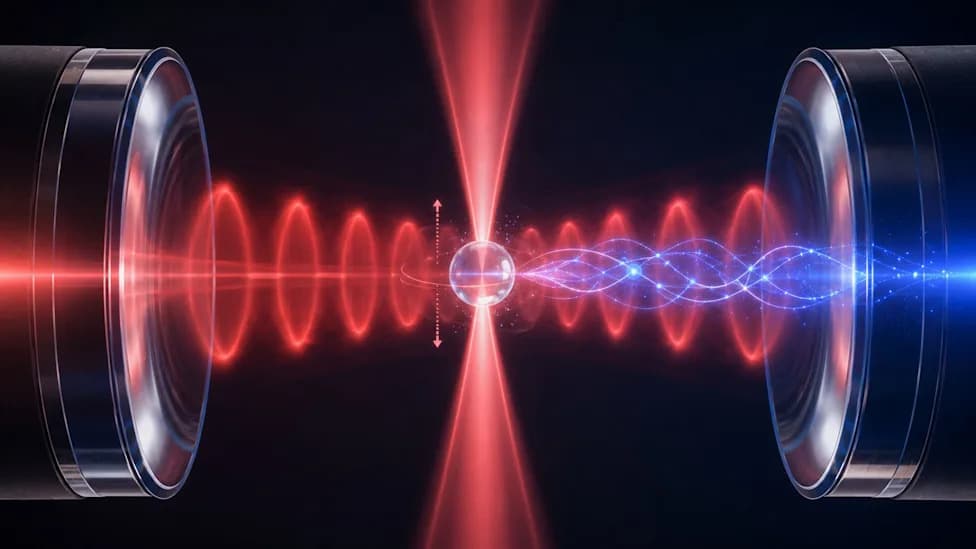
ISTS and TUM Confirm 20-Year-Old Entanglement Theory. Scientists used an autonomous "quantum bath" of microwave photons to stabilize entanglement between spatially separated qubits, creating a stationary, on-demand entangled resource. The team verified synchronization with nanosecond microwave probes; the prototype routed photons through ~50 cm of cable and currently transfers about 10% of available entanglement. While active-control methods remain more efficient today, the scalable framework could enable larger quantum networks and hybrid quantum systems.
After 20 Years, Scientists Experimentally Confirm Quantum Entanglement Theory Using an Autonomous "Quantum Bath"

(Tony Melov/Canva)
Researchers at the Institute of Science and Technology Austria (ISTA) and the Technical University of Munich (TUM) have experimentally confirmed a two-decade-old theory of quantum entanglement by using an autonomous "quantum bath" of microwave photons to stabilize entanglement between spatially separated qubits.

YouTube Thumbnail
What the team did. Instead of relying on precisely timed, active control signals or matching emitted photons from each qubit, the researchers fed a low-energy microwave field—the quantum bath—into two distant qubits. The bath drives the system into a stationary, stabilized entangled state that remains available on demand rather than oscillating or decaying rapidly.
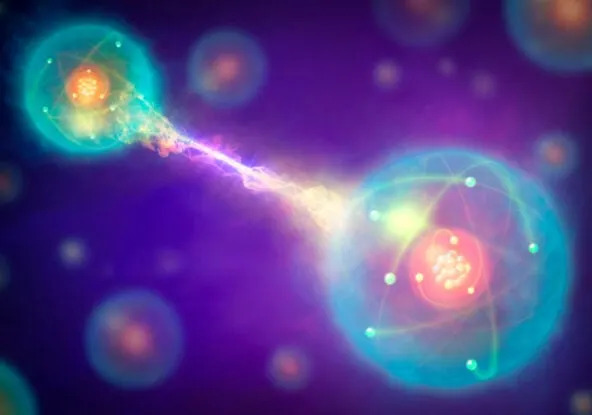
An artist's rendition of two entangled particles, whose characteristics are linked. (Mark Garlick/Science Photo Library/Getty Images)
How they verified it. The team confirmed synchronization of the qubits using extremely short microwave probe pulses lasting on the order of a nanosecond (billionths of a second). Their measurements show that the qubits share the targeted correlated quantum state predicted by the 20-year-old theory.
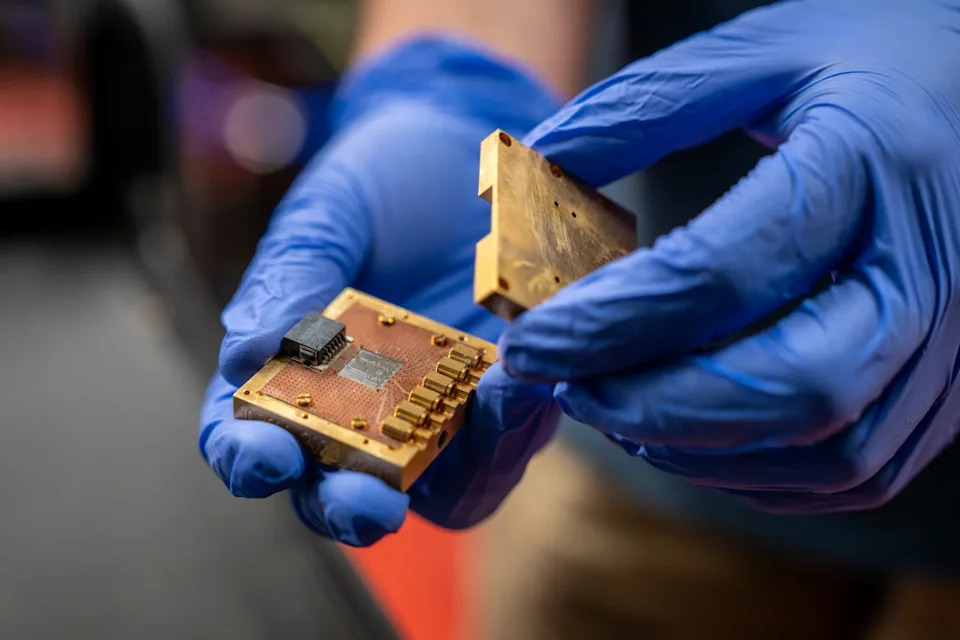
The "quantum bath" device used to deliver entangled microwave photons to the qubits.(ISTA)
Practical details and limits. In the laboratory implementation the entangling microwave photons traveled about 50 centimeters (20 inches) of cable between components, though the authors say the scheme is, in principle, applicable over much longer distances. The current prototype transfers roughly 10% of the bath's available entanglement to the qubits, so established active-control techniques remain more efficient today. The experiment also required cryogenic infrastructure typical of superconducting qubit platforms.

Subscribe to ScienceAlert's free fact-checked newsletter
Why it matters. Stabilized, on-demand entanglement can act as a persistent resource for quantum processors and networks. The approach may scale to synchronize multiple, distant qubits and could enable hybrid systems that bridge different frequency domains—such as optical photons and microwaves—allowing disparate quantum hardware to interoperate.

YouTube Thumbnail
"In this work, we aimed to overcome the mismatch between the readily available and the practically useful forms of entanglement," said Alejandro Andrés-Juanes, the study's first author. "By stabilizing the entangled states remotely, our approach is fully autonomous and requires no active control or measurement." Johannes Fink, the study's senior author, added: "The entangled qubit state is stabilized, even beyond the qubits' own 'lifetime', and remains available as a resource for further quantum processing."
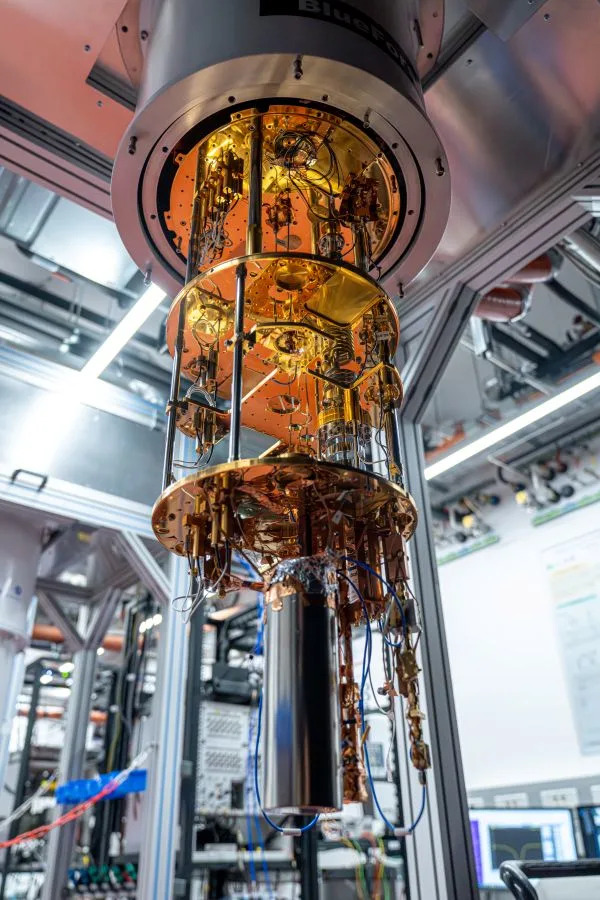
Aquantum computer. The bulk of this machinery (i.e., the golden-chandelier-style structure) comprises the cooling unit necessary to drive temperatures down to nearly absolute zero.(ISTA)
Outlook. Although efficiency and engineering remain to be improved, the experiment—published in Physical Review X—provides a scalable prototype for future quantum networks and hybrid quantum technologies. Improved stabilization could benefit quantum computing, secure communications, optimization problems, and quantum-enhanced materials and drug-discovery workflows.
Help us improve.