Researchers found that switching night lighting to amber 1800 K LEDs — which emit very little blue light — significantly reduced the number of nocturnal insects attracted to lights. A field experiment on six railway platforms in the Westhavelland Dark Sky Reserve compared 2000 K HPS, 4000 K LEDs and 1800 K amber LEDs, with sampling from July–October 2023 and April–June 2024. Analyses used traps, spectroradiometry, AI image recognition and DNA metabarcoding. The authors recommend amber low-blue lighting as a practical step to reduce harm to many night-active insects while calling for further species-level studies.
A Simple Switch: Amber (1800K) LEDs Could Save Millions Of Nocturnal Insects
(0802290022/iStock/Getty Images Plus)
Artificial light at night is an often-overlooked threat to insect biodiversity. New research led by the Leibniz Institute for the Analysis of Biodiversity Change shows a simple change in public lighting — swapping blue-rich lamps for amber LEDs — can substantially reduce the number of insects attracted to night-time lights.
Why Light Matters
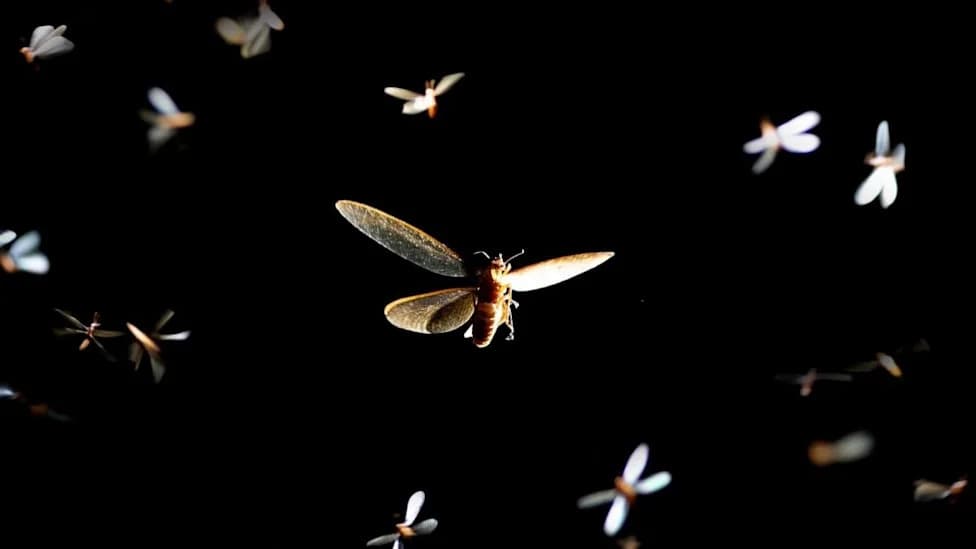
Around 40% of the world's insect species are estimated to be at risk of extinction over the coming decades, driven mainly by habitat loss, pollution, pathogens, invasive species and climate change. Artificial night lighting is among these stressors because it disrupts the natural behaviour of many species: more than 60% of invertebrates are active at night, so light sources in their habitats affect them during their peak activity.
YouTube Thumbnail
It is estimated that around one billion insects are affected every summer night in Germany, often dying from artificial light sources.
Different insects react differently to light. Moths are famously drawn to lamps, where exhaustion or predation can cause heavy losses — some estimates suggest roughly one-third of insects attracted to stationary artificial lights may die before morning. Others, like New Zealand's weta, avoid lit areas entirely, effectively losing access to habitat and resources.
The Study: What They Did
The researchers conducted an experiment at six railway platforms inside the Westhavelland Nature Park, a designated Dark Sky Reserve where platform lights are often left on all night. Before the study the platforms used warm 2000 K high-pressure sodium (HPS) lamps. For the experiment the team left two HPS lamps unchanged, replaced two lamp pairs with cool white 4000 K LEDs, and replaced another pair with amber 1800 K LEDs. Two unlit control sites nearby provided baseline data.
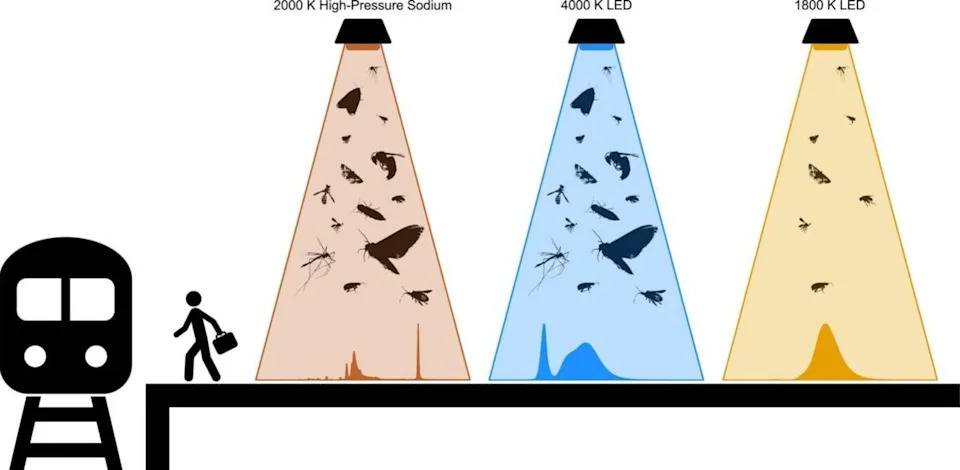
The kinds of light we use at night could make a huge difference for the insects that live alongside us. (Ludreschl et al.,Biol. Conserv., 2026)
Emission spectra of each light type were measured with a spectroradiometer. Insect sampling was carried out with traps from July–October 2023 and April–June 2024, and catches were analysed using AI-based image analysis and DNA metabarcoding to determine numbers, species composition and biomass.
Key Findings
The study found that amber 1800 K LEDs — which have a narrow spectral output and very low short-wavelength (blue) light — attracted significantly fewer individual insects and fewer species, including fewer threatened and legally protected taxa, compared with conventional 4000 K LEDs and 2000 K HPS lamps. The authors attribute the effect primarily to the absence of short-wavelength blue light in the amber LEDs.
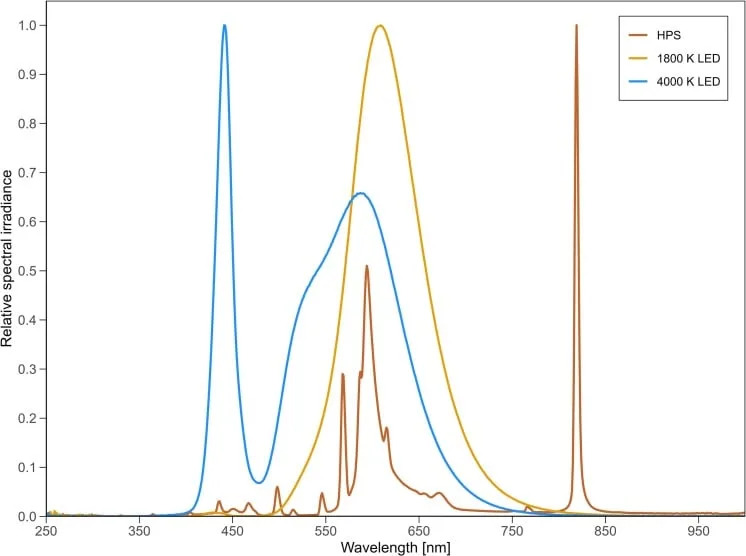
Emission spectra of the tested light sources, measured using a spectroradiometer. (Ludreschl et al.,Biol. Conserv., 2026)
Following the study, all railway platform lights in the Westhavelland Dark Sky Reserve were replaced with 1800 K LEDs as a practical conservation step.
Limitations And Next Steps
The experiment focused on nocturnal flying arthropods; it does not directly address ground-dwelling or non-flying species. The authors also caution that lower attraction to lights does not by itself resolve all ecological consequences of artificial night lighting. They call for further species-level research to understand taxon-specific responses, especially for threatened and legally protected species.
Implications
While not a complete solution, switching to amber, low-blue LEDs offers a readily available, low-cost, and effective measure that cities, transport operators and homeowners can adopt to reduce harm to night-active insects without sacrificing human safety or visibility. The study was published in Biological Conservation.
Help us improve.