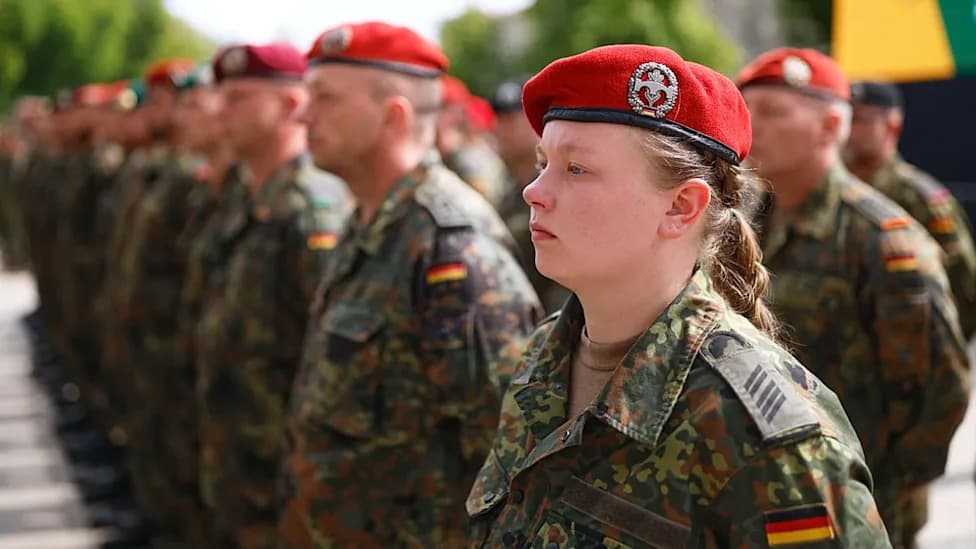
Austrian leaders plan to extend compulsory military service from six to nine months in response to security concerns raised by Russia's war in Ukraine. The reforms would introduce a reservist model with follow-up exercises within 10 years, allow voluntary two-month extensions for civilian service, and raise conscript pay to about €1,000/month. Passage requires a two-thirds parliamentary majority and backing from opposition parties.
Austria to Extend Compulsory Military Service to Nine Months Amid Ukraine War

Austrian Defence Minister Klaudia Tanner, Vice Chancellor Andreas Babler and Chancellor Christian Stocker, July 27, 2026. (Leonhard Foeger/Reuters)
Austria's coalition government announced plans to lengthen compulsory military service from six to nine months, saying the move is required to adapt to a security environment reshaped by Russia's war in Ukraine.
Why the Change?
For decades neutral Austria's armed forces have primarily performed civil-protection duties: assisting emergency responders during floods and wildfires, conducting border patrols to intercept irregular migrants, and supporting civilian authorities. Officials say the forces must be strengthened and better equipped because they would currently struggle to repel a serious external assault.
What the Government Proposes
The package of proposed reforms includes:
- Extending compulsory military service from six to nine months.
- Introducing a reservist model that requires conscripts to attend follow-up exercises within 10 years of their initial service.
- Allowing those in the nine-month civilian alternative to volunteer for a two-month extension.
- Improving recruitment and retention incentives, including additional holiday days and increasing conscript pay to about €1,000 per month.
Leaders' Comments
“The security conditions have changed fundamentally in the past years, months and weeks. The dream of a lasting peace in Europe shattered at the latest with the Russian war of aggression against Ukraine,” Chancellor Christian Stocker said at a press briefing at a military barracks outside Salzburg. He warned that new threats — including hybrid attacks and cyberwarfare — require a reassessment of national defence priorities.
Political and Practical Hurdles
Turning the plan into law will require a two-thirds majority in parliament. That means the government must secure support from opposition parties — most likely the Greens or the far-right Freedom Party — and formal talks have not yet begun. Implementation also implies budgeting for higher pay and training, and building the institutional capacity to run a reservist system with periodic exercises.
Context
Austria is bordered by eight countries; all but Switzerland and Liechtenstein are NATO members. Neighbours include Germany and the Czech Republic to the north, Italy and Slovenia to the south, and Slovakia and Hungary to the east. Officials frame the changes as a step toward greater national self-reliance and improved protection of the population in a more uncertain European security environment.
What to watch next: whether opposition parties agree to the constitutional-majority vote, the timeline for legislation, and how quickly the defence ministry can expand training and funding to meet the new requirements.
Help us improve.