UiO researchers modelled what happens when a mirror is removed while reflecting a photon and found the truncated photon becomes a complex quantum state that can be a superposition of many photon-number outcomes. Removing the mirror can convert vacuum fluctuations into real photons, but the expected number of produced photons is finite — producing infinitely many would require an impossibly fast mirror removal. Observers on opposite sides of the former mirror see locally different results: one side can appear to have a single photon while the other registers vacuum, with a complicated transition region between them.
Can You 'Cut' a Photon? Physicists Show Mirror Removal Creates a Complex Quantum Burst
A visualization of a photon, courtesy of researchers at the University of Birmingham. (Benjamin Yuen/University of Birmingham)
Photons — the indivisible quanta of electromagnetic energy — behave in ways that routinely defy everyday intuition. Massless and able to travel at light speed, photons also display wave–particle duality: depending on how you observe them they can act like waves or like particles, as Thomas Young’s double-slit experiment famously demonstrated.
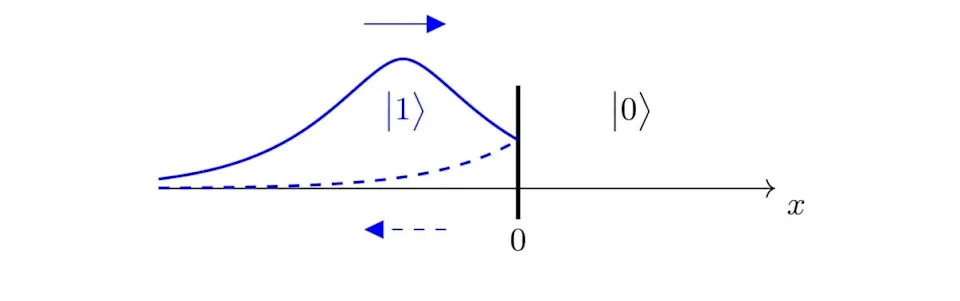
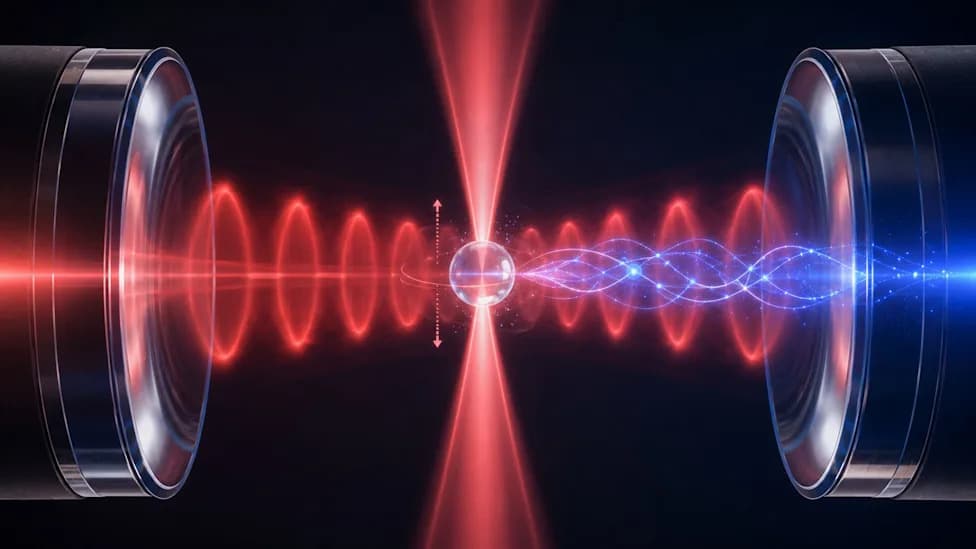
A photon approaching an optical shutter, or mirror, from the left, and being reflected back.(Rukan et al.,Phys. Rev. Lett., 2026)
Researchers at the University of Oslo (UiO) explored a provocative thought experiment: what happens if you "cut" a photon by removing an optical shutter or mirror while it is reflecting the photon? Because a photon is an elementary quantum, it cannot literally be sliced like fruit. Instead, the team modeled the quantum state that results when a mirror is pulled away mid-reflection.

Subscribe to ScienceAlert's free fact-checked newsletter
The calculations reveal that truncating a photon in this way produces a surprisingly complicated quantum state. Rather than producing a simple pair of photons traveling in opposite directions, the act of removing the mirror can produce a superposition of states with different photon numbers. Measured outcomes can, in principle, be zero, a few, many, or arbitrarily large numbers of photons — though not literally infinite in any realistic physical process.
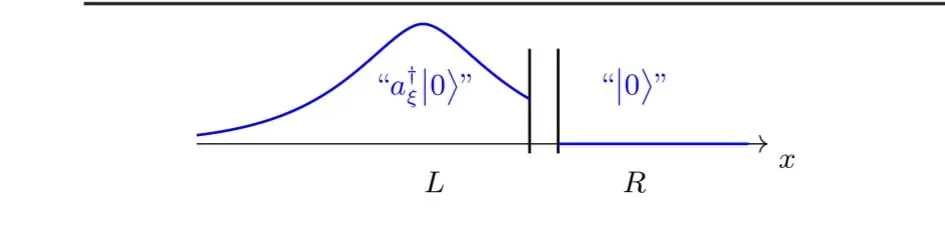
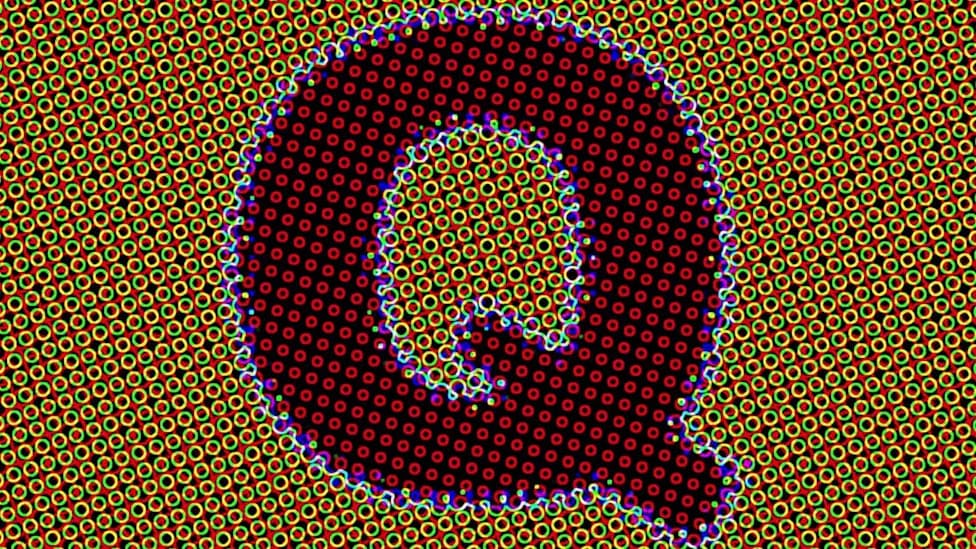
There would appear to be a single photon to the left of the mirror, an explosion of many photons in the transition area in the middle, and zero photons to the right of the mirror.(Rukan et al.,Phys. Rev. Lett., 2026)
"When truncating the photon by removing the mirror, the expected number of produced photons is not infinite," says Johannes Skaar, a theoretical physicist at UiO and co-author of the study. "If the mirror is removed slowly, the number is small; if it is removed quickly, the number is large. But the expected number is never infinite — that would have required infinitely fast mirror removal, which is not possible."
The work also highlights an important quantum effect: even the vacuum is not truly empty. The mirror’s removal can convert vacuum fluctuations into real photon energy, so the process can generate photons that did not exist as detectable quanta before the shutter was moved.
Practically speaking, Skaar notes that photon truncation is not purely a theoretical fantasy. Photons with narrow bandwidths can be extremely long — meters or even kilometers — so a physical mirror does not need to move at impossible speeds to truncate such a photon. How quickly the mirror is removed controls the distribution and expected number of produced photons: slower changes produce fewer photons on average, while faster changes increase the expected count.
Another striking result is the effect’s locality. Outside a narrow transition region near the former mirror position, the resulting mixed state appears locally simple: on one side it looks like a single photon, and on the other side like vacuum, with the complicated burst-like superposition confined to the transition zone.
In short, removing a reflecting mirror mid-reflection transforms a single incoming photon into a rich quantum mixture whose measured photon number can vary widely, while the expected photon count remains finite in any realistic scenario. The authors describe the full state as "rather complicated," and their calculations are published in Physical Review Letters. The work was discussed with ScienceAlert.
Help us improve.