George J. Marlin argues that recent state and city decisions — including a $277 billion state budget dependent on one-time measures, pension rollbacks, a 12% Medicaid increase, and large teacher payments — are worsening New York's fiscal outlook. The author highlights a projected two-year deficit near $32 billion and warns that one-shot revenues and deferred pension contributions expose long-term risk. Marlin also criticizes proposed statutory language changes, a possible 2027 gerrymandering amendment, rising anti-Jewish hate crimes, and controversial primary candidates supported by some local leaders.
New York's Budget Balloon: $277B, One-Shot Fixes and Political Fallout
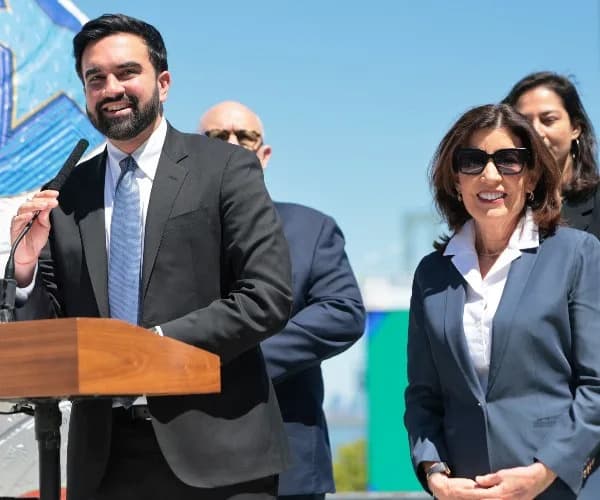
New York City Mayor Zohran Mamdani speaks during a press conference at Staten Island University Hospital Community Park on April 27, 2026 in NYC. Mayor Mamdani was joined by Gov. Kathy Hochul, D-N.Y., government officials and members of the New York New Jersey FIFA World Cup 2026 Host Committee. (Michael M. Santiago/Getty Images)
Opinion by George J. Marlin. After a two-week trip to Europe, the author returned to find New York facing renewed fiscal and political pressures as the state and city finalize budgets and debates about priorities intensify.
Budget and Fiscal Concerns
Two months after the close of the state's fiscal year, lawmakers approved a $277 billion budget — $9 billion more than Gov. Kathy Hochul's original $268 billion proposal. Much of the increase relies on one-time revenues and accounting measures, which Marlin warns push the projected two-year cumulative deficit to roughly $32 billion and raise long-term fiscal risks.
Union Concessions and Education Costs
The plan contains several concessions to public-sector unions. A 2012 pension-reform framework has been set aside in favor of retroactive pension increases for state, municipal and public-school employees, which are estimated to cost taxpayers more than $500 million annually. Medicaid spending — already among the highest per capita in the nation for New York — is slated to rise about 12%, and the budget includes $100 million to support the SEIU's benefit fund.
Education provisions also carry major price tags. A 2022 law caps class sizes at 20 students for kindergarten through third grade, 23 students for grades four through eight, and 25 students for high school. That change obliges New York City to hire an estimated 10,000–12,000 new teachers. To accommodate a requested two-year delay in implementation, the state agreed to "differential pay" for teachers — $8,500 in the first year and $9,500 in the second — which Marlin estimates will total roughly $1.4 billion for the city's more than 80,000 teachers over two years.
Language, Redistricting and Legislative Changes
Legislators have also forwarded a bill to the governor that would replace the words "mother" and "father" in state law with terms such as "gestating parent" and "non-gestating parent." Critics, including Wai Wah Chin of the Manhattan Institute, argue the change is ideologically driven and could affect cultural and legal perceptions of parenting roles.
Separately, lawmakers are proposing a constitutional amendment to repeal the ban on congressional gerrymandering. If voters approve the measure in 2027, it would permit the state legislature to redraw congressional districts without the current statutory constraint — a move that could enable partisan line-drawing.
New York City Budget and Public Safety
At the city level, Mayor Zohran Mamdani's budget relies heavily on one-shot revenues and the deferral of pension contributions to present a balanced plan. Marlin compares such fiscal devices to those that contributed to crises in past decades and cautions they could leave the city exposed to future shocks.
Public-safety concerns have mounted as well: reported hate crimes against Jewish New Yorkers rose roughly 70% in May compared with the same month a year earlier. Marlin criticizes city leadership for what he views as a limited response and points to political activity by some officials as a distraction from public-safety responsibilities.
Political Controversies and Primary Races
Marlin highlights the contentious Democratic primaries as an additional source of polarization. He points to Mayor Mamdani's public support for progressive candidates, including Darializa Avila Chevalier (DAC), who is challenging Rep. Adriano Espaillat in the 13th Congressional District. Marlin summarizes critics' concerns about DAC's past statements and participation in rallies that many viewed as provocative. He argues that prominent Democrats' relative silence on some of these candidacies signals a partisan shift within the party.
Conclusion: This column frames these developments as symptomatic of broader fiscal and political trends that, in the author's view, risk undermining New York's economic stability and civic institutions if not addressed with clearer long-term planning.
George J. Marlin is a former executive director of the Port Authority of New York and New Jersey and author of books on politics and religious persecution. This piece is an opinion column.
Help us improve.