A team led by Xiao Cheng Zeng used unsupervised deep learning on massive GROMACS molecular-dynamics simulations to find molecular evidence supporting the two-state model of liquid water. The AI-derived "reaction coordinates" show two distinct transition pathways: a common single-barrier "semi-loop" and a three-barrier "full-loop" near the high-density/low-density boundary. The researchers are refining their models and urge sensitive experiments to confirm the predicted structures, which could explain water’s many anomalies and affect biological and pharmaceutical science.
AI Reveals Water’s Hidden Flip: Molecules Switch Between Two Distinct Structures
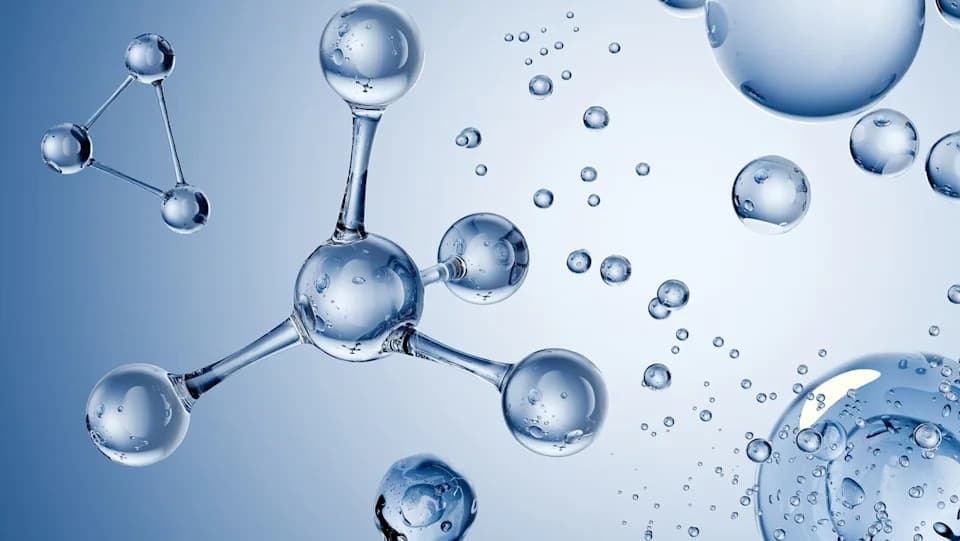
An illustration of a water molecule. New research adds credence to a controversial theory that water actually switches between two chemical structures. | Credit: Yaroslav Kushta via Getty Images
Researchers report computational evidence that liquid water’s molecules can switch between two distinct local structures — a denser arrangement and a less-dense arrangement — supporting a decades-old two-state hypothesis. Using unsupervised deep learning on massive molecular-dynamics simulations, the team mapped how individual water molecules transition between these states and identified distinct conversion pathways with different energy barriers.
Background: Why This Matters
Water displays many unusual behaviors compared with typical liquids: it reaches maximum density near 4 °C rather than continuously becoming denser as it cools, ice floats, and properties such as heat capacity and viscosity behave anomalously under some conditions. Scientists have long suspected a unifying explanation: that water’s local molecular structure can exist in two interconverting states that drive these macroscopic anomalies.
What the Team Did
Led by Xiao Cheng Zeng at the City University of Hong Kong, the researchers ran enormous molecular-dynamics simulations with the GROMACS package, tracking hundreds of thousands of water molecules and generating tens of millions of data points. Postdoctoral researcher Liwen Li applied unsupervised deep learning to that raw simulation data to discover compact "reaction coordinates" — a few distilled variables that describe how a molecule’s local environment changes between denser and looser structures.

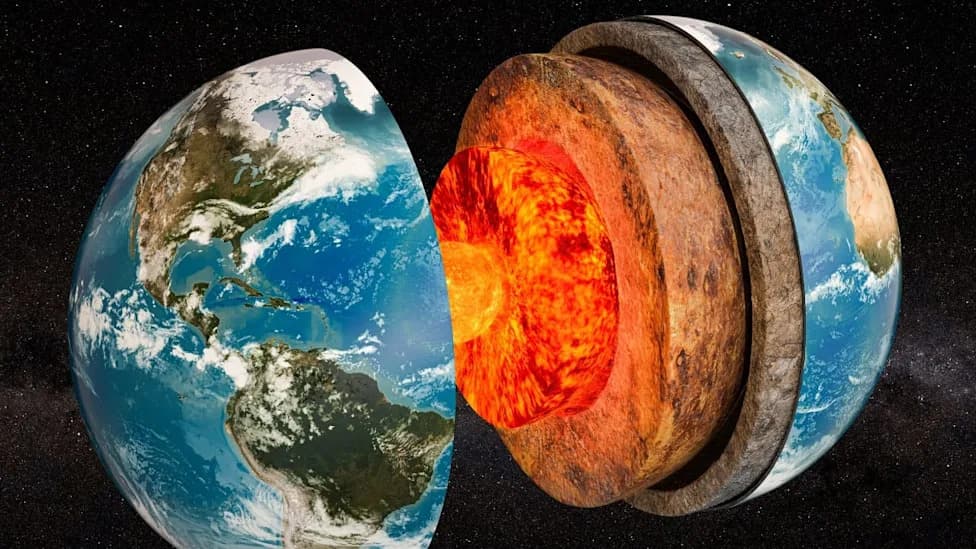
AI was used to study the molecular composition of water. | Credit: Vertigo3d via Getty Images
Key Findings
The analysis revealed two characteristic transition paths between the high-density and low-density local structures. Most transitions follow a simple "semi-loop" route with a single energy barrier. But near the boundary between the two regimes — analogous to the coexistence region between liquid water and ice — molecules can take a more circuitous "full-loop" route that involves three distinct energy barriers. The team visualized these pathways and the saddle points molecules must cross to change state.
Analogy: Zeng compared the two pathways to hiking a mountain split in half: most hikers take the gentle slope (the semi-loop), but where the halves meet the terrain allows a complete circuit around the peak (the full loop).
Next Steps and Implications
The group is developing a more rigorous machine-learning model to validate the pathways and to connect the microscopic reaction coordinates to macroscopic properties such as density, viscosity and temperature. Experimental confirmation will be challenging and likely require very sensitive spectroscopic or scattering techniques; some laboratories have reported indirect spectroscopic hints consistent with two-state behavior.
If confirmed, these structural insights could help explain many of water’s anomalies and improve our understanding of aqueous environments in biology and pharmaceuticals, where solvent structure influences salt behavior, protein folding, and drug interactions. However, translating this knowledge into practical applications will take further work.
Publication: Results published June 4 in Nature Physics.
Help us improve.