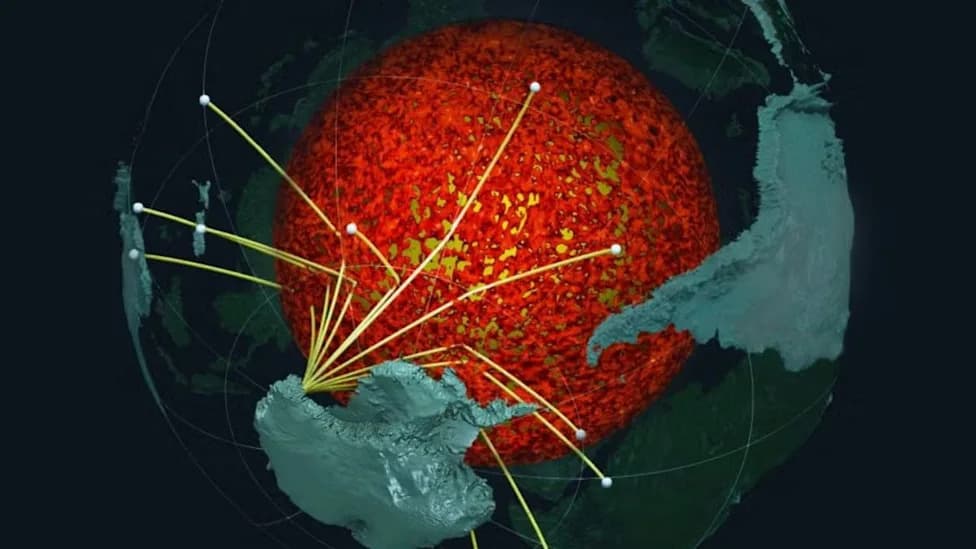
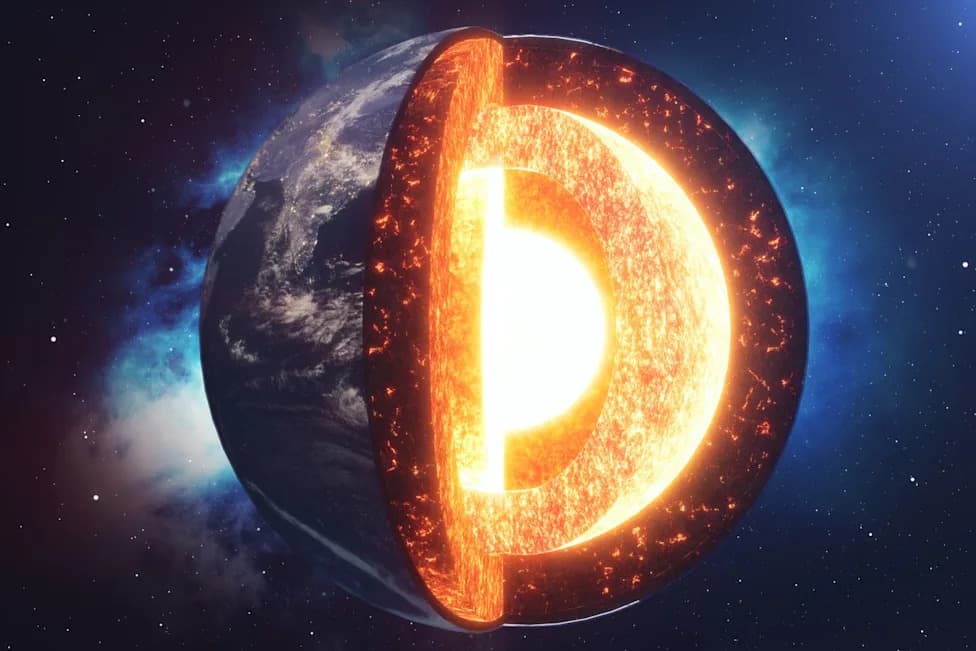
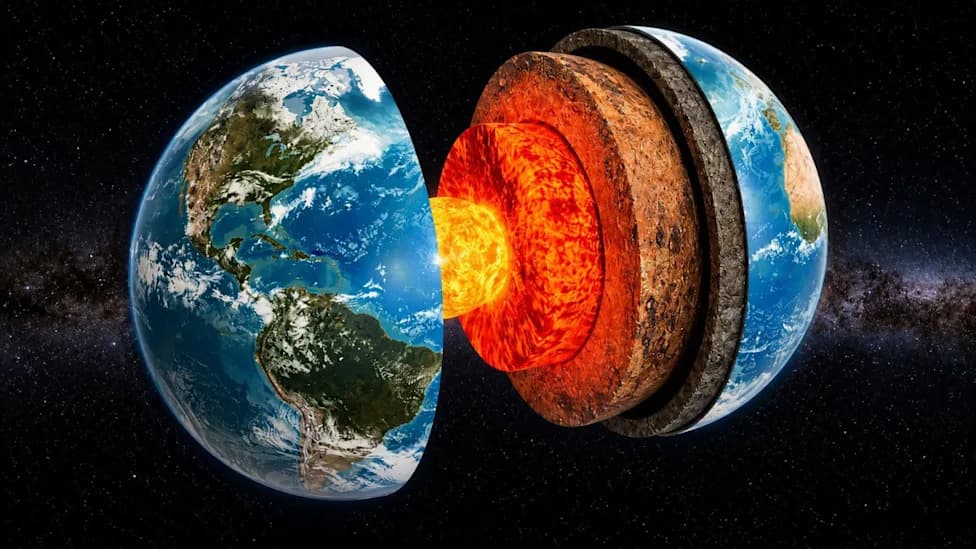
Laboratory experiments using laser‑heated diamond anvil cells have produced two new iron oxyhydroxides, Fe5O12Hx and Fe7O12Hx, that can trap substantial hydrogen and remain stable under lowermost mantle conditions. These dense phases could have formed early in Earth's history, sank to the core–mantle boundary, and serve as long‑lived reservoirs of water. If brought upward by mantle circulation, they might release water back into shallower mantle and ultimately to the surface, suggesting Earth's internal water cycle could extend to the edge of the core.
Hidden Ocean? New Minerals Could Store Vast Water Reserves 1,800 Miles Below Earth's Surface
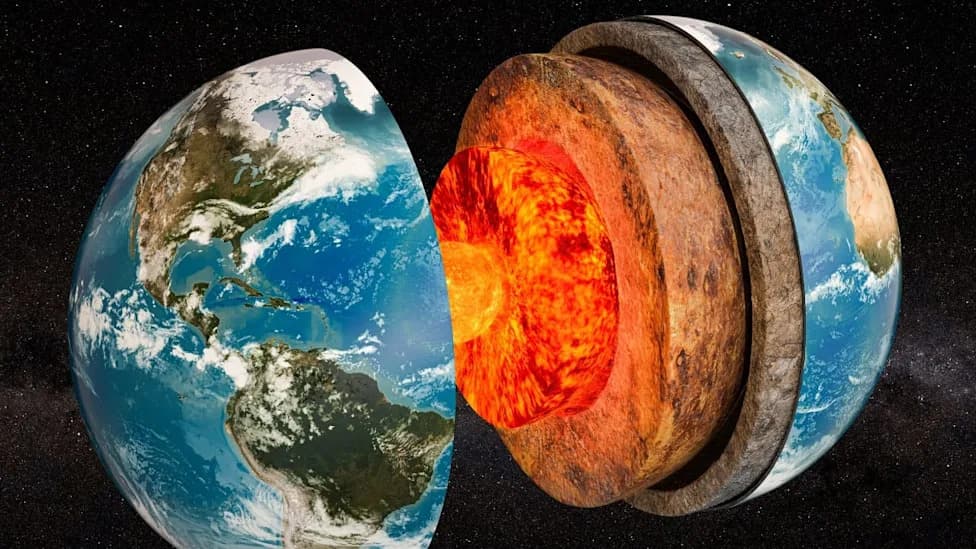
(Olexsii Mach/Canva Pro)
Water does more than sustain life on the surface — it also plays a crucial geologic role by hydrating and lubricating Earth's mantle, enabling slow rock flow that drives plate tectonics and long‑term climate regulation. New laboratory experiments suggest that enormous quantities of water could be stored much deeper than previously recognized, near the boundary between the lower mantle and the liquid outer core.
Laboratory Discovery: Two New Hydrated Iron Phases
Researchers using laser‑heated diamond anvil cells reproduced the extreme pressures and temperatures of the lowermost mantle and identified two previously unknown iron oxyhydroxide phases, Fe5O12Hx and Fe7O12Hx. These dense minerals can incorporate substantial hydrogen (effectively water) into their crystal structures and remain stable under conditions relevant to the deep lower mantle.
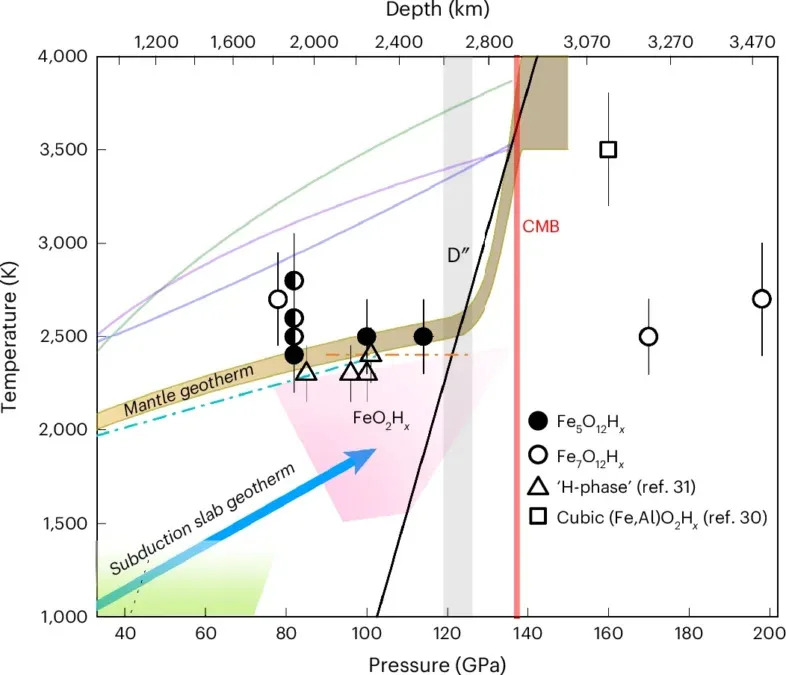
Pressure–temperature conditions for the formation of iron oxyhydroxides. (Yuan et al.,Nature Geoscience, 2026)
How These Phases Could Store Water Deep in the Earth
The lower mantle extends from roughly 660 to 2,900 kilometers (about 373–1,802 miles) beneath Earth's surface. Until now, dominant minerals in this region — such as bridgmanite and ferropericlase — were thought to be largely dry. The new iron oxyhydroxides, however, can form even when starting materials contain minute amounts of hydrogen: some experiments began with under 0.1% water yet still produced the hydrated phases.
Because these phases are both stable at extreme pressure–temperature conditions and substantially denser than surrounding mantle rock, the authors propose they could have crystallized as the early "basal magma ocean" cooled and then gravitationally sank toward the core–mantle boundary, providing a long‑term reservoir for water deep inside Earth.

YouTube Thumbnail
Implications for Earth's Deep Water Cycle
Water stored in these dense minerals may not remain permanently sequestered. Mantle convection can transport deep material upward; decreased pressure during ascent could destabilize the oxyhydroxides, releasing hydrogen that can be incorporated into other minerals and, over geological time, be carried to the surface by mantle plumes and volcanic activity. This mechanism would extend Earth's internal water cycle to the edge of the core.
Connection To Previous Experiments And Open Questions
The experiments also shed light on an earlier puzzle: a previously observed high‑pressure "H‑phase" appears to match one of the newly described oxyhydroxides. The team suggests trace hydrogen contamination in earlier trials — rather than a new dry mineral — may explain that mysterious phase.

Subscribe to ScienceAlert's free fact-checked newsletter
However, key uncertainties remain. The exact hydrogen (water) content of Fe5O12Hx and Fe7O12Hx under natural conditions must be quantified, their stability right at the core–mantle boundary needs further study, and the rates and pathways by which deep‑stored water could return to the surface are still unknown.
"Liquid water is the key component of Earth's habitability," writes Alfred Wilson (University of Leeds) in an accompanying commentary, emphasizing the importance of identifying possible deep reservoirs.
The research is published in Nature Geoscience. While the experiments demonstrate that these hydrated iron phases can form under relevant conditions, they do not yet prove that Fe5O12Hx and Fe7O12Hx actually exist inside Earth — further observational and experimental work will be required.
Help us improve.