Researchers have synthesized two iron oxyhydroxide minerals that are stable at core–mantle boundary conditions and can hold up to 15% water by weight. Created using diamond-anvil compression and laser heating, the dense phases are consistent with both subduction-delivered and primordial water scenarios. Mantle convection could mobilize these minerals and release water at volcanic hotspots, though natural occurrences and global storage capacity remain to be confirmed.
New Iron Minerals Could Store Primordial Water Deep in Earth — A Possible Route from Core to Surface
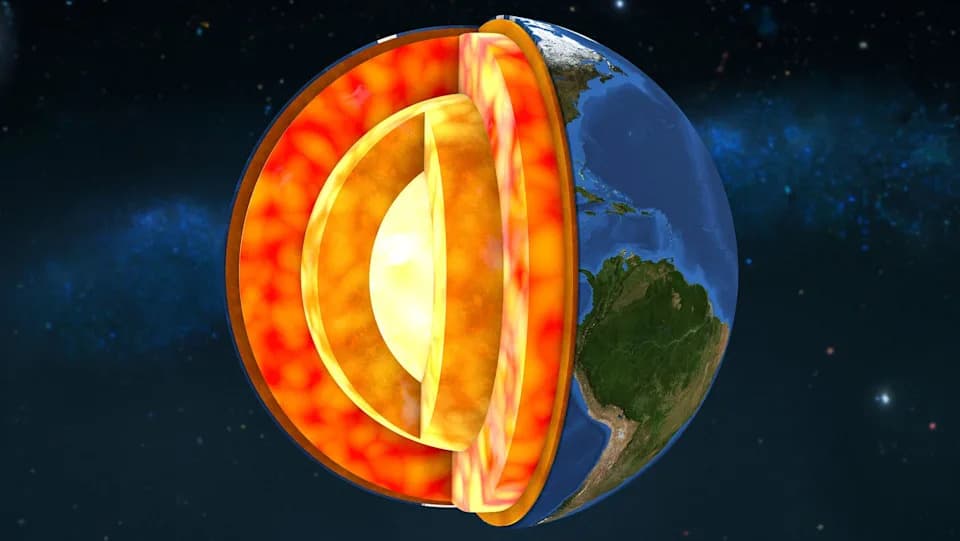
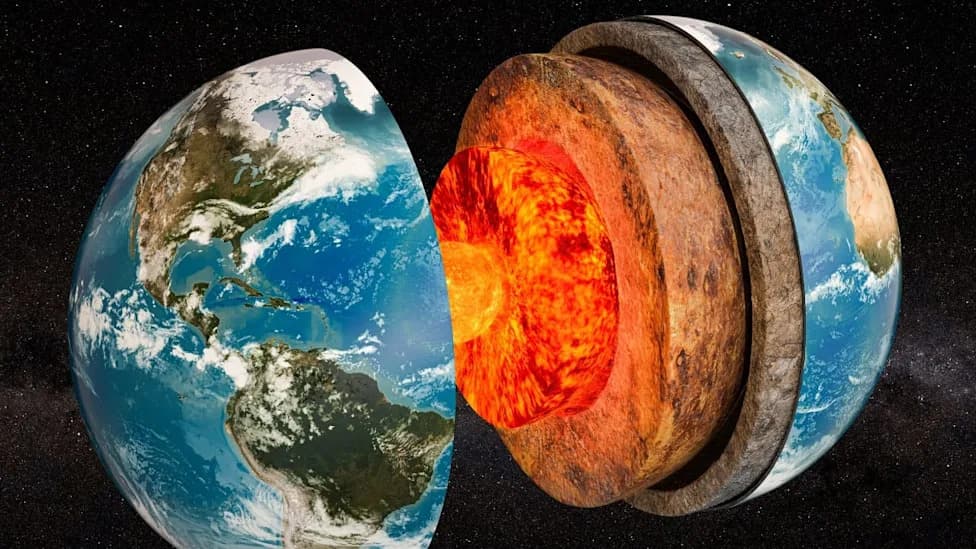
An illustration of Earth's interior, showing the crust, mantle, and core. New research may reveal how minerals in the deepest part of the mantle store and transport water. | Credit: KATERYNA KON/SCIENCE PHOTO LIBRARY via Getty Images
Scientists have synthesized two previously unknown iron oxyhydroxide minerals that remain stable under the extreme pressures and temperatures found at the core–mantle boundary (CMB). Laboratory experiments using diamond-anvil cells and laser heating recreated conditions more than a million times the pressure we experience at the surface, producing dense phases that can incorporate as much as 15% water by weight.
How the Discovery Was Made
In the lab, researchers compressed mineral samples between two tiny diamond anvils and heated them with a laser to generate the new iron-rich oxyhydroxides. High-pressure analyses indicate these phases are both dense and robust, capable of surviving the intense conditions expected during deep subduction and the violent impacts associated with planetary formation.
Why This Matters
Water chemically bound in mantle minerals reduces rock rigidity and enhances ductility, making it easier for the mantle to deform and convect. That enhanced ductility is a key factor in enabling plate tectonics. The newly discovered minerals provide a plausible mineralogical reservoir for deep water that could support this process and influence volcanic activity.
These iron oxyhydroxides are compatible with two leading explanations for deep mantle water. Their density allows them to descend to the base of the mantle during subduction, delivering surface-derived water to extreme depths. At the same time, their stability under high-energy impacts supports the idea that primordial water trapped during early planetary accretion could have been retained near the core.
Once stored near the CMB, pockets of this water-bearing material could be carried upward by mantle convection in large, buoyant plumes. As the minerals are transported into hotter, shallower regions they would melt and release their stored water, potentially feeding volcanic hotspots and closing a deep mantle water cycle. The presence of dense, water-rich iron phases could also help explain seismically anomalous ultra-low velocity zones observed above the core.
Next Steps
The study, published Sept. 8 in Nature Geoscience, does not prove that these minerals actively shuttle water through the mantle, but it establishes a realistic pathway. Future work must search for natural examples of these phases, quantify how much water they could store globally, and incorporate them into geodynamic and geochemical models to evaluate their long-term impact on Earth's water budget and volcanic activity.
Credit: KATERYNA KON/Science Photo Library (via Getty Images).
Help us improve.