Researchers directly observed liquid water transforming into an amorphous, glassy solid by confining sub‑nanometer films of water between phytantriol lipid layers, which prevented crystallization. Using synchrotron SAXS/WAXS and neutron spectroscopy (Emu and Pelican), the team tracked dynamics across six orders of magnitude in time and across a wide temperature range (~-63 °C to -20 °C). They identified a major kinetic slowdown near -35 °C to -21 °C and a static glass transition between -74 °C and -64 °C. The findings clarify a hidden regime of water physics and could inform cryopreservation and deep-freeze food technologies.
Scientists Observe Water Turning Into an Unusual Glassy Solid Instead of Ice
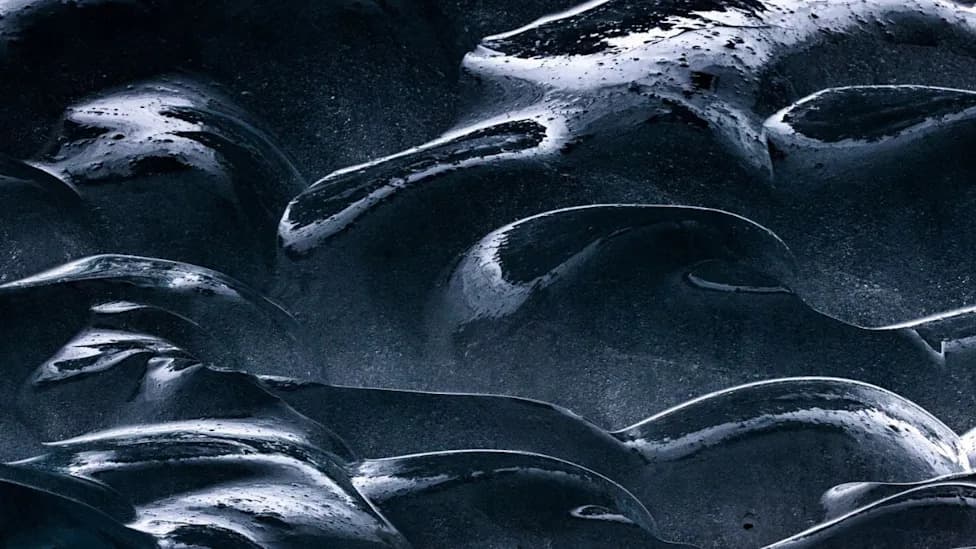
(Francesco Bergamaschi/Moment/Getty Images)
Water — which covers about 70% of the planet and makes up roughly 60% of the human body by mass — still surprises scientists. In a new study published in Nature Communications, researchers directly observed liquid water transforming into an amorphous, glassy solid rather than crystallizing into ordinary ice.
Background: Under typical cooling, water forms crystalline ice: molecules lock into an ordered lattice. But under certain conditions water can become "glassy" — a disordered solid with no long-range crystalline order. Glassy water occurs naturally in polar stratospheric clouds and helps cold-adapted organisms avoid ice-crystal damage, yet bulk water's liquid-to-glass transition has been difficult to observe because crystallization usually intervenes.
(Francesco Bergamaschi/Moment/Getty Images)
Experimental Breakthrough: The team led by Raffaele Mezzenga (ETH Zurich), in collaboration with scientists at the Australian Nuclear Science and Technology Organisation (ANSTO), prevented crystallization by confining ultrathin water films — just a few molecules thick — between lipid layers made from phytantriol, a fatty alcohol that remains stable and fluid at low temperatures. This nanoconfinement allowed the researchers to cool the sample without ice crystallization and to directly follow the liquid-to-glass transition.
How They Measured It: The group combined molecular simulations with advanced probes. They used synchrotron-based Small Angle and Wide Angle X-ray Scattering (SAXS/WAXS) to map structural changes and two neutron spectrometers (Emu and Pelican) at the Australian Centre for Neutron Scattering to measure hydrogen-atom motion and molecular vibrations. As ANSTO instrument scientist Alice Klapproth noted, neutron scattering is especially sensitive to hydrogen motions, enabling selective tracking of confined water dynamics inside the lipid matrix.
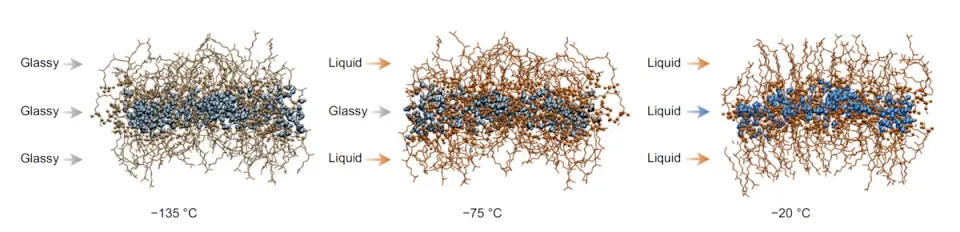
A schematic illustration based on molecular simulations shows the messy but solid state that emerges when water (shown in blue) is cooled in a phytantriol matrix (brown) to extremely low temperatures and not allowed to crystallize. (Züblin et al.,Nat Commun, 2026)
Key Findings: Confinement revealed a much broader and warmer glassy transition than previously expected. The researchers observed a progressive slowing of molecular dynamics across roughly -63 °C to -20 °C, probed across six orders of magnitude in time (from microseconds to picoseconds). A marked kinetic slowdown in molecular mobility occurred near -35 °C to -21 °C, while the static structural signature of a glassy solid was detected between about -74 °C and -64 °C. At still lower temperatures the combined water–phytantriol samples became brittle and developed macro- and microscopic cracks.
Implications: Beyond resolving a longstanding experimental blind spot about water physics, these results are relevant to any cryogenic situation involving nanoconfined water: cryopreservation of biological tissues, the deep freezing of food, and other technologies that rely on controlling ice formation. Whether the findings directly translate into improved tissue restoration protocols or novel frozen-food textures remains to be determined, but the study provides actionable insight into how confinement and interfaces alter water's low-temperature behavior.
Publication: The research appears in Nature Communications. The combined experimental and computational approach demonstrates a clear route to observe glass formation in water that would otherwise crystallize, opening new experimental and practical possibilities.
Help us improve.