President Miguel Diaz-Canel told the Communist Party politburo that Cuba needs "urgent changes" to address a crisis worsened by a U.S. oil blockade and long-standing internal problems. He proposed looking to China and Vietnam as models for opening the economy, and urged fast-tracked reforms to boost the private sector and attract capital from the diaspora. Diaz-Canel acknowledged bureaucracy and delayed decisions as domestic obstacles, and warned some measures may lack full consensus but cannot be postponed.
Cuban President Calls for 'Urgent Changes' as Economy Teeters on Collapse
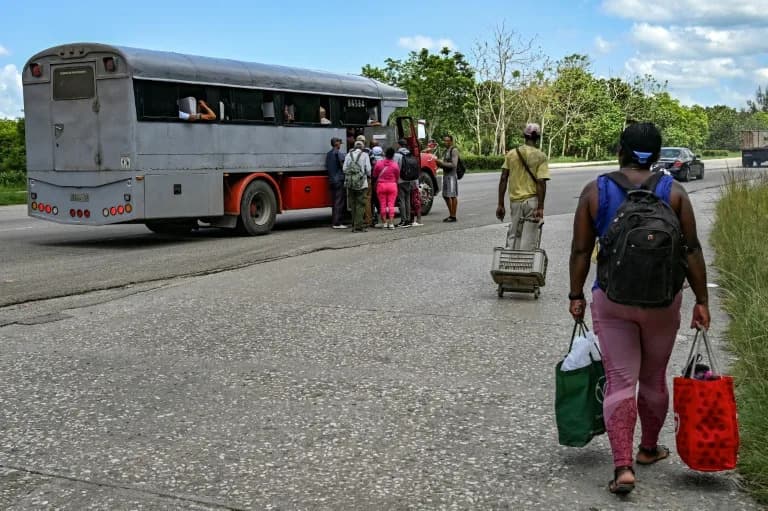
People board a private vehicle transporting passengers on the outskirts of Havana -- new restrictions on transport in Cuba are coming into force amid a severe fuel shortage (YAMIL LAGE)(YAMIL LAGE/AFP/AFP)
President Miguel Diaz-Canel told members of the Communist Party politburo that Cuba's economy needs "urgent changes" to pull the country out of a deepening crisis, citing both an external U.S. oil blockade and internal failings as drivers of the emergency.
Reforms to Open the Economy
Diaz-Canel pointed to the economic trajectories of China and Vietnam as possible models for opening Cuba's economy to foreign investment and trade while seeking to preserve social equality. He said reforms should be fast-tracked to strengthen the expanding private sector and attract capital from millions of Cubans living abroad.
Admission of Internal Problems
"The situation calls for urgent and necessary changes," Diaz-Canel told the politburo. "When people's lives become this hard... we must change what needs to be changed."
In a notable admission, the president acknowledged that not all obstacles are external. He singled out "slowness, bureaucracy and norms that impede those who want to produce," along with delayed decisions, as barriers that must be overcome to revive growth.
Impact of the U.S. Blockade
Officials say an oil blockade imposed in January has worsened an already fragile economy, contributing to prolonged power outages—sometimes exceeding 30 hours—and shortages of food, fuel, drinking water and medicine. Havana has long blamed a decades-old U.S. trade embargo; Diaz-Canel reiterated that external pressure has contributed to the crisis while also acknowledging internal weaknesses.
Political Stakes and Uncertainty
Diaz-Canel warned that some measures "will not have absolute consensus but cannot be postponed," underscoring the political difficulty of implementing rapid changes. Observers described the proposed package as an eleventh-hour attempt to avert economic collapse. It remains unclear whether the reforms will satisfy critics in Washington, where the administration has pushed for political as well as economic change in Cuba.
What Comes Next: The government faces the twin challenge of designing reforms that stimulate production and investment while maintaining social protections and political stability. The pace and scope of any opening will be closely watched by Cubans at home and abroad, investors, and foreign governments.
Help us improve.