The privately funded $850m Obama Presidential Center in Chicago opens on 19 acres of Jackson Park with a large commissioning program of 30 artists, major public artworks and a museum of personal artifacts and civic history. Anchor works include Martin Puryear’s 34-ft sculpture, Julie Mehretu’s 83-ft painted-glass window and Mark Bradford’s 38-ft mural. The centre mixes celebratory objects with sober exhibits on racism and political backlash, funds digitisation of federal records instead of housing them on-site, and offers public amenities and a free eighth-level contemplative space overlooking the city.
“This Will Be Timeless”: The Art, Objects and Ambition of Chicago’s $850m Obama Presidential Center
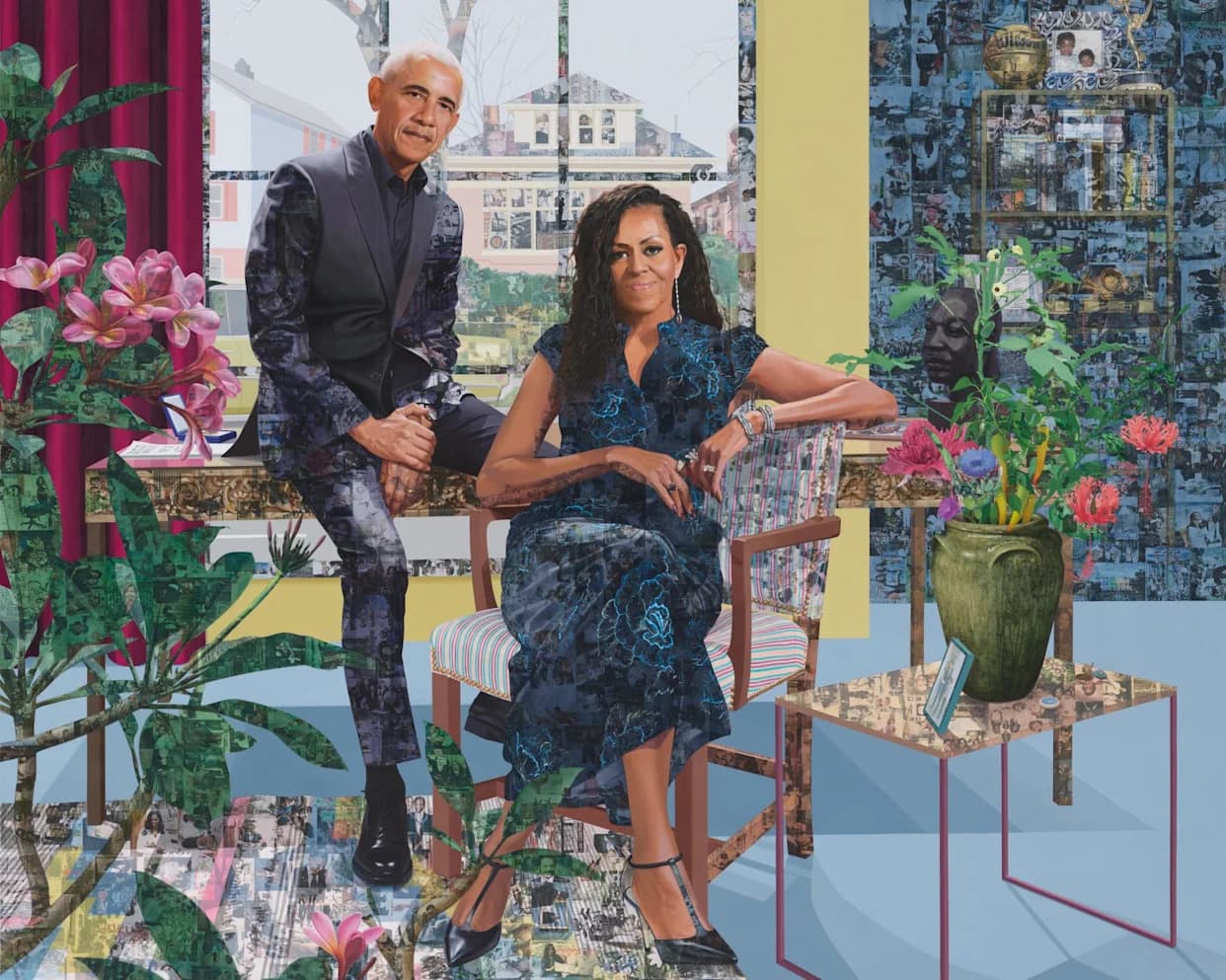
Njideka Akunyili Crosby – The Obamas: Springing Forth, 2026.Photograph: Courtesy of the artist, Victoria Miro, and David Zwirner(Photograph: Courtesy of the artist, Victoria Miro, and David Zwirner)
It is, in many ways, a story of two recent presidencies. On 14 June, Donald Trump celebrated his 80th birthday with a raucous UFC event on the White House South Lawn. Four days later, on the eve of Juneteenth, Barack Obama inaugurated a new institution on Chicago’s South Side that puts art at the heart of how his legacy is presented.
The privately funded, $850 million Obama Presidential Center sits on a 19-acre campus in Jackson Park, close to the neighborhoods where Obama lived as a young man and began his political career. The campus includes a branch of the Chicago Public Library, an NBA-regulation basketball court, a recording studio and even a sledding hill — built in part because Michelle Obama never had one growing up on the famously flat South Side.
Art as a Throughline
In an ambitious departure for a presidential library, the Obamas commissioned original works from 30 artists across a wide range of backgrounds. The art is woven throughout the campus and museum, intended to prompt strangers to stand together, look, and talk. Valerie Jarrett, chief executive of the Obama Foundation, emphasises that the collection was not designed to be overtly political; nonetheless many works engage directly with African American history, civil-rights struggles and Chicago’s cultural identity.
Anchor installations include:
- Martin Puryear — Bending the Arc: A monumental 34-foot sculpture inspired by Martin Luther King Jr.’s line about the moral universe bending toward justice, and dedicated in part to Congressman John Lewis. Puryear hand-carved a wooden beam that was 3D-scanned, digitally enlarged and finally realised in stainless steel for the John Lewis Plaza.
- Julie Mehretu — Uprising of the Sun: An 83-foot painted-glass window on the museum exterior inspired by Obama’s Selma remarks, creating a visual beacon for the site.
- Mark Bradford — City of the Big Shoulders: A 38-foot textured mural that cloaks the three-storey west wall of the Our Story atrium, mapping Chicago and Lake Michigan in layered colours and recycled materials.
- Maya Lin — Seeing Through the Universe: A stone-and-water installation on the Ann Dunham Water Terrace (named for Obama’s mother) featuring an oculus that emits mist and a flat, cascading “pebble” of water.
- Richard Hunt — Book Bird: Located in the library garden, this sculpture — the artist’s final work before his death in 2023 — shows a bird bursting from a book to evoke the emancipatory power of reading.
- Njideka Akunyili Crosby: A mixed-media portrait of Barack and Michelle Obama created from archival imagery, family albums and historical ephemera — the first major portrait of the couple together in the centre.
- Nick Cave and Marie Watt: A multimedia textile collaboration that weaves Indigenous and Black traditions through beaded nets and sculptural jingle elements.
- Idris Khan — Sky of Hope: Thousands of hand-stamped words from Obama’s speeches honouring civil-rights leaders form a burst of textual colour across the Nelson Mandela Sky Room ceiling.
The Museum: Personal Objects and Public History
The museum balances celebration and sober reflection. Visitors encounter intimate objects that trace Obama’s life: a woven wall hanging made by his mother when she was pregnant with him; his grandfather Hussein Obama’s colonial-era passbook from 1940s Kenya; an early essay on Hamlet and King Lear from Obama’s Occidental College days; a brown briefcase embossed with "Barack" and the invitation to his 1992 wedding to Michelle Robinson. Campaign ephemera — from posters and 440 campaign buttons to a box of "Obama O’s" cereal and a 7-Eleven cup with his name — now read as historical artifacts.
A featured display, The President’s Lucky Charms, gathers the small keepsakes and religious tokens supporters gave Obama on the campaign trail — objects he carried as reminders of the people he met. The Bible used at his oath (also used at Abraham Lincoln’s inauguration) and his Nobel Peace Prize are also on view. A lighter anecdote: the tan suit that briefly became an internet controversy is absent because President Obama gave it away; the foundation rejected creating a replica as inauthentic.
The museum does not shy away from darker currents. Panels recount how Richard Nixon in 1968 exploited stereotypes about Black Americans, and how Obama’s candidacy attracted racist and xenophobic attacks — from the birther lies to other falsehoods. Those exhibits operate as context and, at times, as implicit warnings about later political developments; the centre largely avoids naming Donald Trump directly, and he was not invited to the opening ceremony.
Organization, Tone and Public Spaces
Unlike previous presidential libraries, the Obama Presidential Center did not deposit its physical federal records with the National Archives and Records Administration. Millions of documents remain in a Maryland warehouse while the centre funds their digitisation. Admission to the museum is priced at $30, though the eighth-level contemplative space with sweeping views of the South Side, the Chicago skyline and Lake Michigan is free and open to the public.
The museum is arranged into themed levels: Working for the Common Good chronicles eight years in office, listing achievements such as stabilising the economy after the 2008 financial collapse, expanding healthcare under the Affordable Care Act (with honest acknowledgement of its limits), restoring diplomatic ties such as with Cuba, and the Paris climate agreement — items later reversed by the next administration. The fourth level, The People’s House, offers lighter, interactive exhibits: dioramas of White House rooms, Michelle Obama’s dresses, and a replica Oval Office (without the gaudy gold associated with the Trump White House) where visitors can sit at the Resolute desk and find the letter George W. Bush left in its drawer.
Louise Bernard, the museum’s founding director, says artists were given broad latitude to interpret themes of hope, place and memory — especially Chicago’s role in Obama’s life. The result is a campus that intentionally mixes art, community amenities and museum storytelling to create experiences that feel personal, civic and civic-minded all at once.
"We believe that this campus will be timeless," Valerie Jarrett said. "What will be the constant is the values that drove President Obama to run for office and serve — and the work we do now to prepare the next generation."
Whether visitors leave uplifted, challenged, nostalgic or uneasy, the Obama Presidential Center places art at the centre of a modern attempt to record a presidency — pairing large-scale public works with fragile, intimate objects that together aim to reflect a complex national story.
Help us improve.