The Wall Street Journal filed a 22-page motion seeking to dismiss President Trump’s amended $10 billion defamation suit over a July 2025 article that reported he contributed a signed note and a lewd sketch to Jeffrey Epstein’s birthday book. The paper argues the amended complaint still fails to allege "actual malice," that the article is not defamatory, and that the reporting was corroborated when the House Oversight Committee released the matching birthday‑book page. The Journal asks the court to dismiss the case with prejudice and award attorneys’ fees under Florida’s anti‑SLAPP law.
WSJ Asks Court To Toss Trump’s Epstein Defamation Suit, Calls Claims ‘Groundless’ and Dishonest
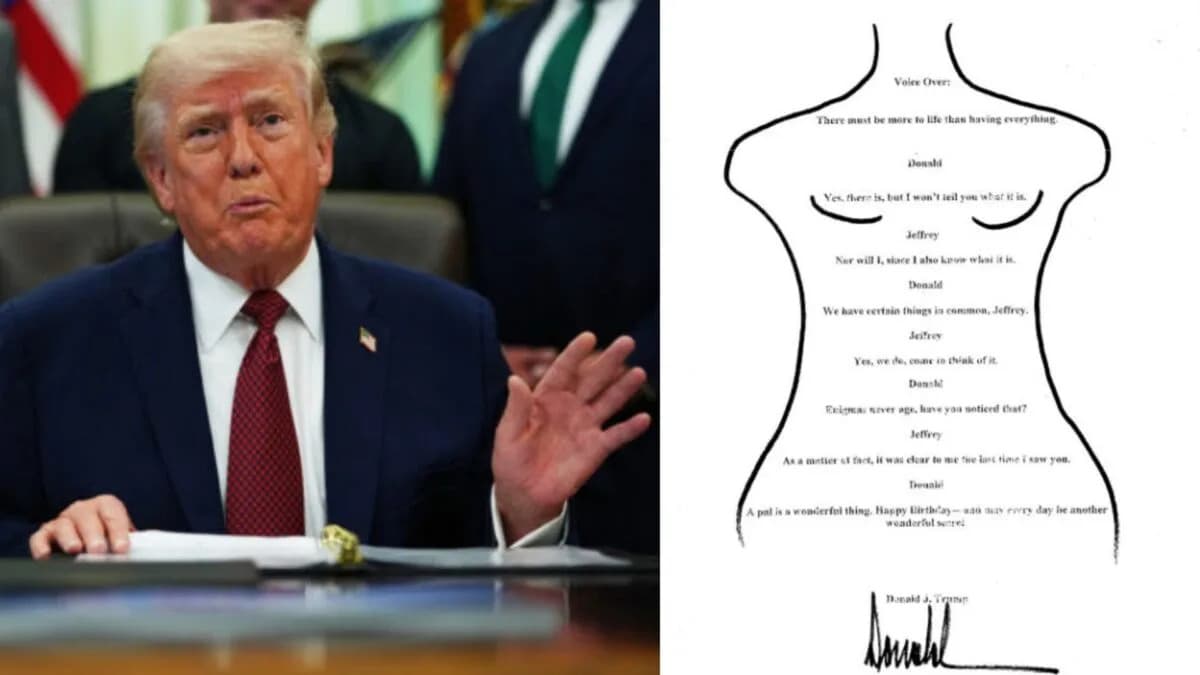
Donald Trump and Epstein Birthday letter drawing
The Wall Street Journal has filed a forceful 22-page motion asking a federal court to dismiss President Donald Trump’s renewed defamation lawsuit over a July 2025 article that reported he contributed a signed note and a lewd sketch to Jeffrey Epstein’s 50th birthday book. The Journal’s filing accuses the president’s legal team of advancing dishonest and groundless arguments in an amended complaint that, the paper says, fails to cure the defects identified by the court.
Background
The July 17, 2025 Journal article, by reporters Khadeeja Safdar and Joe Palazzolo, said an entry in Epstein’s birthday album — compiled by Epstein associate Ghislaine Maxwell — included a page attributed to Trump featuring a signature reading "Donald," a brief message and a drawing of a nude female figure. Trump denied the report and sued the Journal and several related defendants a day after the story appeared, naming Dow Jones, News Corp, owner Rupert Murdoch, News Corp CEO Robert Thomson and the two reporters.
Developments And Evidence
Legal observers viewed the suit skeptically from the start because, as a public figure, Trump must show the paper acted with "actual malice" — a high bar in U.S. defamation law. That skepticism heightened when the House Oversight Committee released documents from Epstein’s estate, including the birthday book, containing a page that matched the Journal’s description.
In April, U.S. District Judge Darrin P. Gayles dismissed Trump’s original complaint, finding it had "not plausibly alleged that the Defendants published the Article with actual malice." The judge later denied Trump’s request to proceed with discovery and allowed limited time to file an amended complaint.
The Amended Complaint And The Journal’s Response
Trump filed a 25-page First Amended Complaint in late May asserting claims of defamation per se and defamation per quod and seeking $10 billion in damages. On Wednesday, the Journal defendants filed two responses: a motion to dismiss and a motion to stay discovery while the court resolves the dismissal motion.
In their 22-page motion, the defendants argue the amended complaint "does not remedy any of the defects identified" by Judge Gayles and in many respects "compounds" them. The Journal asks the court to dismiss the case with prejudice and to award attorneys’ fees under Florida’s anti-SLAPP statute.
Main Arguments From The Journal
The defendants describe the suit as "groundless" and "baseless" for three principal reasons:
- It still fails to plausibly allege actual malice by the reporters or the paper.
- The article does not carry a defamatory meaning — reporting that someone sent a bawdy note to a friend is not inherently defamatory, and the story never said Trump personally hand-drew the note.
- The reporting was corroborated when the House Oversight Committee released documents that included a letter identical to the one described in the article.
The Journal also says Trump’s lawyers mischaracterized the reporting — for example, by comparing the signature on the birthday page ("Donald") to examples of Trump’s full-name signatures rather than to instances where he used only his first name, which is the comparison the reporters actually made. "Plaintiff tellingly does not dispute that resemblance (because he cannot)," the motion says.
The motion notes precedent that mere association or friendship with someone later accused of crimes is not, by itself, defamatory. It also argues that Trump’s claimed damages remain conclusory and unsupported by factual allegations.
Conclusion
Urging dismissal with prejudice and an award of fees, the Journal emphasizes the constitutional stakes, arguing that this high-profile lawsuit touches "the heart of the First Amendment." The defendants tell the court that Trump has had multiple opportunities to plead a viable defamation claim and has twice failed to do so.
Help us improve.