Summary: Inner London is experiencing a sharp fall in birth rates, with some boroughs nearing just one child per woman. At the same time, nurseries, maternity units and schools are closing or shrinking, even where demand for places remains. High housing costs, delayed household formation and underfunded early-years provision — amplified by wage and tax pressures on providers — are major drivers. Policymakers face hard choices to adapt services to an unstable, fluctuating child population.
London’s Baby Bust: Nurseries Close as Birth Rates Plummet in Inner Boroughs
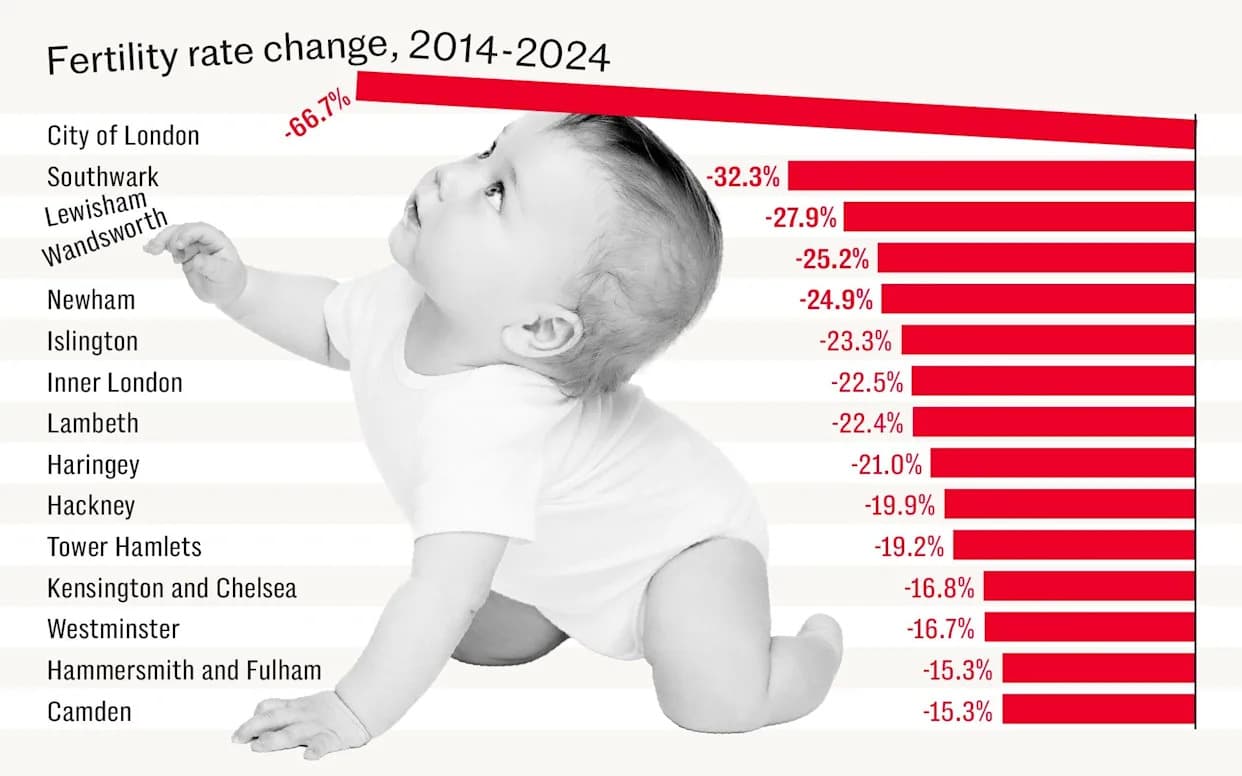
Illustration of London birth-rates
London is confronting a deepening childlessness crisis: birth rates in many inner boroughs have fallen to levels once seen only in parts of East Asia, while childcare provision is shrinking just as demand remains patchy and unpredictable.
A Personal Story
Jonny Singer, a 34-year-old sports administrator in Islington, and his wife Ellie, a doctor, welcome their two-year-old daughter but have been blindsided by a sudden nursery closure this summer. Singer says there is 'no one with a space before September for under-2s' and that parents are being told there may only be room for one sibling but not the other — a situation that is untenable for working families.
'Even with saying that my wife works three days a week, we have family on the doorstep, it’s still incredibly difficult when your nursery gives you seven weeks’ notice that they’re shutting,' Singer adds.
How Widespread Is the Decline?
Islington has one of the lowest birth rates in England and Wales at 0.99 children per woman. Inner London boroughs including Camden, Southwark, Wandsworth and Lambeth reported fertility rates of roughly 1.05–1.10 in 2024, and some boroughs have seen declines approaching a third over the last decade. At the same time, more than 40 London schools have closed since 2020 and nearly 100,000 children under 10 left London between 2013 and 2023 — a demographic shift equivalent to roughly 250 primary schools.

Finding a nursery in inner London has proved difficult for Jonny Singer and his wife Ellie Croft - Jamie Lorriman
Why Birth Rates Are Falling
Experts point to several interlocking causes. High housing costs are a central factor: Londoners typically spend about two-fifths of their income on housing, compared with about a third elsewhere in the UK, squeezing household budgets. Rising living costs have also delayed household formation — more than one in three men aged 20–35 still live with their parents, and about one in five women do the same — which tends to postpone childbearing.
Pressure On Services
As births fall, services aimed at young children are being scaled back. The Royal Free Hospital in Camden announced the closure of its maternity unit amid plunging births, and many nurseries and early-years settings have become financially unviable. Neil Leitch, chief executive of the Early Years Alliance, says his organisation reduced the number of settings it runs from 132 to 29 over six years because they could not be made to pay.
Funding problems compound the issue: while the government has expanded free nursery hours for under-2s, the linked funding often does not cover providers' real costs. Sector pressures — including higher minimum wages and increased employer National Insurance contributions, which one provider group said added around £1.2m to its wage bill — have further squeezed margins.

Despite Islington having the fourth-lowest birth rate in England and Wales, parents like the Singers are finding local nurseries oversubscribed – and expensive - Jamie Lorriman
City Design, Community Life And The Risk Of A Vicious Cycle
Childhood experts warn that visible children are an indicator of a healthy city. When schools and nurseries close, neighbourhoods can become less attractive to families, which can trigger shop closures and reduced services and thereby discourage other parents from moving in — a potential downward spiral for some inner-city areas.
What Comes Next?
Demographers caution that population change often moves in waves. The Office for National Statistics expects the current 'baby bust' could be followed by a temporary rise and then another downturn, creating planning challenges for schools and local services that must adapt to fluctuating demand. Policy choices — from targeted housing and childcare funding to reconsidering how nursery funding reflects local costs — will shape whether London can stabilise family life in its central boroughs.
Final thought: For parents like Singer, raising children in London is still rewarding but expensive and precarious. For policymakers and providers, the task is to align funding and services to a shifting demographic landscape before the visible signs of family life in the city fade further.
Help us improve.