Nagatitan chaiyaphumensis, a newly described titanosaur from northeastern Thailand, is the largest dinosaur yet documented in Southeast Asia—about 28 tonnes and 27 metres long. Discovered in 2016 in the Khok Kruat Formation, the specimen includes vertebrae, ribs, pelvis fragments, a humerus and a femur. Researchers used 3D surface scanning to share fragile fossils between Thai institutions and University College London. The team suggests Nagatitan may represent one of the last large sauropods preserved in the region before it became a shallow sea.
Nagatitan chaiyaphumensis: A Giant New Sauropod Tells the Tale of Southeast Asia’s Last Titans
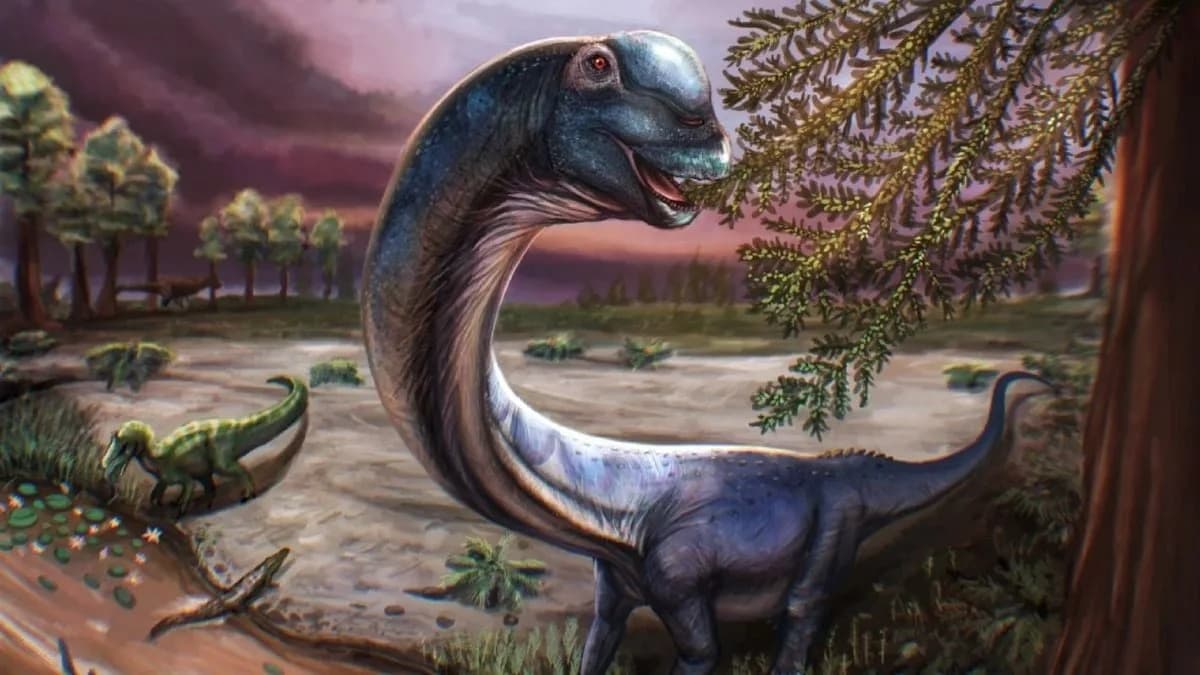
Artistic illustration of Nagatitan. (Patchanop Boonsai)
An enormous sauropod, Nagatitan chaiyaphumensis, has been described from northeastern Thailand and is the largest dinosaur yet identified from Southeast Asia. Estimated at roughly 28 tonnes and about 27 metres (89 feet) long, this Early Cretaceous giant adds an important chapter to the region's fossil record.
Discovery and Name
The specimen was found in 2016 on the edge of a dried pond in Chaiyaphum Province’s Khok Kruat Formation. The name combines regional and mythological references: "Naga" for the serpentine water spirits of Asian and Buddhist traditions, "titan" for the colossal deities of Greek myth, and "chaiyaphumensis" for the discovery locality.
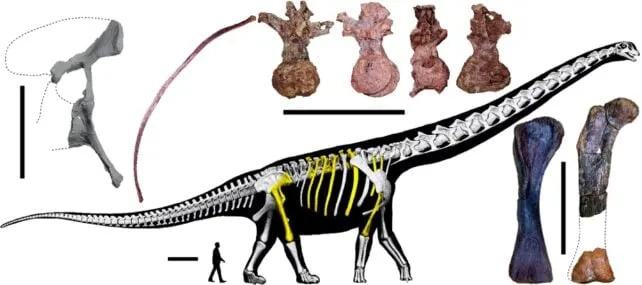
An illustration showing the skeleton ofN. chaiyaphumensis, with the preserved bones highlighted in yellow. (Sethapanichsakul et al.,Sci. Rep., 2026)
What Was Found
The fossil material is relatively complete for the area and includes eight vertebrae, five ribs, parts of the pelvis, a humerus, a femur and several indeterminate fragments. Comparative anatomy shows subtle but consistent differences from other known sauropods, supporting recognition of a new species within the titanosaur group.
Methods and Collaboration
A team of Thai researchers working with University College London (UCL) published the find in Scientific Reports. To share fragile elements and analyze details across institutions, the team used surface 3D scanning and printing. As UCL paleobiologist Paul Upchurch noted, 3D models "allow us to study the specimen and collect data without having to travel."
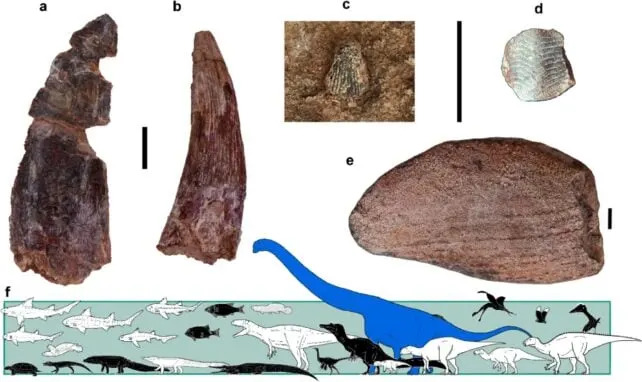
Figures a-e show other, non-sauropod remains found in the same area. Figure f depicts the known faunal assemblage from the Khok Kruat Formation, withN. chaiyaphumensisin blue and tentative taxa in black. (Sethapanichsakul et al.,Sci. Rep., 2026)
Paleoenvironment and Significance
The Khok Kruat Formation preserves a diverse Early Cretaceous ecosystem—sharks, turtles, pterosaurs, early crocodilians and large theropods (including an 8‑metre, shark‑toothed predator) have all been reported from the same beds. At the time, the landscape likely consisted of shrublands and savanna cut by meandering rivers. Flying reptiles may have plucked fish from the currents while long-necked sauropods like Nagatitan could lower their necks to feed or drink.
Because the Khok Kruat beds are among the youngest dinosaur-bearing sediments in Thailand, the authors describe Nagatitan as something of an "endling" or "last titan"—possibly one of the most recent large sauropods preserved in the region before a later marine transgression turned the area into a shallow sea.

Subscribe to ScienceAlert's free fact-checked newsletter
Context
Although impressive for Southeast Asia, Nagatitan would still have been smaller than the largest known sauropods worldwide, such as Patagotitan (estimated near 70 tonnes). The discovery is scientifically important for clarifying titanosaur diversity in Asia and adds a memorable milestone for the Thai team: for first author Thitiwoot Sethapanichsakul, the naming of a dinosaur fulfilled a long-held childhood ambition.
"So this may be the last or most recent large sauropod we will find in Southeast Asia," — Thitiwoot Sethapanichsakul, first author.
Reference: The study was published in Scientific Reports and reports the collaborative work between Thai institutions and UCL.
Help us improve.