Researchers are rethinking the idea that consciousness is solely a product of the cerebral cortex. Observations of children born without much cortex and affective responses produced by deep-brain stimulation have led some scientists to propose that ancient subcortical structures can generate basic feelings. New tools such as transcranial focused ultrasound (tFUS) could test whether subcortical activation produces subjective states, with wide ethical and scientific implications.
Is Consciousness Hidden in the Ancient Deep Brain? The Case for the Subcortex
Amanda Montañez
One unsettling proposal from parts of Silicon Valley imagines growing human surrogates that lack conscious brains. Some speculative biotech projects have reportedly explored creating bodies without a cerebral cortex—the wrinkled outer layer tied to language, reflection and abstract thought—as a way to sidestep ethical objections to radical procedures such as whole-body transplants. The premise: if a surrogate has no inner life, its use would not raise the usual moral concerns.
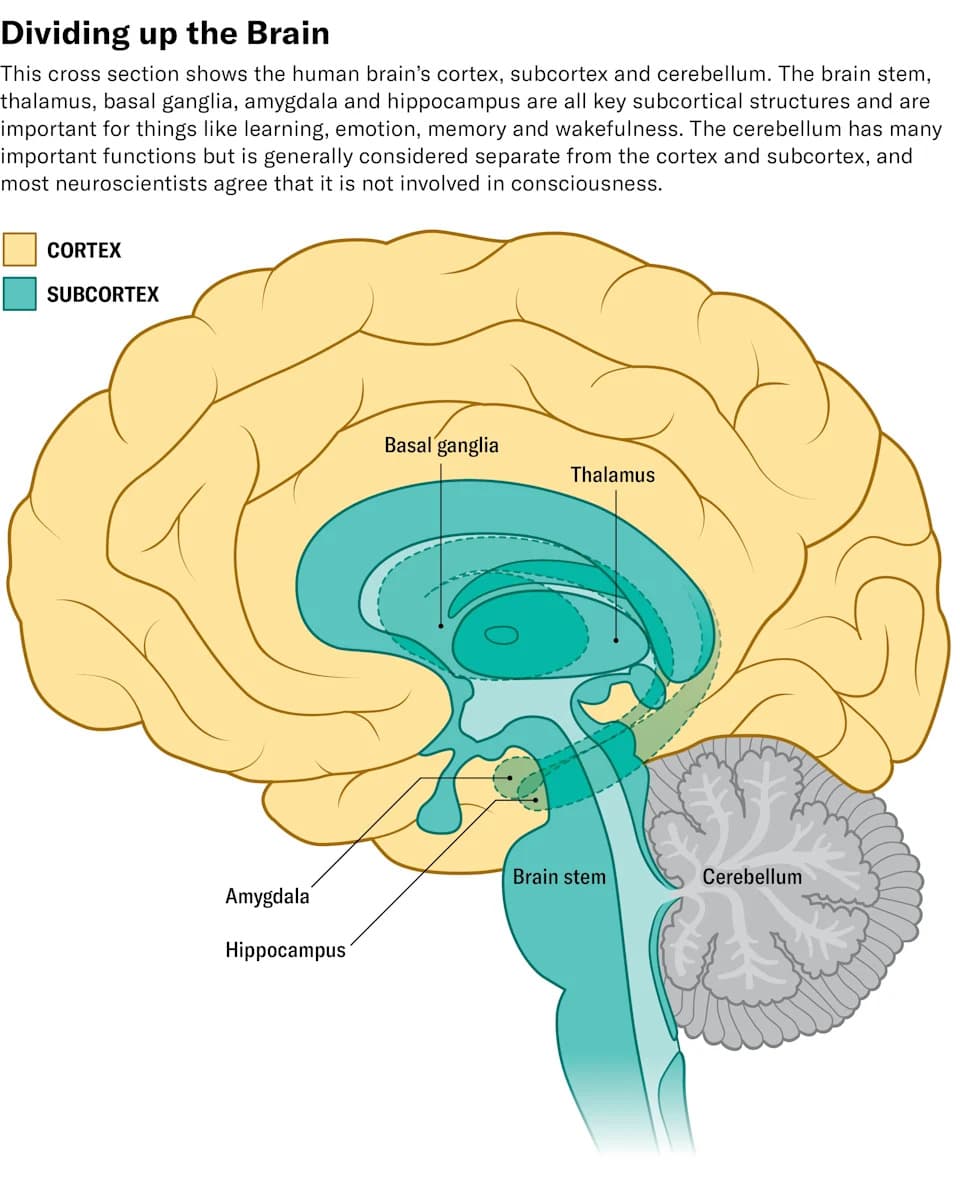
But that assumption depends on a long-standing idea: that consciousness arises chiefly from cortical activity. A growing minority of neuroscientists and philosophers challenge this corticocentric view, arguing instead that the evolutionarily ancient subcortex—structures deep beneath the cortex that regulate arousal, emotion and basic bodily functions—may itself generate rudimentary conscious feeling.
Why the Subcortex Matters
The cortex is a relatively recent evolutionary innovation and dominates human brain mass, but it sits atop far older systems. The subcortex routes sensory signals, maintains wakefulness and mediates affective states. Cortex and subcortex operate in continuous reciprocal loops: sensory information often passes through subcortical relays before reaching the cortex, and the cortex returns feedback in an ongoing dialogue.
Nearly all neuroscientists agree that certain subcortical nuclei are essential for the global state of consciousness—damage there can extinguish awareness. The dispute is over function: is the subcortex merely a “power supply” that enables cortical consciousness, or can it by itself create a basic subjective life?
Compelling Observations: Hydranencephaly and Behavior
A striking line of evidence comes from children with hydranencephaly, a rare condition in which much or all of the cerebral cortex is missing. These children are often labeled vegetative, yet researchers who observed them report emotionally driven, purposeful behaviors. In 2004 Björn Merker spent a week with several such children and found that they laughed, played and oriented to stimuli in ways that suggested affective responsiveness rather than reflexive automatism.
Mark Solms and others have made similar observations, arguing that the behavioral signs we use to infer feeling in pets apply equally to these children. Critics counter that behavior alone cannot prove subjective experience: without verbal report, we must infer consciousness from anatomy, physiology and behavior, a process fraught with uncertainty.
Vision, Feeling, and the Limits of Past Research
Much consciousness research has focused on visual awareness. Visual signals travel from the eyes through subcortical relays to primary visual cortex, with an early feedforward sweep that appears unconscious and later cortical feedback associated with reported perception. Phenomena such as blindsight—where people respond to visual stimuli without conscious sight—show that perception can guide action without subjective awareness.
Proponents of subcortical consciousness argue that focusing on vision may have skewed the field. They propose that feelings—affective states that guide motivation and decision-making—are intrinsically conscious and evolutionarily older than sophisticated cortical cognition. From this perspective, feelings evolved to help organisms balance competing biological needs and could therefore be widespread across vertebrates and perhaps some invertebrates.
What Deep-Brain Stimulation and tFUS Reveal
Support for subcortical contributions comes from clinical observations: deep-brain stimulation of certain hypothalamic and brainstem regions can evoke intense emotions—fear, despair, pleasure—suggesting that subcortical activation can produce affective states. Skeptics argue these effects may still depend on residual or downstream cortical processing.
New methods offer a way forward. Transcranial focused ultrasound (tFUS) is a noninvasive technique capable of reaching deep-brain structures. If targeted subcortical stimulation could restore a sensation or affective state lost due to cortical damage, it would provide strong evidence that the subcortex can support aspects of consciousness independently.
Implications and the Road Ahead
The stakes are high. Accepting subcortical consciousness would expand which animals we consider morally relevant and reshape ethical debates about biotechnology and medical care. The New York Declaration on Animal Consciousness (2024), endorsed by nearly 600 scientists, already reflects a growing willingness to consider broad possibilities for animal experience.
For now, the field remains divided. Many researchers emphasize compelling links between cortical activity and conscious report, while others argue those data do not rule out a foundational role for ancient deep-brain systems. Increasingly powerful tools, refined experiments and careful cross-species comparisons will be needed to settle where—and how—consciousness arises.
Bottom line: Consciousness may not be an exclusively cortical product. The deep, ancient subcortex could generate a basic felt life that the cortex later enriches and elaborates.
Help us improve.