The Trump administration proposes folding the Rural Education Achievement Program (REAP) into a $2 billion block grant that would shift funding decisions to governors and state education chiefs. Rural leaders warn that consolidating REAP risks diverting money away from small districts and eliminating a simple, flexible source of aid used for technology, tutors and aides. Education officials dispute whether the program is underused, and critics note there has been no recent comprehensive federal evaluation of REAP’s student outcomes. For many small districts, the uncertainty puts essential programs and personnel at risk.
Trump Proposal Would Fold REAP Into Block Grant, Sparking Fears From Rural Schools

On the shores of Lake Ontario in northern New York, the 430-student Sackets Harbor Central School District depends on Rick Bice, the district's technology coordinator, to keep its internet and data systems running.
“We wouldn’t be able to function as an organization without him,” Superintendent Jennifer Gaffney said. “A lot of what students, teachers and our office staff do is centered around the use of technology and data systems. He is the backbone of all that.”
Under the Trump administration’s proposal to consolidate 17 separate education funding streams into a single $2 billion block grant, the Rural Education Achievement Program (REAP) would be absorbed and decisions about distributing extra funds for rural districts would be shifted to governors and state education chiefs. Congress approved $220 million for REAP this year, but the administration’s plan would remove the program’s direct, targeted funding mechanism.

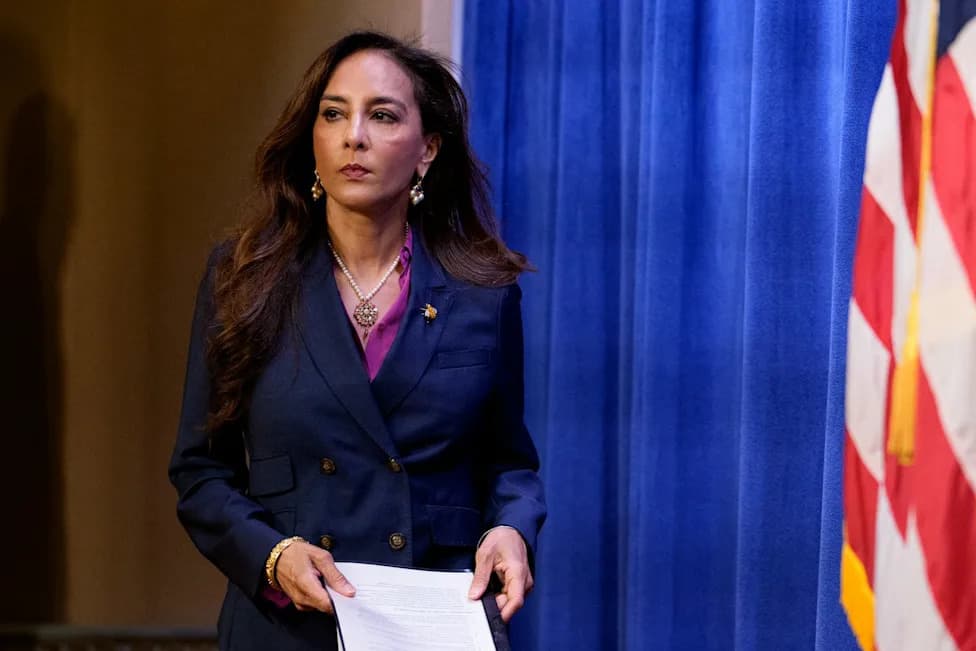
During a budget hearing before the Senate Appropriations Committee in April, Education Secretary Linda McMahon questioned the “efficacy” of the Rural Education Achievement Program. (Graeme Sloan/Getty)
Small districts warn the change could strip away a reliable source of flexible aid used for technology, tutors, aides and other local priorities. Monty Mayer, superintendent of Velva Public Schools in North Dakota, said the $14,000 his district received this year from REAP paid for teaching assistants who worked with students falling behind.
“Money rolled into a block grant would be swallowed up by the bigger schools as their needs are much greater than ours,” Mayer said. “That would leave small rural schools looking to find answers in different places without a clear picture as to where those resources would come from.”
During testimony before the Senate Appropriations Committee, Education Secretary Linda McMahon suggested REAP has been underused, saying many rural districts lack grant writers and that some states have not participated in certain grant programs. She argued a consolidated grant would ensure every state receives a portion and let state officials target funds where they see greatest need.
Rural-education officials and former Education Department staff dispute that characterization. Eligible districts do not compete for REAP funds through complex proposals; they receive invitations to apply based on size and location, and most qualifying districts take the funding. “Rural districts rely on REAP because it is simple, direct and does not require extensive administrative capacity,” said Steven Johnson, superintendent of Fort Ransom Public School District in North Dakota.
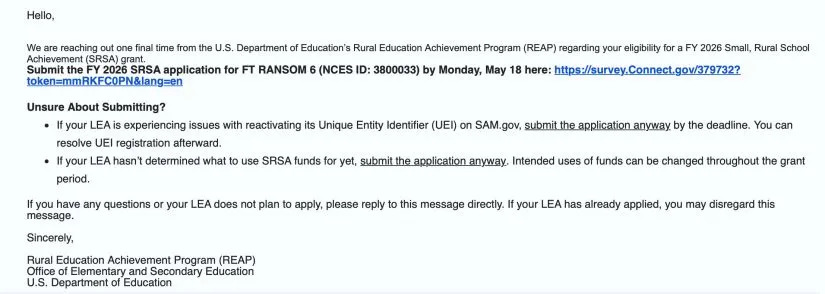
An example of the “final reminder” email that districts eligible for REAP funding receive from the U.S. Department of Education.
Abigail Swisher, who previously worked on REAP at the Education Department, added that REAP was created to bridge the gap for small districts that cannot compete for large, competitive federal grants and that efforts to help rural districts access those programs have eased under the current administration.
There are two REAP programs: Small, Rural School Achievement (for districts under 600 students in state-defined rural areas) and Rural and Low-Income School (for districts with at least 20% of students below the poverty line). Some districts qualify for both; this year, 17,873 districts were eligible for one or both programs.
Kirstin Baesler, assistant secretary for Elementary and Secondary Education, reminded rural districts they have flexibility to use federal funds for tutoring, after-school programs and other supports. But officials say that flexibility is precisely why REAP matters: it lets small districts use modest federal dollars to meet local priorities—often in ways that larger competitive grants do not permit.

Maine Sen. Susan Collins, a Republican running for reelection, has made rural schools a priority. (Graeme Sloan/Getty)
Critics note the Education Department has not produced a recent comprehensive federal evaluation of REAP’s student-impact outcomes. Melissa Sadorf of the National Rural Education Association said the department tends to focus on compliance because grantees use funds for varied local purposes, making a single outcome metric difficult to apply. Monitoring reports have identified administrative errors in some districts—such as data-entry mistakes in Custer County, Colorado (2023), and Attica Consolidated School Corporation, Indiana (2022)—but not a broad, nationwide assessment of student gains.
The administration floated the block-grant idea last year and Congress rejected it. With the appropriations process likely to drag on, it remains unclear whether lawmakers will approve the consolidation this cycle.
For districts like Sackets Harbor—site of a historic naval base from the War of 1812—the uncertainty is unsettling. Voters recently approved a nearly 8% tax increase, but rising numbers of English learners and students with disabilities continue to pressure the district’s budget. “That is precisely why every dollar matters to us, including REAP funding,” Gaffney said. “These resources are vital in helping us maintain programs, services and opportunities for our students.”
Help us improve.