Researchers led by Ali Ertürk developed MouseMapper, an AI‑powered pipeline that maps nerves and immune cells across intact, optically cleared mice. In mice fed a high‑fat diet, overall nerve density fell and the infraorbital (trigeminal) nerve lost branching complexity—nerve endings declined by 60.7%—with accompanying weaker whisker responses. Spatial proteomics identified 230 differentially regulated proteins in trigeminal ganglia, and similar pathway changes were found in human post‑mortem tissue from people with BMI > 30. The maps also reveal widespread, tissue‑specific inflammatory immune clustering, highlighting obesity’s system‑wide impact.
AI Whole‑Body Maps Reveal Obesity Remodels Facial Sensory Nerves and Drives Systemic Inflammation

Whole-body mouse maps link obesity to facial sensory nerve damage and widespread inflammatory hotspots across organs and tissues. (CREDIT: Shutterstock)
Obesity does more than expand fat stores: new AI‑driven whole‑body maps show it can reshape nerve architecture and immune landscapes across the body. A team led by Prof. Ali Ertürk (Helmholtz Munich and LMU) developed MouseMapper, a deep‑learning pipeline that analyzes intact, optically cleared mice to map nerves, immune cells and tissues. Their work—published in Nature—identifies dramatic remodeling of facial sensory nerves and widespread inflammatory hotspots in mice fed a high‑fat diet, with supporting molecular signals detected in human post‑mortem tissue.
Methods and Approach
The researchers used genetically labeled mice in which peripheral nerves or monocytes/macrophages fluoresced. After rendering whole animals transparent with tissue‑clearing techniques, they captured three‑dimensional images using light‑sheet fluorescence microscopy, producing datasets with tens of millions of cellular structures. MouseMapper processes these scans through three linked modules—for nerves, immune cells, and organ/tissue mapping across 31 anatomical regions—enabling an unbiased, body‑wide search for disease hotspots.
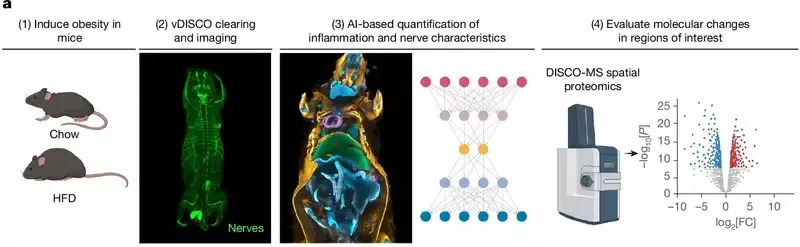
Direct visualization of nerves and macrophages in obesity at the whole-body scale. (CREDIT: Nature)
“MouseMapper is built on a foundation model, which means it generalizes far beyond the data it was originally trained on,” said Ying Chen, co‑first author.
Key Findings
After 16–18 weeks on a high‑fat diet, mice became obese, accumulated adipose tissue and developed impaired insulin response. Across the whole body, overall nerve density fell even though total nerve voxels remained similar—suggesting innervation did not scale with tissue expansion. The most striking effect occurred in the infraorbital branch of the trigeminal nerve, which transmits facial sensation:
- Number of nerve endings dropped by 60.7%;
- Edges decreased by 57.8% and vertices by 57.6%;
- Nerve thickness was unchanged, indicating a loss of branching complexity rather than wholesale fiber collapse.
Functionally, obese mice showed weaker responses in whisker‑stimulation tests, linking the structural remodeling to sensory impairment.
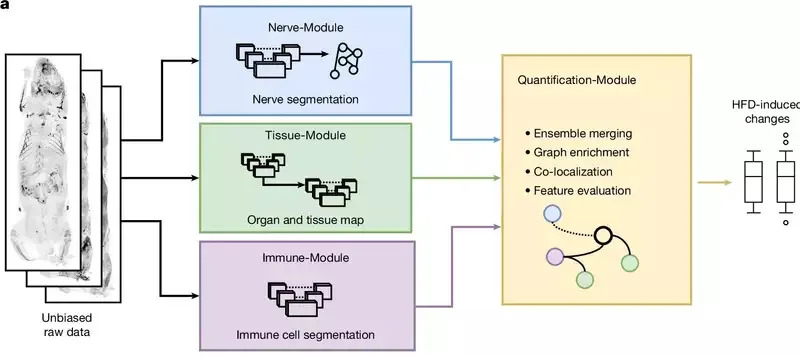
Mice that underwent vDISCO clearing, light-sheet imaging and 3D reconstruction were analysed using MouseMapper. (CREDIT: Nature)
Molecular and Translational Evidence
Spatial proteomics of trigeminal ganglia identified more than 6,000 proteins per sample, with 230 proteins differentially regulated (67 up, 163 down). Pathway analysis implicated actin cytoskeleton regulation, RHO GTPase effectors, axon guidance, complement/coagulation cascades, ERBB signaling and sphingolipid signaling. Several SERPIN‑A family proteins that limit inflammation‑related tissue damage were downregulated; western blots validated reduced SERPINA1, increased ERK activation and elevated SEPTIN7.
To probe relevance to humans, the team analyzed post‑mortem trigeminal ganglia from lean individuals (BMI < 25) and people with obesity (BMI > 30). Proteomic profiles showed shared pathway changes linked to axon guidance, neurodegeneration and actin regulation, suggesting a conserved molecular signature though not proving identical functional deficits in people.
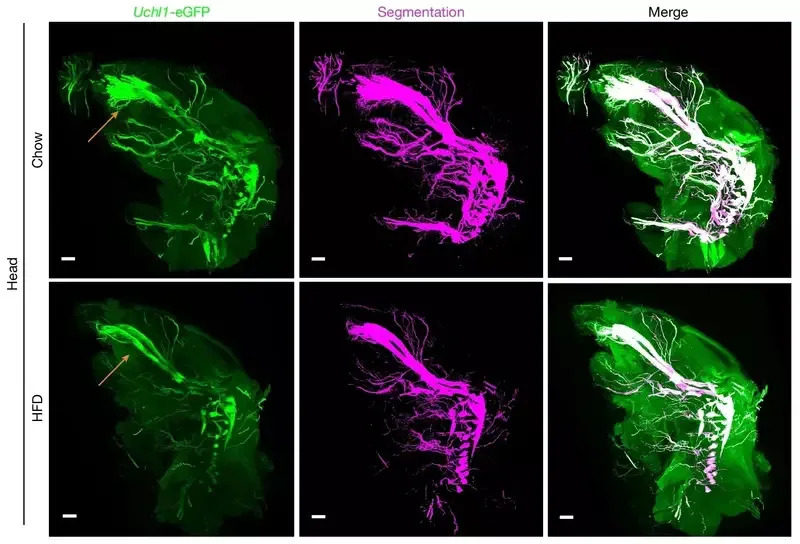
Representative heads of chow and HFD-fed mice showing Uchl1-eGFP+ nerves and AI-based segmentation of these nerves. (CREDIT: Nature)
Immune Landscape and Tissue Context
MouseMapper mapped Cd68‑positive immune cells across the body and categorized clusters by size. Obesity shifted cluster distributions: small clusters decreased in liver, visceral fat and stomach while medium and large aggregates increased in visceral and subcutaneous fat, muscle, stomach, adrenal glands, Peyer’s patches and other tissues. High‑resolution, multiplexed labeling revealed macrophage‑rich clusters adjacent to T cells, NK cells and endothelial cells—consistent with organized perivascular immune hubs rather than isolated cell piles.
Limitations
The standard whole‑body imaging cannot fully resolve the thinnest axons or subcellular details. A higher‑resolution 4× acquisition improved detection and reduced acquisition time from nearly two weeks to about 20 hours, but produced data loads up to ~50 TB per mouse. The authors also note that full generalizability across imaging modalities is limited and additional fine‑tuning will be needed for new datasets.
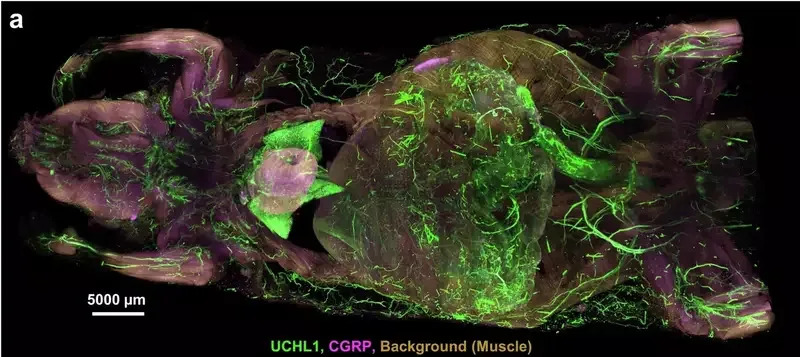
3D representation of ventral light-sheet fluorescence microscopy scan of a wildtype mouse (n=1) that was antibody labelled with the pan-nerve marker UCHL1 and a sensory nerve marker (CGRP). (CREDIT: Nature)
Implications
These results show obesity affects connected systems—nerve architecture, immune clustering, lymph node and liver size, and molecular pathways—rather than only expanding fat depots. MouseMapper enables unbiased, whole‑body hotspot discovery and can be adapted to study systemic diseases such as diabetes, cancer, neurodegeneration and autoimmune disorders. Paired with molecular profiling, the platform could help identify early structural warning signs and prioritize therapeutic targets while reducing the number of targeted experiments required.
Publication: The research is available online in Nature.
Help us improve.