Anstice Justin, who took part in authorised visits to North Sentinel Island from 1986 to 2004, warns that the Sentinelese — an isolated community of about 50 people — face growing risk from outsiders. While India's policy of "eyes on, hands off" aims to protect them, social-media–driven trespassers and past disease-driven collapses among neighbouring tribes make absolute isolation fragile. Justin recommends tightly regulated, medically supervised contact to warn the community about external threats and deter would-be intruders.
Encroaching World Threatens North Sentinel's Isolated Community — Expert Urges Careful Protection
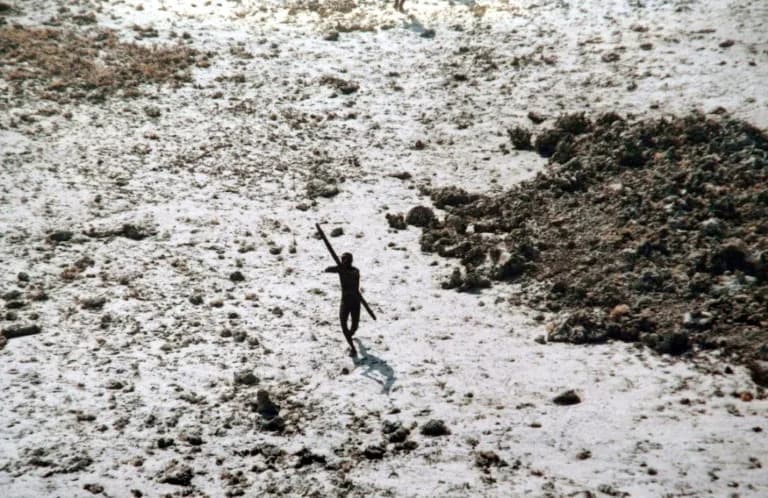
File photo of a man with the Sentinelese tribe aiming his bow and arrow at an Indian Coast Guard helicopter as it flies over North Sentinel Island in the Andaman Islands (Handout)(Handout/Indian Coast Guard/AFP)
Anstice Justin, a 71-year-old anthropologist who took part in India's authorised visits to North Sentinel Island between 1986 and 2004, warns that the island's isolated inhabitants may soon need tightly controlled contact to shield them from increasing outside intrusion.
Background
North Sentinel is a roughly 10-kilometre island in the Andaman Sea, ringed by coral reefs and cloaked in rainforest. Government estimates place the Sentinelese population at about 50 people, who are officially designated a "Particularly Vulnerable Tribal Group." What little is known about them comes primarily from occasional, highly regulated government missions.
Firsthand Encounters
Justin, formerly deputy director of the Anthropological Survey of India and a member of another Andamanese community, participated in more than 30 authorised visits. He recalls wading through crocodile-inhabited lagoons and offering coconuts as a goodwill gesture on his first authorised landing in 1986. "We saw smoke curling from the forest," he said. "After a few minutes, the Sentinelese emerged." He emphasised that his contacts did not reveal the overt hostility sometimes portrayed in media accounts.
Growing Threats From Outsiders
Indian authorities maintain an "eyes on, hands off" policy: distant monitoring to avoid exposing the community to disease and disruption. Nevertheless, modern pressures — including social-media–driven fame seekers, poachers and trespassers — are making strict isolation harder to enforce. Police have carried out surprise patrols and arrested people who breached the five-kilometre protected exclusion zone.
Notable incidents: In 2018 an American missionary, John Allen Chau, was killed after illegally attempting to contact the Sentinelese. In March 2025, US citizen Mykhailo Viktorovych Polyakov briefly landed on the island and was later arrested; he served a 25-day jail term and paid a fine. In February, two fishermen were also detained for entering the protected waters.
Health Risks and Historical Context
Rights groups point to devastating precedents: contact with outsiders brought epidemic disease to other Andaman groups. Survival International notes that the Great Andamanese peoples suffered population collapses of up to 99 percent after exposure. Given their small numbers and lack of immunity to common illnesses, accidental disease transmission remains a major concern.
What Experts Recommend
Justin argues that carefully managed, infrequent contact — conducted under strict medical and ethical safeguards — could help protect the Sentinelese by warning them about increasing threats and deterring would-be intruders. "We would be living in a fool's paradise if we assume they are living in their own insulated world," he said. He suggests that regulated outreach might be preferable to a situation in which online publicity or curiosity leads to repeated illegal landings.
Andaman authorities say they will continue enforcement efforts to protect the island, but they acknowledge the challenge of policing remote waters and deterring individuals motivated by social media fame. The debate remains sensitive: balancing the Sentinelese's clear desire for isolation with the practical need to protect them from external harms.
Help us improve.