British chemists David Klenerman and Shankar Balasubramanian and French biophysicist Pascal Mayer won the Princess of Asturias Award for Scientific and Technical Research for breakthroughs in DNA sequencing. Their innovations, developed through Solexa and Mayer's work on surface amplification, made genome sequencing dramatically faster and far more affordable, enabling rapid SARS-CoV-2 sequencing and supporting vaccine development. The prize includes 50,000 euros and a Joan Miró sculpture and will be presented in October in Oviedo.
British and French Scientists Win Princess of Asturias Award for Game-Changing DNA Sequencing
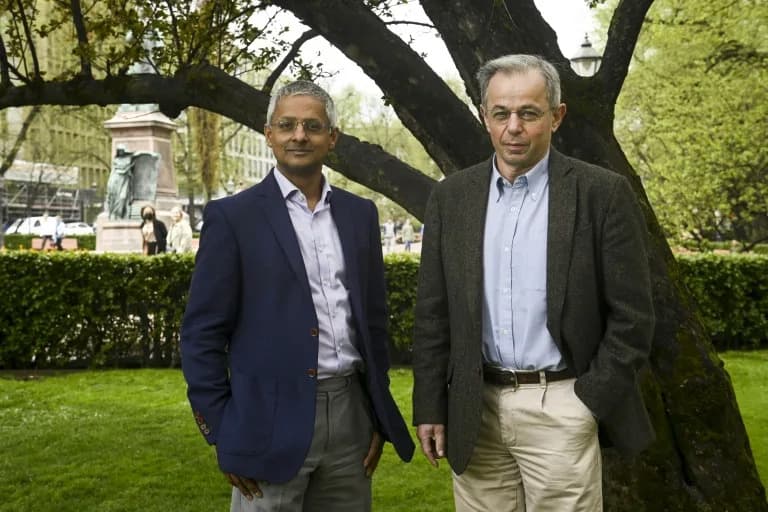
Shankar Balasubramanian (L) and David Klenerman pose ahead of the 2020 Millennium Technology Prize award ceremony in Helsinki in 2021 (Emmi Korhonen)(Emmi Korhonen/LEHTIKUVA/AFP)
British chemists David Klenerman and Shankar Balasubramanian, together with French biophysicist Pascal Mayer, were named winners of the Princess of Asturias Award for Scientific and Technical Research for pioneering advances in DNA sequencing that transformed genomics and proved vital during the Covid-19 pandemic.
Why This Matters
The Princess of Asturias Foundation praised the trio for turning whole-genome sequencing from a months-long, multi-million euro effort into a procedure that can be completed in a day and at a tiny fraction of the former cost. Those gains in speed, scale and affordability enabled the rapid sequencing of SARS-CoV-2, accelerating surveillance and vaccine development worldwide.
Their Contributions
Klenerman and Balasubramanian co-founded Solexa, whose sequencing technology was later acquired and commercialised by Illumina. The foundation noted that this work produced a commercial sequencing method that is rapid, cost-effective and widely adopted across research, clinical diagnostics, forensic science and ecology.
Pascal Mayer was recognised for foundational laboratory work on the surface amplification of DNA, a technique that allows DNA copies to be generated on solid surfaces and supports massive parallel sequencing approaches now central to next-generation sequencing platforms.
“The emergence of next-generation sequencing was the result of curiosity-driven science, multidisciplinary thinking, and remarkable collaborations across institutions and countries,” Mayer said, adding he hopes the award inspires younger generations to explore the intersections between scientific disciplines.
Prize And Ceremony
The Princess of Asturias Awards, established in 1981 and among the highest honours in the Spanish-speaking world, carry a prize of 50,000 euros and a sculpture by the late Catalan artist Joan Miró. King Felipe VI and Queen Letizia are scheduled to present the awards in October in Oviedo, the capital of Spain's Asturias region.
The foundation also noted last year’s winner in this category, US geneticist Mary-Claire King, who was honoured for using genetics to help prevent cancer and save millions of lives.
Significance: The award recognises work that reshaped modern biology and medicine by making genomic information accessible at unprecedented speed and scale, with immediate public-health benefits during the Covid-19 pandemic and continuing impact across scientific fields.
Help us improve.