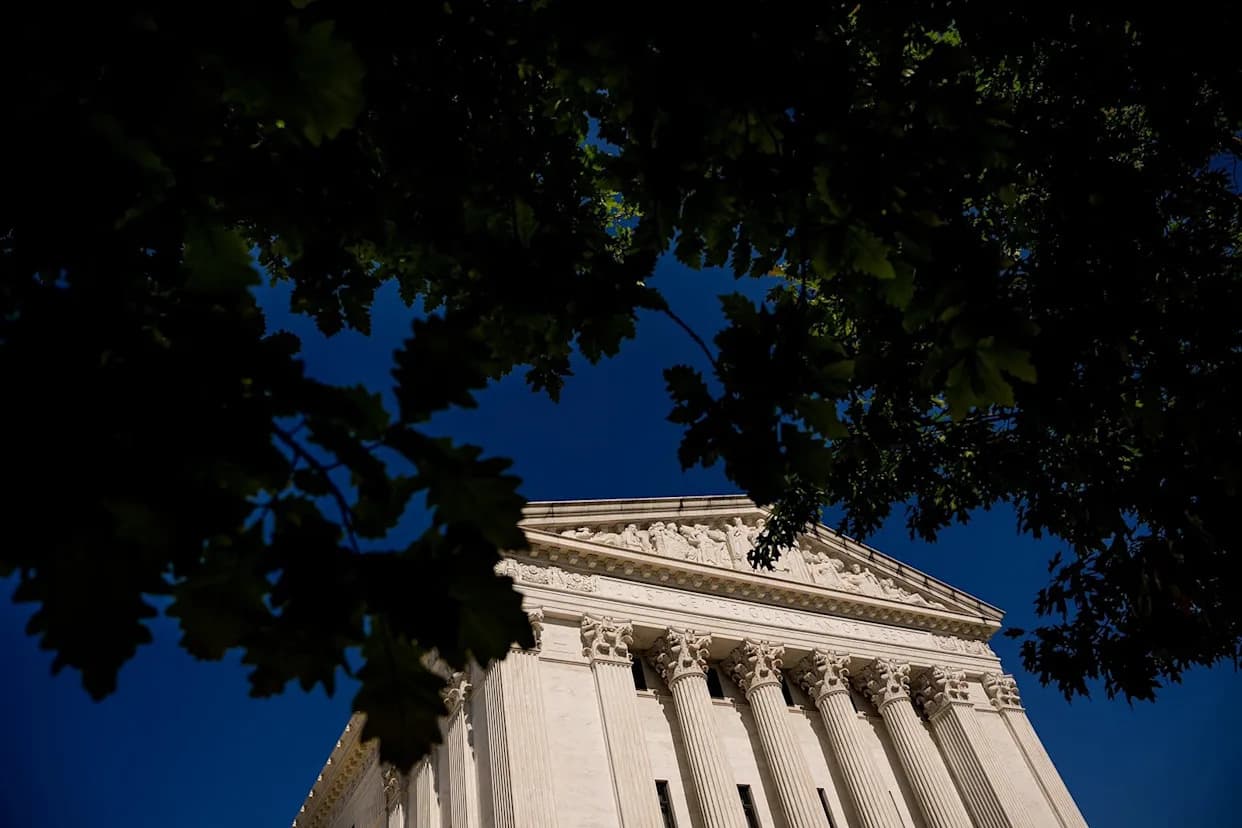
It was difficult to take Chief Justice John Roberts at his word when he recently said that Supreme Court justices are not 'political actors.' The court’s unsigned emergency order in the Alabama redistricting dispute has renewed skepticism about that claim.
On Monday night the Supreme Court, divided largely along the party lines of the presidents who appointed them, granted Alabama’s emergency request and vacated a district court judgment that had found the state’s congressional map racially discriminatory. The one-paragraph order—unsigned and unexplained—sent the case back to the lower court for further consideration in light of the Court’s recent ruling in Louisiana v. Callais.
Such invitations for lower courts to revisit cases after new high-court precedents are not unusual. But Justice Sonia Sotomayor, joined by Justices Elena Kagan and Ketanji Brown Jackson, issued a four-page dissent arguing the intervention was unnecessary and likely to cause confusion.
Sotomayor emphasized that the district court’s decision rested not only on the Voting Rights Act provision affected by Callais but also on an independent finding that Alabama intentionally discriminated against Black voters under the 14th Amendment. She wrote that this constitutional finding is "independent of, and unaffected by, any of the legal issues discussed in Callais," and therefore Supreme Court intervention was "inappropriate."
The timing increased the stakes: Alabama’s congressional primary was imminent, and voting had already begun. Sotomayor warned that vacating the injunction would immediately reinstate Alabama’s 2023 Redistricting Plan—one that contains only a single Black opportunity district rather than the two the lower court had ordered and that the Court previously recognized in Allen v. Milligan (2023).
"The Court today unceremoniously discards the District Court’s meticulously documented and supported discriminatory-intent finding and careful remedial order without any sound basis for doing so and without regard for the confusion that will surely ensue," Sotomayor wrote.
Her dissent noted that the Court’s 2023 decision in Allen v. Milligan—in which Roberts and Justice Brett Kavanaugh joined the three Democratic appointees—had previously upheld a finding that Alabama’s map likely violated the Voting Rights Act. Sotomayor argued Alabama’s efforts to entrench the 2023 plan after that ruling were evidence of discriminatory intent.
Critics point to the unsigned order and lack of published reasoning—typical features of the so-called shadow docket—to argue the Court is exercising power without transparent justification. The majority provided no explanation for why expedited intervention was necessary despite the district court’s separate constitutional finding and the imminent elections.
Practically, the order gives Alabama and Republican officials a near-term advantage that many observers say was not strictly required by Callais. Legally, it signals that the Court may be willing to use emergency procedures to produce politically consequential outcomes in redistricting disputes. Politically, the action reinforces perceptions of partisan alignment on the bench and raises fresh questions about claims of judicial nonpartisanship.
The litigation is not over: the district court can and must reassess its findings in light of the new precedent, and the Supreme Court could intervene again if the lower court rules against the state. For now, the unsigned order and the split it exposed have amplified concerns that the Court’s immediate decisions sometimes resemble political maneuvers as much as judicial corrections.