Researchers led by Luca Bindi report the first crystallographically confirmed calcium–copper–silicate type-I clathrate found in red trinitite from the 16 July 1945 Trinity nuclear test. X-ray diffraction shows silicon cages trapping calcium with traces of copper and iron, formed as fleeting temperatures (>1,500 °C) and pressures (~5–8 GPa) rose and fell during the blast. Modeling indicates the clathrate and a nearby quasicrystal formed independently despite similar compositions, offering new insights into materials produced by extreme, high-energy events and potential forensic applications.
A Crystal From the First Nuclear Blast: Scientists Discover an "Impossible" Clathrate in Trinitite

The only well-exposed color image of the Trinity test. (Jack W. Aeby/Manhattan Project/Public Domain)
At 5:29 AM on 16 July 1945, the Trinity test in New Mexico detonated the world's first plutonium implosion device, vaporizing a 30-meter test tower and converting fused metal, asphalt, and desert sand into a glassy residue later called trinitite. More than eight decades later, researchers continue to probe that material and are still uncovering surprising mineralogical products of the blast's extreme, transient conditions.
New Discovery: A Type-I Clathrate
In work led by geologist Luca Bindi of the University of Florence, scientists report the identification of a previously unknown calcium–copper–silicate cubic type-I clathrate embedded in red trinitite. Using X-ray diffraction on a copper-rich droplet within the sample, the team found a cage-like silicon framework that traps single calcium atoms, with traces of copper and iron present. This is the first crystallographically confirmed clathrate ever found among nuclear-explosion products and was published in the Proceedings of the National Academy of Sciences.
How It Formed
The Trinity fireball briefly produced extreme conditions — temperatures exceeding about 1,500 °C and pressures on the order of 5–8 GPa — before both dropped off rapidly as the melt cooled. Those fleeting conditions allowed atoms in the molten mixture to arrange into unusual, otherwise inaccessible configurations and become locked in place, preserving a mineralogical snapshot of the detonation's environment.
Clathrate and Quasicrystal: Siblings Or Strangers?
In 2021, the same red trinitite variety yielded an unexpected quasicrystal that incorporated metal from the tower and instrumentation. Because clathrates and quasicrystals can form under similar extreme conditions and the two phases here have comparable bulk compositions, the team modeled whether the quasicrystal could have transformed from the clathrate. Their modeling indicates that, in this particular sample, the copper concentration was too high for a simple clathrate-to-quasicrystal transformation. Instead, the clathrate and the quasicrystal appear to have formed independently from the same ingredients under the same transient conditions.
Why This Matters
Beyond offering a striking example of "nature's high-energy laboratory," the discovery has practical implications. Studying exotic phases preserved in nuclear-explosion residues can improve our understanding of the physical effects of detonations and may yield new forensic markers for identifying and characterizing blast events. More broadly, it highlights how rare, high-energy phenomena — from nuclear blasts to lightning strikes and hypervelocity impacts — can produce novel crystalline matter not reproducible under ordinary laboratory synthesis.
Quick facts: Trinity blast ≈21 kilotons TNT; trinitite formed from fused tower metal, instruments, asphalt and desert sand; clathrate is a silicon-cage structure trapping calcium; pressures during formation ~5–8 GPa; temperatures >1,500 °C.
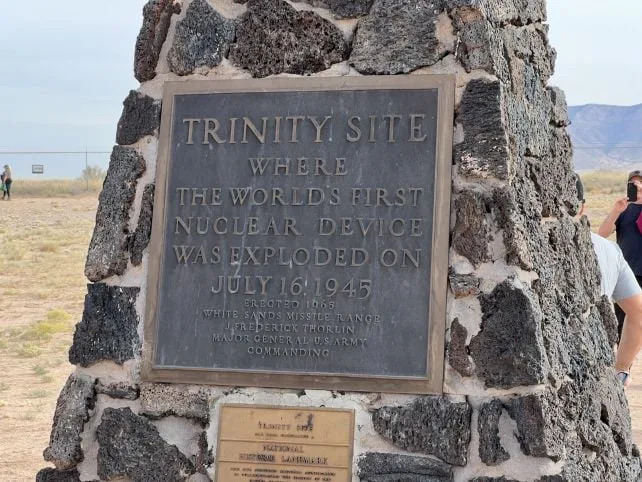
A monument that stands on the site of the Trinity test. (Lily Kimei/iStock Editorial/Getty Images Plus)
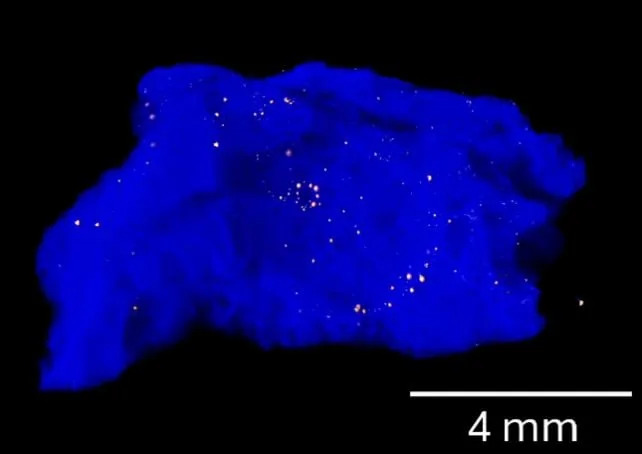
Nano-tomographic image of the trinitite sample, with the glass in blue and the copper inclusions in orange. (Bindi et al.,PNAS, 2026)
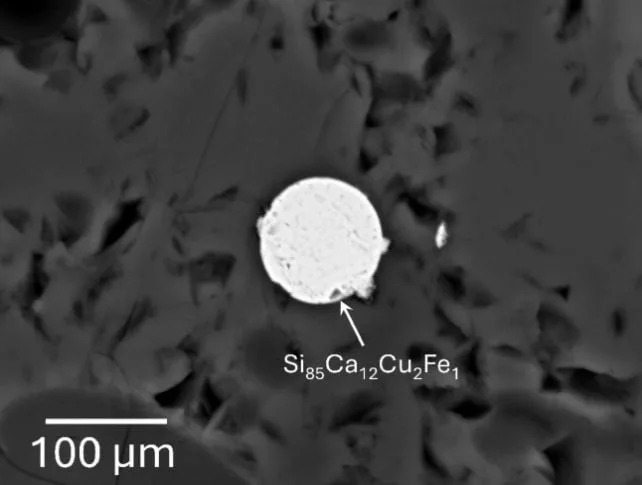
The tiny blob of copper that contained the clathrate. (Bindi et al.,PNAS, 2026)
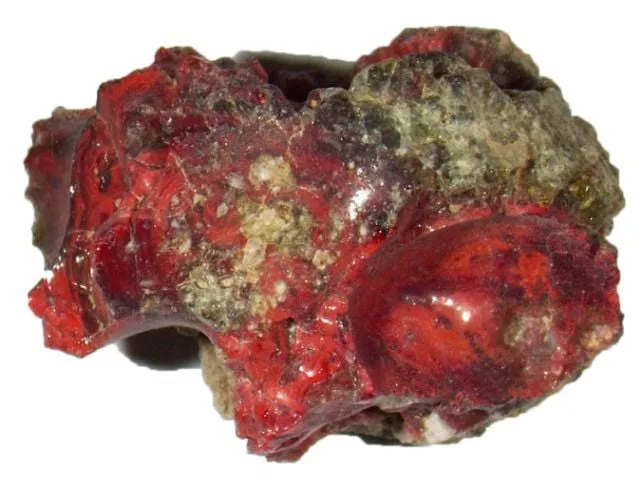
The sample of red trinitite that yielded the clathrate. (Bindi et al.,PNAS, 2026)
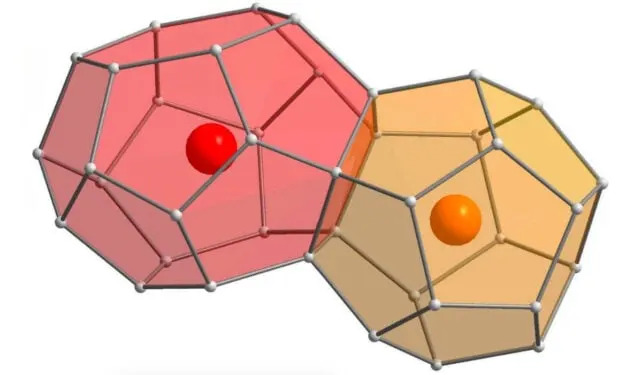
A diagram illustrating the clathrate structure, with grayspheresrepresenting silicon, and orange and red representing the calcium sites.(Bindi et al.,PNAS, 2026)

Subscribe to ScienceAlert's free fact-checked newsletter
Help us improve.