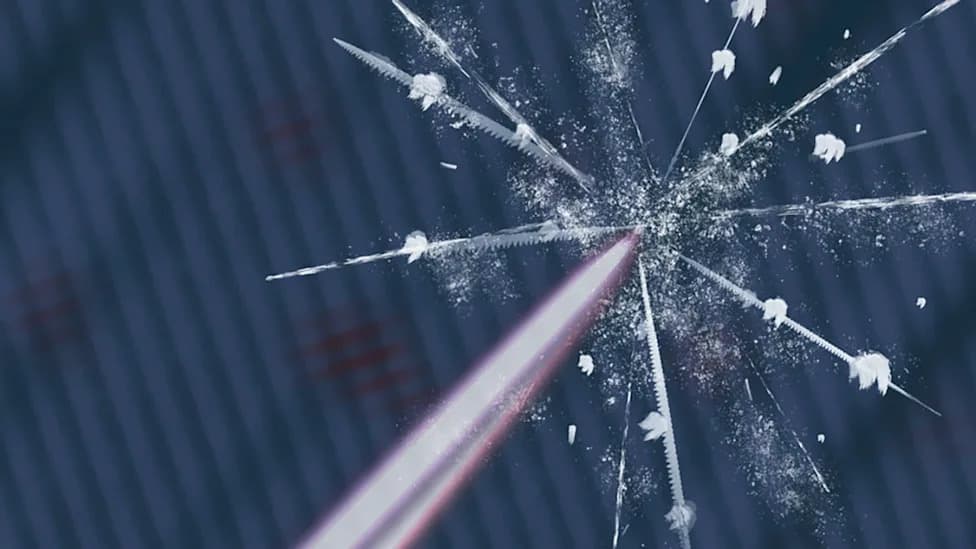
The study used ultraviolet laser-driven shocks on tiny synthetic diamond plates to make the most accurate laboratory measurement of diamond's melting point to date, showing it is over 1,300°F (≈700°C) lower than previous experimental values. Optical reflectivity jumps and thermal emission mapping identified melting, while time-resolved X-ray diffraction found no intermediate solid-carbon phase under single shocks. The results reconcile a long-standing ~2,240°F discrepancy with models and refine conditions where diamond can coexist with metallic liquid carbon, with important implications for fusion research and models of Uranus and Neptune.
New Laser Shock Experiments Show Diamond Melts Thousands of Degrees Cooler Than Previously Measured
A photo of a diamond sitting in a pool of meltwater. New research reveals the most precise measurement of diamond's melting point ever, paving the way for better fusion experiments and studies of giant plants. | Credit: Aitor Diago via Getty Images
Researchers using intense ultraviolet laser-driven shock waves have produced the most precise laboratory measurements yet of diamond's melting point, finding that earlier experiments overstated it by more than 1,300°F (about 700°C). The results, published Aug. 13 in Nature Physics, bring experimental data into alignment with theoretical predictions and resolve a long-standing discrepancy in high-pressure carbon physics.
Key Findings
The team shocked microscopic plates of synthetic diamond, driving pressures of hundreds of gigapascals and temperatures hotter than the Sun's surface. As shock waves traveled through the samples the diamonds abruptly turned from transparent to mirror-like; that rapid rise in reflectivity, combined with measurements of thermal emission, was used to pinpoint the melting transition with high precision. X-ray diffraction recorded during the experiments showed no evidence that diamond first rearranged into another solid-carbon phase before liquefying in single-shock conditions.
Researchers were able to compress tiny diamond samples to temperatures hotter than the surface of the Sun and to pressures comparable to or exceeding the centers of Uranus and Neptune, while measuring structure, temperature, density and optical reflectivity.
Numbers to Know
The new measurements indicate the melting point is more than 1,300°F (≈700°C) lower than prior lab estimates. Earlier discrepancies between experiments and models reached roughly 2,240°F (1,244°C), or nearly 20 percent. The researchers identified a regime between about 660 and 1,060 gigapascals and near 12,140°F (6,727°C) where solid diamond can coexist as chunks floating in metallic liquid carbon.
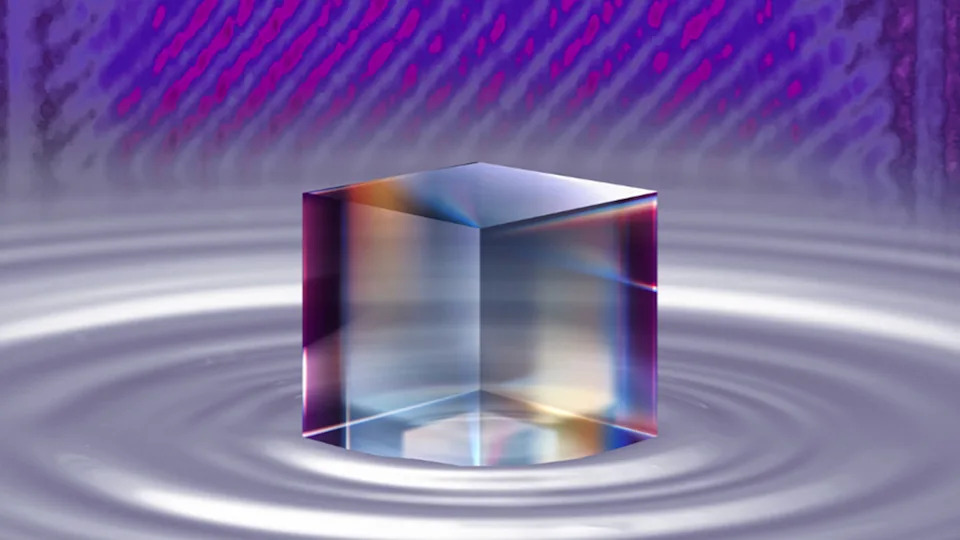
An artist's concept of a solid chunk of diamond floating in a metallic liquid carbon pool. The new experiment proves this sort of situation is possible deep within other planets. | Credit: James Wickboldt/LLNL
Methods
Teams used ultraviolet laser pulses to launch rapid, high-amplitude shock waves through tiny synthetic diamond plates. Optical reflectivity changes signaled the transition to a liquid state, while spectrally resolved brightness (thermal emission) provided temperature estimates. Time-resolved X-ray diffraction was used simultaneously to monitor the diamond crystal lattice and confirm the absence of a solid-solid phase transition under single shock loading.
Implications
These refined melting data improve models used in inertial confinement fusion experiments, where lasers compress and heat diamond capsules that hold fusion fuels. The findings also inform planetary models: laboratory and spacecraft data have long suggested that Uranus and Neptune may host 'diamond rain' and layers of liquid carbon in their mantles. Narrowing the melting curve and clarifying the conditions for liquid carbon enhances predictions of those planets' interior structure and carbon transport.
The authors note that while single, strong shocks did not produce a preceding solid-solid transition, multiple shocks or different shock-loading sequences might. Such differences could matter for specific fusion designs or other high-pressure experiments.
Reference: Millot et al., Nature Physics, Aug. 13. Measurements combine laser-driven shock compression, optical reflectivity, thermal emission, and X-ray diffraction to map diamond's melting behavior under extreme conditions.
Help us improve.