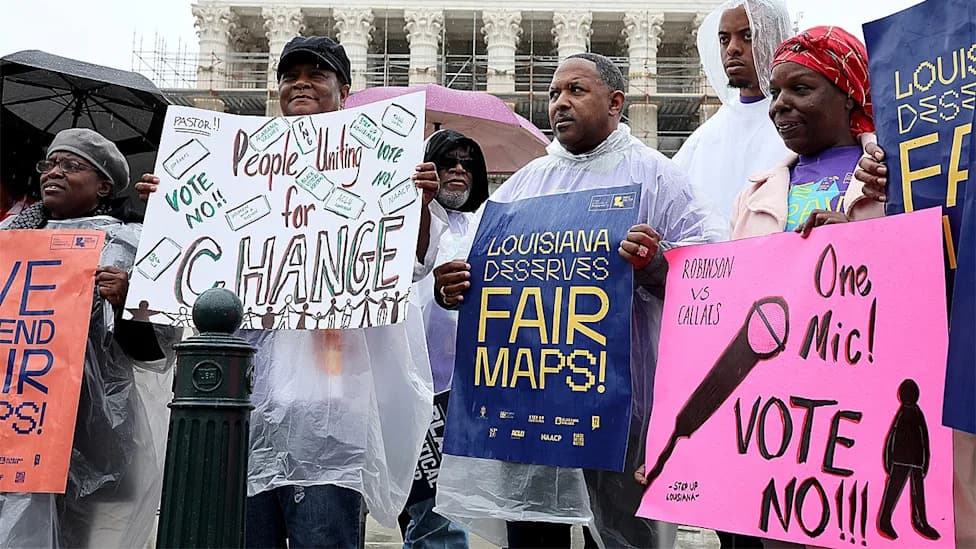
The Supreme Court's 6-3 decision in Louisiana v. Callais significantly weakened Section 2 of the Voting Rights Act, removing a federal requirement that electoral maps provide minority voters a realistic opportunity to elect their preferred candidates. The ruling applies to congressional, state legislative, county, municipal and school board maps, prompting immediate calls in several states to redraw districts. Analysts warn it could cost minority communities seats and shift dozens of state legislative and several U.S. House seats toward Republicans. Lawmakers in some states are pursuing state-level voting-rights protections as litigation and political responses unfold.
Supreme Court Ruling in Louisiana v. Callais Could Shift Power From Statehouses Down to School Boards
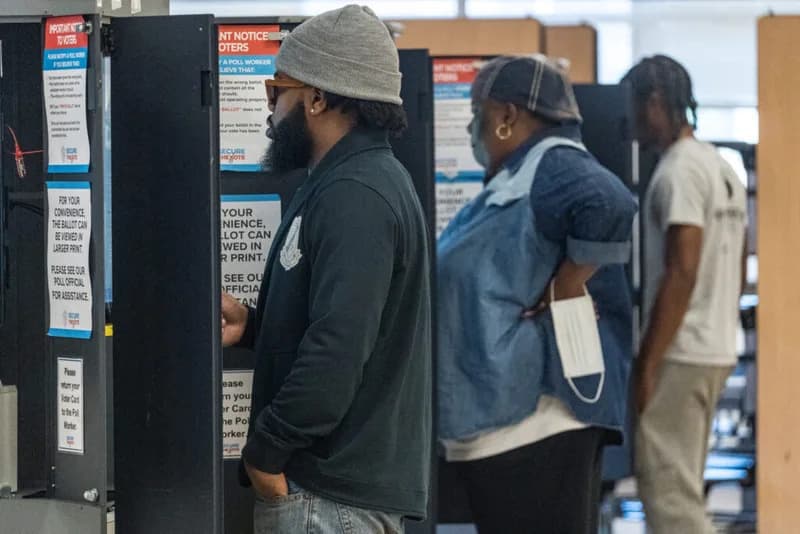
Community members arrive at their local polling location to vote in November 2022 in Atlanta. While intense national attention on the fallout from the recent Supreme Court decision gutting a key provision of the federal Voting Rights Act has focused on Congress, the new ruling also applies to state legislative districts and maps for county or municipal elections. (Photo by Megan Varner/Getty Images)
The U.S. Supreme Court's 6-3 decision in Louisiana v. Callais last week substantially weakened Section 2 of the 1965 Voting Rights Act, removing a key federal requirement that electoral maps give racial minority voters a realistic opportunity to elect candidates of their choice. Legal experts and voting-rights advocates warn the ruling removes one of the last federal guardrails that helped protect the political power of Black, Hispanic and other racial minority communities.
What the Ruling Means
The opinion effectively neutralizes the legal standard under Section 2 that courts used to require jurisdictions to draw so-called opportunity or majority-minority districts. While much national attention has centered on the effect on U.S. House maps ahead of the 2026 midterms, the decision applies equally to state legislative maps and the district lines that determine representation on county commissions, city councils and local school boards.
Immediate Political Fallout
Within hours of the ruling, Republican officials in several states called for maps to be redrawn in places where courts had previously required majority-minority districts. Some governors have called special legislative sessions; others have postponed primaries while lawyers and state officials assess the path forward. Examples include Mississippi's special session for state Supreme Court maps and Louisiana's postponement of U.S. House primary timing.
"This is a decision on who gets to serve on a school board, who gets to serve on a city council, who gets representation in the judiciary," said Davante Lewis, a member of the Louisiana Public Service Commission and a plaintiff tied to the litigation behind the maps at issue in Callais.
Where Experts See the Impact
Legal scholars say the ruling clears the way for more aggressive partisan mapmaking at state and local levels, with the most visible effects likely after the next full redistricting cycle following the 2030 census. Analysts quickly warned of significant potential shifts: voting-rights groups estimated Republicans could gain more than 190 state legislative seats in the South, and a New York Times analysis projected Democrats could lose roughly a dozen U.S. House seats across the region.
Tribal voting-rights challenges are also in limbo: tribes that relied on Section 2 to challenge certain maps—such as a North Dakota case over a 2021 legislative map—now face greater uncertainty.
Legal and Legislative Responses
Gerrymandering for partisan advantage remains broadly legal under federal law, though many states have their own restrictions. In response to the Supreme Court's decision, some states are exploring or strengthening state-level Voting Rights Acts. The National Conference of State Legislatures notes nine states already have state VRAs (California, Colorado, Connecticut, Illinois, Minnesota, New York, Oregon, Virginia and Washington), and lawmakers in at least 11 other states have introduced similar bills this year.
Experts caution that challengers will likely lean on themes from the Court's opinion when contesting state voting-rights laws, potentially creating a new wave of litigation over how those laws are interpreted and enforced.
Long-Term Political Consequences
Civil-rights advocates warn the ruling could erode a pipeline that has enabled Black and other minority candidates to win local offices and advance to state and federal positions. Critics say state legislatures could redraw districts to favor partisan outcomes and dilute minority representation without citing race as their stated motive—making it harder for minority communities to elect representatives who reflect their interests.
The ruling has therefore amplified both immediate political maneuvering and longer-term questions about how race, partisanship and mapmaking will shape American democracy from the U.S. House down to local school boards.
Reporting note: Stateline reporter Anna Claire Vollers can be reached at [email protected].
Help us improve.