U.S. Magistrate Judge Shannon Elkins ruled that the Department of Justice may appoint active‑duty Judge Advocate General (JAG) attorneys as special assistant U.S. attorneys to prosecute civilians, finding that congressional statutes create exceptions to the Posse Comitatus Act. The decision arose in the case of Paul Johnson, charged with assaulting a Customs and Border Protection agent during an immigration enforcement surge. Johnson's lawyers argued the appointments violated the 1878 law and Defense Department rules, and 11 former JAG attorneys filed a supporting brief; Johnson's counsel intends to appeal.
Judge Rules DOJ Can Appoint Active‑Duty JAG Lawyers To Prosecute Civilians, Citing Congressional Exceptions
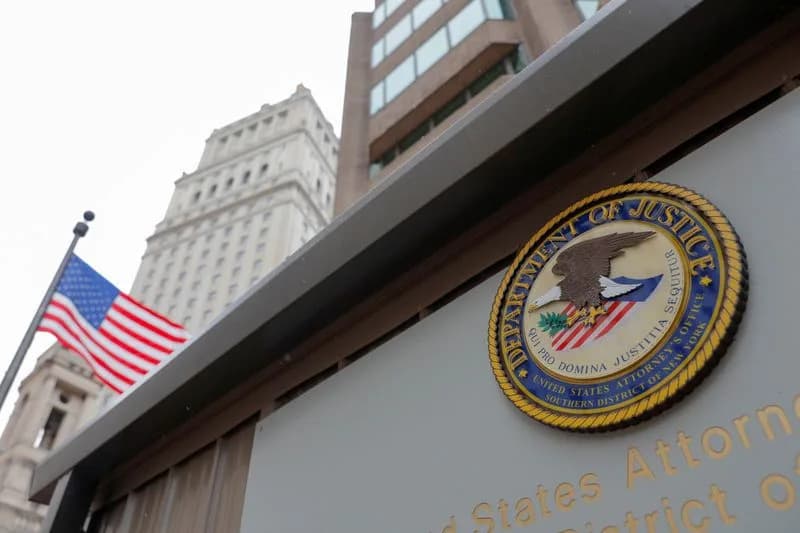
The seal of the United States Department of Justice is seen on the building exterior of the United States Attorney's Office of the Southern District of New York in Manhattan, New York City, U.S., August 17, 2020. REUTERS/Andrew Kelly
May 1 (Reuters) - A U.S. magistrate judge in Minnesota has ruled that the Department of Justice may lawfully appoint active‑duty military lawyers from the Judge Advocate General's (JAG) Corps to prosecute civilians, finding that Congress created statutory exceptions to the Posse Comitatus Act.
U.S. Magistrate Judge Shannon Elkins in Minneapolis reached the decision in a high‑profile challenge brought by Paul Johnson, a Minnesota resident charged with assaulting a Customs and Border Protection agent in January amid an intensified immigration‑enforcement operation in the state.
As part of that enforcement effort, the Defense Department assigned JAG attorneys to assist the U.S. Attorney's Office in Minnesota after previously deploying JAG officers to support prosecutions in Washington, D.C., and Tennessee. Johnson's lawyers argued the practice violated the Posse Comitatus Act of 1878—which generally restricts the military from taking part in civilian law enforcement—and conflicted with Defense Department regulations. They sought to have the military attorney removed from Johnson's case.
The matter drew national attention when 11 former JAG attorneys filed a brief supporting Johnson, warning the government had "crossed a perilous line."
"If Congress passes statutes giving the Department of Justice the authority to appoint active military personnel as SAUSAs to prosecute civilians, that is the law," Judge Elkins wrote.
Elkins concluded that two statutes passed by Congress create exceptions to the Posse Comitatus Act that authorize the attorney general to appoint active‑duty military lawyers as special assistant U.S. attorneys (SAUSAs). She also noted that while Defense Department guidance describes using JAG attorneys in unrelated civilian prosecutions as "ill‑advised," those internal rules do not provide a legal basis for a court to disqualify a military lawyer appointed under statutory authority.
Kevin Riach, who represents Johnson, said he plans to appeal the decision. Representatives for the U.S. Attorney's Office in Minnesota did not respond to requests for comment.
Why This Matters
The ruling clarifies a contested boundary between military legal personnel and civilian law enforcement prosecutions. It could influence how the Justice Department leverages military legal resources in other districts and under similar enforcement operations, while setting up a likely appellate fight over the proper scope of the Posse Comitatus Act and Defense Department guidance.
(Reporting by Nate Raymond in Boston; Editing by William Mallard)
Help us improve.