Two trade deals take effect that many see as evidence of global commerce shifting away from the U.S. A Mercosur–EU free-trade agreement has entered into force, and China has granted tariff-free access to all African countries except Eswatini, which recognizes Taiwan. Experts say the moves may be more symbolic than structurally transformative but signal that countries are willing to pursue major partnerships without U.S. leadership.
Two Major Trade Deals Take Effect Without the U.S., Signaling a Shift in Global Commerce
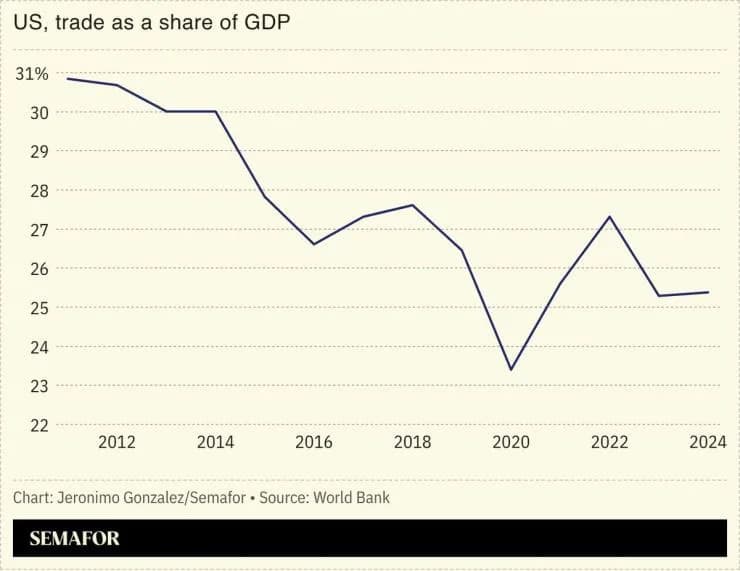
A chart showing the US’ trade as a share of its GDP.
Two new trade agreements that take effect today underscore a reorientation of global commerce that excludes the United States — a movement many observers link to the protectionist trade stance of President Donald Trump.
What changed today: A free-trade agreement between Mercosur, South America's largest trading bloc, and the European Union has entered into force. Separately, China has granted tariff-free access to virtually all African countries; only Eswatini is excluded due to its diplomatic recognition of Taiwan.
How significant are the deals? Analysts caution the accords may be more symbolic than immediately transformative. The China–Africa measures are unlikely to reverse an existing, largely one-way flow of manufactured goods from China to African markets. Meanwhile, the Mercosur–EU pact still faces substantial political headwinds in parts of Europe, which could limit its near-term impact.
Implications
Beyond trade volumes, the deals send a political signal: countries and regions appear willing to pursue large-scale economic partnerships without direct U.S. involvement. As a senior expert at the Center for Strategic and International Studies put it, these developments illustrate that "countries are moving on without the U.S."
What to watch next: Look for how quickly tariff liberalization translates into new investment and trade flows, whether EU members overcome domestic opposition to fully implement the Mercosur deal, and whether China's tariff concessions spur deeper economic ties or remain largely symbolic concessions.
Bottom line: The agreements are an important marker of shifting diplomatic and economic alignments — even if immediate trade patterns change only gradually.
Help us improve.