The Rev. Adam Hamilton, pastor of the Church of the Resurrection — the largest United Methodist congregation in the U.S. — has entered the Democratic primary for U.S. Senate in Kansas. Hamilton, 61, leads about 22,000 members across nine campuses and could leverage strong fundraising and volunteer networks. He briefly explored an independent run but re-registered as a Democrat; opponents question his party loyalty while Republicans plan to paint him as too liberal for the state. Winning statewide will require appealing to unaffiliated voters and disaffected Republicans, especially in populous Johnson County.
Rev. Adam Hamilton Launches Competitive Bid for U.S. Senate in Kansas
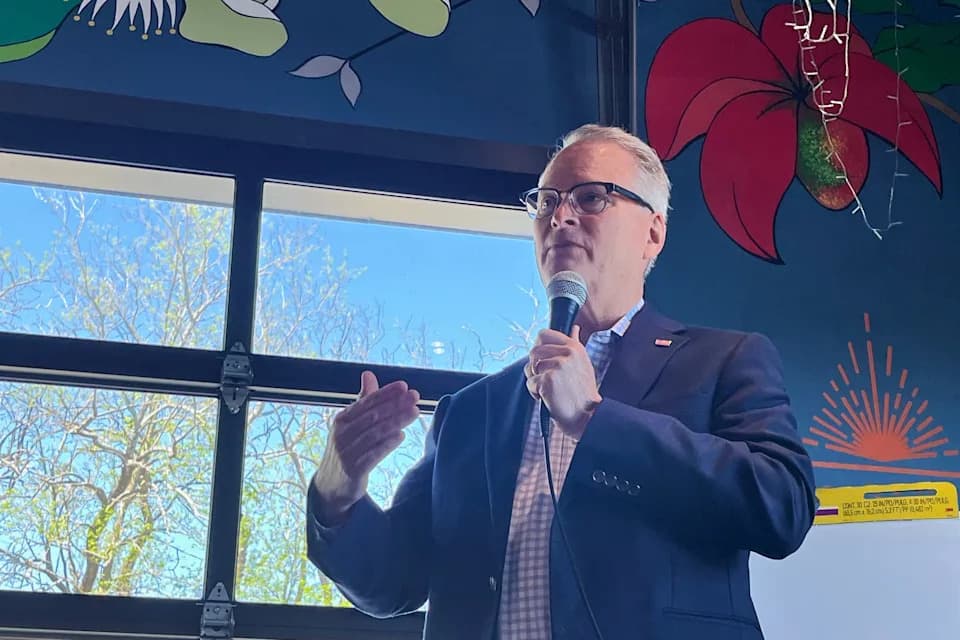
Adam Hamilton, a Methodist mega-church pastor from Kansas, talks to voters as he wraps up a U.S. Senate listening tour on Saturday, April 18, 2026, at Limitless Brewing in Lenexa, Kansas. (AP Photo/Heather Hollingsworth)(ASSOCIATED PRESS)
The Rev. Adam Hamilton, pastor of the Church of the Resurrection — widely described as the largest United Methodist congregation in the United States — announced Thursday he is running for the Democratic nomination for the U.S. Senate in Kansas, injecting new momentum into a race in a state that has long leaned Republican.
Hamilton, 61, who has led the Church of the Resurrection in the Kansas City area for roughly 35 years, oversees a congregation of about 22,000 members across nine campuses. That organizational scale and a national following among mainline Protestants give him a ready base for volunteers and fundraising as he seeks to challenge incumbent Republican Sen. Roger Marshall in the general election.
Primary Landscape
The Democratic primary is set for Aug. 4, and several lesser-known Democrats have already entered the race. Hamilton’s entry makes him the frontrunner by name recognition, though at least some of the eight other declared Democrats appear likely to remain on the ballot.
Party Affiliation And Political Pitch
Hamilton had briefly explored an independent run, saying to his congregation that he believed he could help bridge partisan divides in a polarized political climate. Many Democrats opposed an independent bid, warning it would split the anti-incumbent vote and improve the incumbent’s chances of re-election. According to voter records, Hamilton has been registered as both a Republican and a Democrat in the past; he switched to unaffiliated in February and re-registered as a Democrat this week, his campaign says.
“Every week, it seemed there was another news story in the last year where I would find myself shaking my head and thinking, we have to do better,” Hamilton said, describing his motivation for running. He calls himself a fifth-generation Kansan.
What He Brings To The Race
Hamilton’s pastoral work includes authorship of dozens of books, popular video-based Sunday school curriculum, and a national profile highlighted by his invitation to preach at the 2013 National Prayer Service. His church’s Christmas Eve offering — devoted to mission work — has sometimes topped $2 million, illustrating both his fundraising reach and institutional resources.

Adam Hamilton, a Methodist mega-church pastor from Kansas, talks to voters as he wraps up a U.S. Senate listening tour on Saturday, April 18, 2026, at Limitless Brewing in Lenexa, Kansas. (AP Photo/Heather Hollingsworth)(ASSOCIATED PRESS)
Hamilton’s Johnson County home base — the state’s most populous county with roughly 643,000 residents — has shifted politically in recent years and is a crucial battleground for statewide candidates. Winning statewide will likely require Hamilton to attract not only Democrats but also unaffiliated voters and disaffected Republicans, a coalition that helped elect Gov. Laura Kelly in 2018 and secure her narrow reelection in 2022.
Policy Positions And Criticism
Although Hamilton has not held public office, he is a public figure with decades of sermons, podcasts and social media content that offer insight into his views. He says he voted against a 2022 Kansas constitutional amendment that would have enabled stricter abortion restrictions in the state and has said lawmakers should not be the primary spiritual or ethical guides for women. He also disclosed that his mother considered abortion when she became pregnant with him as a teenager. Critics inside the Democratic primary, including rival Noah Taylor and state Rep. Alexis Simmons, have questioned the timing and sincerity of some of his positions.
The Kansas Republican Party quickly sought to frame Hamilton as out of step with conservative voters. "His so-called ‘independent’ exploration was little more than a political marketing strategy to mask a radical left agenda," said Rob Fillion, the state party’s executive director.
Outlook
Republicans have not lost a U.S. Senate race in Kansas since 1932, making any Democratic bid an uphill challenge. Still, Hamilton’s name recognition, organizational capacity and fundraising potential will force both parties to reassess the dynamics of the race — especially in Johnson County, where demographic and political trends have made statewide contests more competitive.
As the campaign progresses, voters and party leaders will weigh whether Hamilton can translate pastoral leadership and national profile into a broad political coalition capable of overcoming historical partisan barriers in Kansas.
Help us improve.