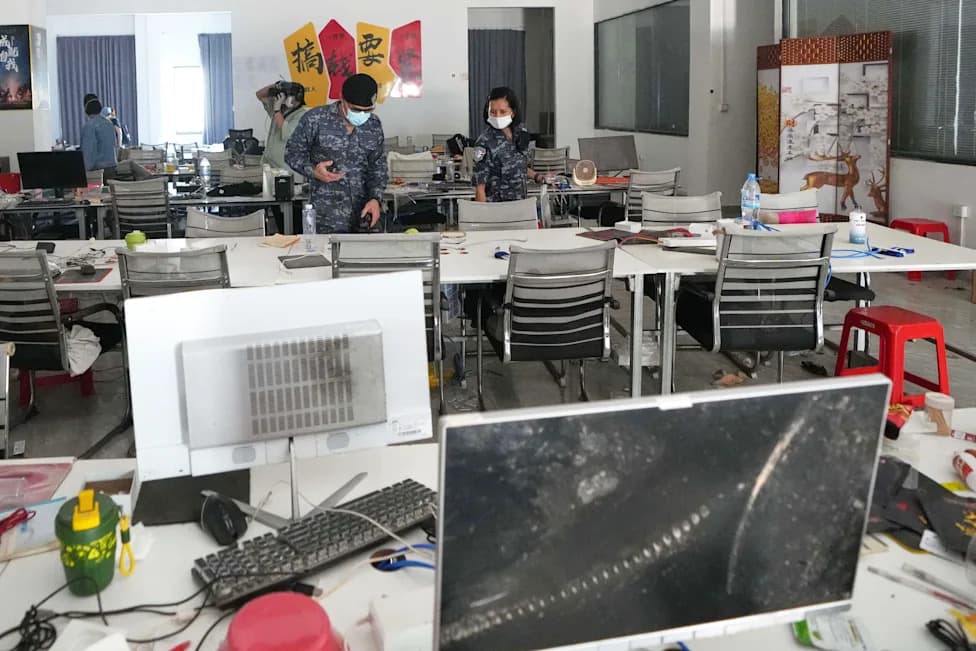
Dubai Police led an international operation targeting "pig-butcher" scam centers that resulted in 276 arrests and involved both US and Chinese authorities. China has executed 11 ringleaders this year, while US officials estimate Americans lost $16.6 billion to the scams. The frauds are largely run from Southeast Asia, and experts warn corruption, illicit trade and lawlessness in parts of Myanmar make the networks hard to eradicate.
Dubai-Led Raid Nets 276 Arrests as US and China Cooperate Against ‘Pig-Butchering’ Scam Rings

US and Chinese authorities participated in a major international operation led by Dubai Police to dismantle so-called "pig-butchering" scam centers, resulting in 276 arrests. The operation represented an uncommon instance of cooperation between Washington and Beijing and highlighted the growing global threat posed by sophisticated online fraud networks.
What Is “Pig-Butchering”? The term refers to long-term romance and investment scams in which criminals groom victims over weeks or months to win their trust before persuading them to transfer money or invest in fraudulent schemes.
The raids underline the scale of the problem: Chinese authorities have this year executed 11 ringleaders linked to such frauds, while US officials estimate Americans have lost about $16.6 billion to these scams. Many of the operations are believed to be run from hubs in Southeast Asia, where criminal networks exploit corruption, illicit trade routes and, in some areas, weak or fragmented law enforcement.
Experts warn that while high-profile crackdowns disrupt individual cells and bring arrests, they are unlikely to eliminate the trade entirely. Underlying drivers — including transnational criminal syndicates, porous borders, corrupt officials, and pockets of lawlessness in parts of Myanmar — continue to enable recruitment, money laundering and the establishment of new scam centers.
What Comes Next? Analysts say sustained international cooperation, stronger regional law enforcement, enhanced anti-money-laundering measures and public awareness campaigns are needed to reduce the harm. The Dubai-led operation is an important demonstration of cross-border coordination, but experts caution that long-term solutions will require persistent, multilateral effort.
Help us improve.