Cambodia opened a now-shuttered scam compound to international media ahead of a two-day anti-fraud conference attended by about 20 countries, including the US and China. Officials say they have closed 663 scam sites, frozen around $300 million and arrested nearly 30,000 suspects, but critics argue enforcement has been superficial. Analysts warn networks have adapted and could relocate to smaller, less visible locations. The summit aims to foster cooperation, though observers are skeptical about long-term impact without deeper investigations and sustained action.
Cambodia Showcases Closed Scam Compound Ahead Of Global Anti-Fraud Conference — Critics Doubt Lasting Impact

Cambodia is hosting an anti-scam conference to try to burnish its crackdown credentials (Suy Se)
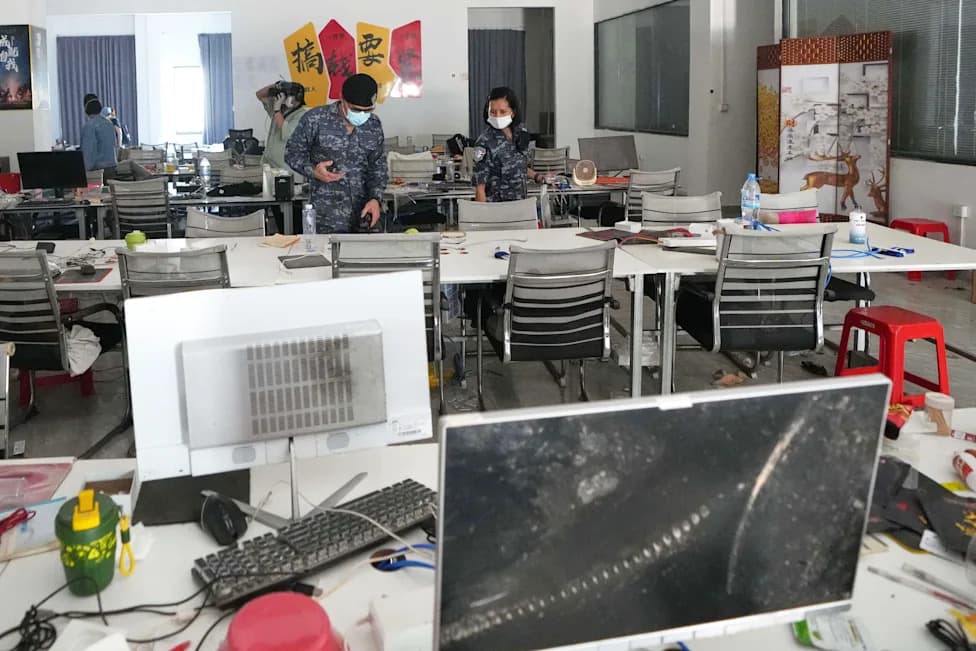
Cambodian authorities opened a shuttered scam compound to international media this week — complete with counterfeit banknotes, soundproofed phone booths and a staged police station — as Phnom Penh prepares to host a two-day international conference on online fraud.
Conference and International Pressure
Delegations from around 20 countries, including the United States and China, are due to attend the meeting, which officials say aims to strengthen collective efforts against transnational online scams. The event comes amid mounting international pressure for Cambodia to do more to dismantle a multibillion-dollar scam industry that has been concentrated in parts of Southeast Asia.
What Officials Showed
Journalists were taken through a vast site near the Vietnamese border that authorities say once employed about 20,000 workers. Reporters saw rows of soundproof phone booths, piles of counterfeit $100 bills and motivational slogans in Chinese such as 'Give it your all' and 'Getting rich overnight.' A mock Singapore police station had reportedly been used by scammers on video calls to impersonate officers.
Government Claims and Actions
Cambodian officials say they have closed 663 scam locations, including 86 large compounds, frozen roughly $300 million in related accounts and arrested nearly 30,000 suspects, among them 15 senior officials and law-enforcement officers. Authorities also reported extraditions: leaders linked to the Prince Group and Huione Group were sent to China this year.
Analysts Remain Skeptical
'They could come back tomorrow,' said transnational crime analyst Jacob Sims, underscoring concerns that the underlying networks, financial channels and local protection structures remain largely in place.
Experts note the industry has adapted by dispersing operations into smaller, less visible locations — rented homes, hotels and even cars — and say some compounds may have received advance warning of raids, allowing operators to evacuate equipment and personnel.
Scope And Regional Context
Southeast Asia has emerged as a regional hub for organised groups running large call-centres that dupe victims via fake romances, investment scams and impersonation. The US estimates that in 2025 transnational networks based in the region defrauded Americans of at least $18.2 billion. Other identified hotspots include conflict-affected Myanmar and parts of Laos.
Responses From Abroad
Several governments have imposed sanctions or visa restrictions. The United States recently announced visa bans on 32 individuals, most reportedly affiliated with the Prince Group, which has been sanctioned by the US, UK and South Korea. FBI leadership has called online scams a 'top priority' and urged stronger measures to hold senior operators and complicit officials accountable. China has pressed Phnom Penh as well, though analysts say Beijing tends to apply pressure more quietly.
Outlook
While Cambodian authorities present the closures as decisive progress, outside experts warn that without deeper investigations, evidence-gathering and disruption of financial and protection networks, the industry's capacity to reorganize remains high. The conference aims to boost cooperation, but concrete outcomes will depend on sustained enforcement, international information-sharing and follow-through beyond high-profile raids.
Help us improve.