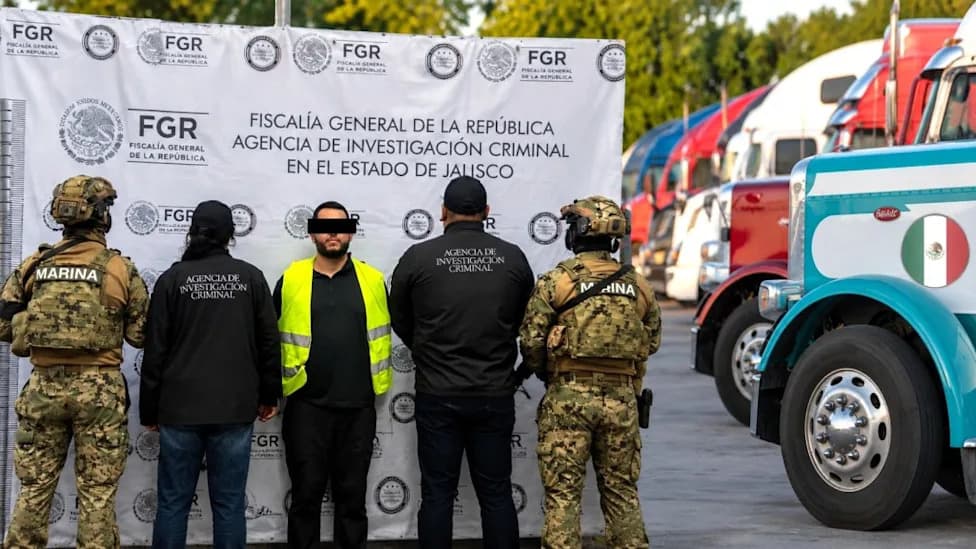
The U.S. Justice Department has indicted Sinaloa Governor Ruben Rocha and several officials, alleging they conspired with the Sinaloa Cartel to traffic large quantities of narcotics into the United States. The charges, rare for a sitting Mexican politician, reflect a U.S. strategy to pursue alleged political enablers as well as cartel leaders and risk heightening diplomatic strain. Rocha denies the allegations, while Mexico's foreign ministry says recent extradition requests lacked sufficient evidence and have been passed to the Attorney General's Office for review.
U.S. Indicts Sinaloa Governor Ruben Rocha Over Alleged Cartel Links, Raising Diplomatic Stakes
United States Department of Justice logo and U.S. flag are seen in this illustration taken April 23, 2025. REUTERS/Dado Ruvic/Illustration
MEXICO CITY, April 29 (Reuters) — The U.S. Justice Department announced on Wednesday that it has indicted Ruben Rocha, governor of Mexico's Sinaloa state, along with several current and former officials, accusing them of conspiring with the Sinaloa Cartel to traffic large quantities of narcotics into the United States. The move marks a significant escalation in U.S. efforts to target not only cartel leaders but also alleged political enablers, and could increase tensions between Washington and Mexico.
Allegations And Political Fallout
According to the Justice Department, Rocha and co-defendants agreed with cartel figures to facilitate the flow of drugs into the U.S. in exchange for political support and bribes. Prosecutors say Rocha secured the 2021 governorship with backing from a faction of the Sinaloa Cartel known as "Los Chapitos," led by sons of cartel founder Joaquin "El Chapo" Guzman. The indictment alleges the faction used kidnapping and intimidation against rivals and expected impunity in return.
Indicting a sitting senior Mexican politician is highly unusual and signals a widening of U.S. investigations beyond traditional cartel kingpins to include public officials accused of enabling organized crime. Rocha’s case presents a political challenge for President Claudia Sheinbaum, as both belong to the ruling Morena party; Rocha is also an ally of former President Andres Manuel Lopez Obrador.
Responses
Rocha denied the charges, calling them baseless and an attack on Mexico's governing movement. In a post on X he said the accusations "lack any truth or foundation whatsoever" and vowed they would be disproven.
Mexico's foreign ministry said it had received several extradition requests the day before but determined they lacked sufficient evidence and forwarded the cases to the Attorney General's Office for further review. The ministry did not name the individuals involved.
U.S. Attorney Jay Clayton, announcing the indictment, said: "Let these charges send a clear message to all officials around the globe who work with narco-traffickers: no matter your title or position, we are committed to bringing you to justice." The U.S. Embassy in Mexico added: "Corruption that enables organized crime and harms both our countries will be investigated and prosecuted wherever U.S. jurisdiction applies."
Scope Of The Charges
Alongside Rocha, the indictment names current and former state-level officials, the mayor and an ex-police commander of Culiacan, Sinaloa's capital, a city long afflicted by drug-related violence. The U.S. action follows a recent pledge by U.S. Ambassador Ronald Johnson to take a tougher stance on corruption tied to organized crime.
Reporting by Kylie Madry in Mexico City and Luc Cohen in New York; Additional reporting by Lizbeth Diaz and Natalia Siniawski in Mexico City; Editing by Stephen Eisenhammer and Lisa Shumaker.
Help us improve.