The French navy used a remotely operated vehicle to investigate "Camarat 4," the deepest known shipwreck in French waters, about 2,500 metres off Ramatuelle. The ROV captured more than 86,000 images to build a 3D model and recovered several decorated jugs and plates, likely from Liguria. Archaeologists say the finds will provide rare insights into 16th-century maritime trade and shipborne commerce.
Deep-Sea Discovery: French Robot Recovers 16th-Century Pottery From Shipwreck 2,500m Down
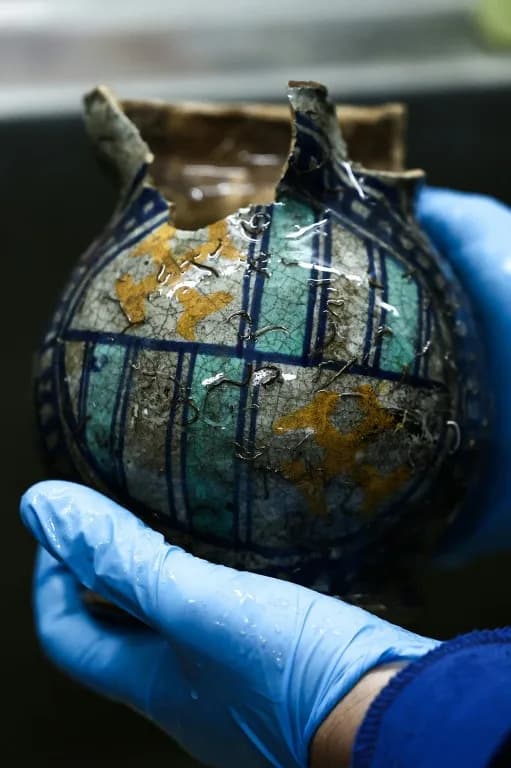
The mission has retrieved some of the deepest objects ever recovered from a wreck in France (Thibaud MORITZ)(Thibaud MORITZ/AFP/AFP)
Deep beneath the Mediterranean off the French Riviera, the articulated claw of a remotely operated vehicle (ROV) gently closes around a centuries-old jug amid the remains of a 16th-century merchant ship.
"You have to be extremely precise so as not to damage the site, so as not to stir up sediment," says navy officer Sebastien, who declines to give his surname for security reasons. He is supervising the first of several archaeological dives to document France's deepest known wreck, located off Ramatuelle near Saint-Tropez.
Chance Discovery and a Secret Site
The wreck was identified last year during a routine military seabed survey. The navy is keeping the exact location confidential and has nicknamed the site "Camarat 4." Archaeologists believe the vessel was a 16th-century merchant ship, likely sailing from Liguria in northwest Italy with a cargo of glazed ceramics and metal bars when it sank.
Robotic Eyes on the Deep
At first light, the mission's tugboat arrived on station carrying the ROV and two large containers that serve as floating field laboratories. The robot, equipped with high-definition cameras and articulated pincers and rated to 4,000 metres, was lowered on a long tether. Specialists on deck monitored its slow descent and the live feed from its cameras.
About an hour into the dive the device glided over stacks of rounded pitchers, plates and a cannon lying on the seabed about 2,500 metres (roughly 1.5 miles) below the surface. Over a three-hour survey the ROV recorded more than 86,000 frames (it records at eight frames per second), footage that will be stitched into a detailed 3D model of the wreck site.
Artefacts and Their Importance
Footage and recovered items show hundreds of jugs and plates decorated with floral motifs, crosses and fish imagery. Archaeologist Franca Cibecchini praised the visibility at depth: "The visibility is excellent. You almost can't tell it's so deep." She and colleagues suggest the pottery likely originated in Liguria and may have been shipped from Genoa or Savona.
Lead archaeologist Marine Sadania says the material will provide valuable evidence about 16th-century maritime trade. "We don't have very detailed texts about merchant ships in the 16th century, so this is a valuable source of information on maritime history," she said.
Careful Recovery, Fragile Finds
The ROV gently placed several intact jugs and plates into protective cases for retrieval. The team noted that roughly one third of ceramics recovered from underwater sites are damaged during salvage operations, so each successful recovery is important. Back on shore at a laboratory in Marseille, Sadania rinsed one jug to reveal dark blue lines forming rectangles, some in turquoise and others inscribed with saffron-yellow motifs. "It's one of the deepest objects ever recovered from a wreck in France," she said.
What began as a routine survey has become a rare scientific opportunity to map a deep wreck in situ and recover artefacts that shed light on 16th-century Mediterranean commerce.
Help us improve.