State leaders from Indiana, Kansas and Ohio have pursued elaborate financing plans to subsidize new pro-sports stadiums, often by redirecting existing revenues or creating bond districts rather than raising clearly labeled taxes. Indiana approved up to $1 billion in potential subsidies funded by new local levies; Kansas plans to divert future sales-tax growth across a broad bond district to back $1.8 billion in support; and Ohio moved to tap roughly $4.8 billion in unclaimed funds before a judge paused that plan. Legal challenges and growing public skepticism underscore that stadium deals frequently shift costs to taxpayers while producing limited public benefit.
When Fiscal Conservatives Fold: How States Mask Stadium Subsidies and Shift Costs to Taxpayers
Republicans Fumble Away Fiscal Conservatism in Stadium Subsidy Projects
Republican leaders who champion tight budgets have repeatedly set fiscal restraint aside when professional sports franchises seek public money. Recent stadium proposals in Indiana, Kansas and Ohio reveal elaborate financing schemes—new taxes, redirected revenues, bond districts and even proposed seizures of unclaimed private funds—that obscure the true costs for taxpayers and local governments.
Indiana: A $1 Billion Push Backed By New Local Levies
In February the Indiana House voted 95–4 to authorize up to $1 billion in subsidies for a potential Chicago Bears stadium through a new public funding mechanism. The package would impose a new 1% food-and-beverage tax across Lake and Porter counties—estimated by the state Legislative Services Agency to raise roughly $18 million annually—double Lake County's hotel tax from 5% to 10%, and levy a 12% tax on individual event tickets (excluding season tickets). Lawmakers would also create two new authorities able to capture state sales and use taxes, income taxes and property taxes inside a Hammond stadium district on the Chicago border.
Kansas: Bond Districts And Captured Sales-Tax Growth
Kansas leaders pledged about $1.8 billion—roughly 60% of a roughly $3 billion stadium, practice facility and headquarters package—to move the Kansas City Chiefs to Wyandotte County. Officials insist there will be "no new state taxes," but the plan relies on issuing bonds and diverting most future sales-tax growth across a Sales Tax and Revenue (STAR) Bond District that could stretch as much as 290 square miles. That means sales-tax increases at businesses many miles from the stadium could be treated as revenues "generated by the project" and siphoned to repay stadium debt. Municipalities were pressured to participate: Olathe agreed to divert 1.5% of its municipal sales tax and 78% of its hotel tax; Wyandotte County committed most of its hotel tax, all county sales-tax revenue not already pledged, and 61% of municipal sales tax inside the district—potentially costing the county about $450 million over 30 years.
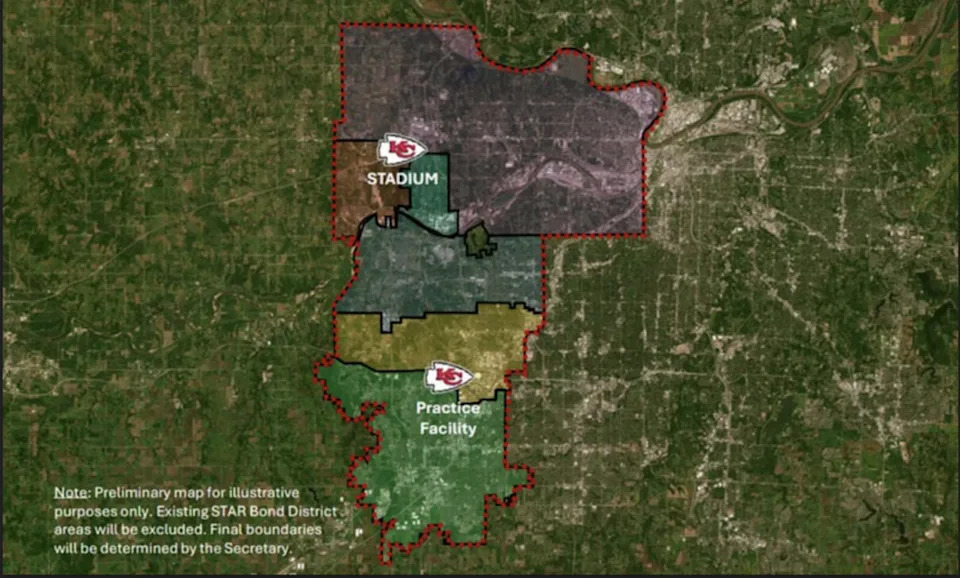
The Kansas Department of Commerce's preliminary map for the sprawling STAR Bond district in which future growth in sales tax revenues would be captured to repay stadium bonds. The urban area at the northeast edge of the district is Kansas City.(Kansas Department of Commerce)
Ohio: Unclaimed Funds And A Court Halt
Ohio’s proposal went further still by targeting the state's Unclaimed Funds Trust—an account holding an estimated $4.8 billion in dormant bank balances, uncashed checks, stocks, utility deposits and other assets—to seed an "Ohio Cultural and Sports Facility Performance Grant Fund" that could cover up to 25% of new stadium costs. Lawmakers set a 10-year deadline on claims, effectively making those assets easier for the state to repurpose. Legal challenges followed: plaintiffs represented by former Ohio Attorney General Marc Dann and ex-Rep. Jeffrey Crossman won a temporary restraining order and a preliminary injunction after Franklin County Magistrate Judge Jennifer D. Hunt found they were likely to succeed on Takings and Due Process claims, rejecting the state's argument that legislative declarations of "abandonment" or asserted public purpose could justify the transfer.
Why These Deals Matter
These proposals share a common logic: rather than raise new, clearly labeled taxes, elected officials design complicated mechanisms that divert existing revenue streams or reclassify unrelated tax growth to pay stadium debt. The economic evidence on stadium subsidies is mixed at best; most independent studies find that large pro-sports projects rarely produce net fiscal benefits for taxpayers and often shift costs onto ordinary residents while enriching wealthy franchise owners.
Wider Pattern And Pushback
Both Republican and Democratic governors and legislatures across the country have approved major stadium deals in recent years—from Florida and Texas to New York and Oregon—demonstrating that support for these packages crosses party lines. Still, there is growing public and legal resistance. Local officials and some judges are pushing back, calling out opaque financing, the diversion of funds from schools and services, and the ethical question of using public money to subsidize wealthy team owners.
Conclusion
Stadium finance debates are not just about sports—they are about transparency, priorities and who bears the cost of big projects. Policymakers promising fiscal discipline should be pressed to justify why complex, opaque financing mechanisms that shift today's and future taxpayers' obligations are preferable to clear, accountable budgeting.
Quote: "I'm very interested to see how the people of Indiana and the voters of Indiana feel about the massive increases in taxes that are being proposed, about paying for a stadium in Indiana for the Chicago Bears." — Gov. J.B. Pritzker
Help us improve.